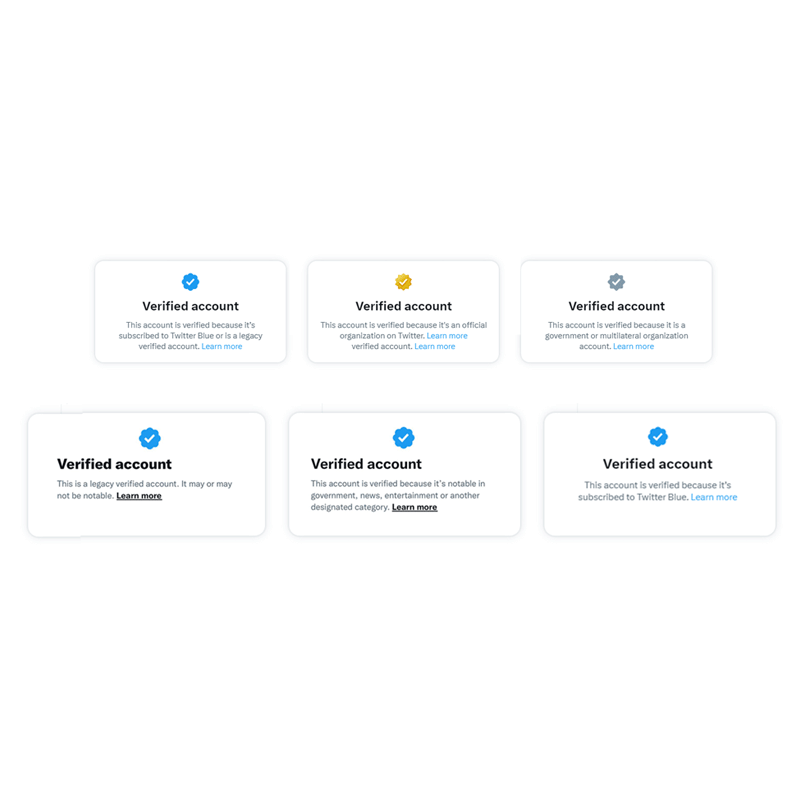
Historically, Twitter's blue checkmark is reserved to those accounts that are "authentic, notable, and active."
This time, that isn't the case anymore because Elon Musk, the eccentric billionaire and serial entrepreneur who bought Twitter, is changing many things in it, in order to restore profit and order.
And according to him, Twitter's legacy verified program is a "lords & peasants" system that he described as "bullshit."
Because of this, Musk considers the verified checkmarks to no longer represent authority and expertise, and because of that, he is removing it.
Starting April 1st, 2023, on April Fool's Day, Twitter is not pranking anyone, when it said that it shall no longer provide the famous blue checkmark though the verified program.
What this means, the microblogging platform won't be providing the blue checkmark for famous and influential figures and brands.
The only way to get the verified blue checkmark, is by paying.
Individuals should pay a few dollars for Twitter Blue, whereas organizations and companies should fill in a form, to then pay $1,000 per month to get the "Verified Organizations" gold checkmark, with additional $50 per month for adding checkmarks to affiliated accounts, such as for individual employees.
On April 1st, we will begin winding down our legacy verified program and removing legacy verified checkmarks. To keep your blue checkmark on Twitter, individuals can sign up for Twitter Blue here: https://t.co/gzpCcwOpLp
Organizations can sign up for https://t.co/RlN5BbuGA3…— Twitter Verified (@verified) March 23, 2023
Of course, the decision is not taken lightly by many, many users.
Some big news organizations responded by saying that they will not pay to get their checkmarks. They also said that they will also not pay for their reporters to get Twitter Blue.
The Washington Post, The Los Angeles Times, and The New York Times have said that they have no plans to pay.
The Washington Post, for example, said that it "will not pay for Twitter Blue service as an institution or on behalf of our journalists" because "it's evident that verified checkmarks no longer represent authority and expertise."
"We aren't planning to pay the monthly fee for check mark status for our institutional Twitter accounts," explained a New York Times spokesperson.
"We also will not reimburse reporters for Twitter Blue for personal accounts, except in rare instances where this status would be essential for reporting purposes."
The same goes with the Los Angeles Times.
Sara Yasin, managing editor of the daily newspaper, wrote in an internal memo, saying that the company isn't planning to pay for Twitter Blue subscription for the gold checkmark, noting that the site was "not as reliable as it once was" and that being verified "no longer establishes authority or credibility."
"We will not be paying to verify our organization on Twitter either," Yasin continued. "It's still unclear if there's actual value in doing so, beyond identifying all of us as LA Times staffers."

Insider also confirmed that it will not be paying for Twitter Blue.
"Insider is not planning on paying for Twitter Blue service as a news organization or on behalf of our journalists. The value of a Blue checkmark was that it said the person was who they said they are," a company spokesperson said.
"Now a Blue checkmark just says they are a Twitter Blue subscriber. That doesn't help Twitter users, or our readers."
The same goes for the BBC, where its spokesperson said that it had "issued updated guidance to staff relating to Twitter's new verification process, and will continue to monitor the changes."
Others, like The Associated Press, BuzzFeed News, HuffPost, Politico, and Vox Media – which owns publications including The Verge, New York magazine, Thrillist, and Vox, also said the same thing.
On April 1st, the moment of truth, the first to have lost their checkmark, is The New York Times.
Starting on Saturday, many Twitter accounts will lose their blue check mark under modifications being made by Elon Musk, the social media company’s owner. The move has implications for a range of users on the platform. Here’s what to know. https://t.co/Sw9TOye64w
— The New York Times (@nytimes) March 31, 2023
Also, their feed is the Twitter equivalent of diarrhea. It’s unreadable.
They would have far more real followers if they only posted their top articles.
Same applies to all publications.— Elon Musk (@elonmusk) April 2, 2023
NY Times is being incredible hypocritical here, as they are super aggressive about forcing everyone to pay *their* subscription
— Elon Musk (@elonmusk) April 2, 2023
Some who have seem to be giving in, include CNN, which said that it doesn't plan to "pay for Twitter Blue subscriptions for either our brand or individual accounts," but with a few exceptions, said Athan Stephanopoulos, its Chief Digital Officer.
British newspaper The Telegraph is also reviewing the change, and would "consider all options."
Not only organizations that started voicing their concerns, because individual users have also complained.
Most notably, Alexandria Ocasio-Cortez, also known by her initials AOC, an American politician and activist, said that the changes were "ripe for targeted harassment" and some celebrities have cited concerns about other accounts impersonating them."
Since taking over the social-media platform in late October, Elon Musk has rolled out sweeping changes to both the site and the wider company.
From cutting costs to the extreme and firing employees, he has also drastically switched up Twitter Blue, the site's subscription service. Musk's changes include upping the price, and only allowing accounts with Twitter Blue to edit tweets, vote in polls, and see fewer ads.
In another dedicated page, Twitter said that Twitter Blue users shall not undergo review to confirm that they meet the active, notable and authentic criteria that was used in the previous process.
In other words, anyone who wishes to have a checkmark besides their names, should pay, unless they're government/multilateral organization or a government/multilateral official, in which they should manually apply for a grey checkmark, which is free.
However, if government or multilateral accounts who wish to have the grey checkmark but don't qualify, "can see if they’re eligible under our Verified Organizations feature."
Read: For 'Twitter Blue' Users Only, Twitter Is Boosting Character Limit From 280 To 4,000






















































































































































































































































































