
What began as a daring experiment in 2001, has now become an open-source encyclopedia that aims to document all of human knowledge.
Wikipedia began in 2001 as a daring experiment, an encyclopedia anyone could edit. Created by Jimmy Wales and Larry Sanger, was a sister project to the more tightly curated Nupedia. But unlike its predecessor, Wikipedia embraced the chaos: trusting that knowledge could be self-correcting through collaboration.
Skeptics doubted it would last. After all, could something edited by the masses really be reliable?
Fast forward over two decades, and Wikipedia has become one of the most trusted and heavily visited sources of information on the internet. Maintained by a decentralized army of volunteer editors, its secret to survival has been its community, which has long been obsessive, meticulous, and proudly combative when it comes to sourcing, neutrality, and factual integrity.
Where the rest of the internet bent to algorithms, advertising, and corporate control, Wikipedia resisted. It outlived social media hype cycles, ignored influencer trends, and remained stubbornly human-powered.
But that’s precisely why the latest flood of AI-generated slop presents such a jarring new challenge.

To combat this, Wikipedia’s volunteer editors have adopted a new "speedy deletion" policy for AI-generated articles.
Or also called the G15, the policy allows editors to skip all the waiting and just remove the offending article.
Whereas the traditional method of deletion may require a full week-long discussion that can include debates to reach consensus to remove an article, the G15 for AI-generated content only requires one flag by an editor to allow a deletion by an administrator without deliberation.
To make things clear, the existing candidates for speedy deletion has a subcategory called candidates for speedy deletion as unreviewed LLM-generated content, where reviewers can see a list of pages that is already flagged by editors.
This subcategory specifically tracks pages that have been nominated for speedy deletion under G15 speedy deletion, as pages that exhibit one or more signs which indicate that the page could only plausibly have been generated by LLM and would have been removed by any reasonable human review.
Wikipedians came up with this to allow the speedy deletion of clearly AI-generated articles that broadly meet certain conditions.
Like whether the article includes “communication intended for the user.” This refers to language in the article that is clearly an LLM responding to a user prompt. Editors target typical AI phrases like "Here is your Wikipedia article on…," "Up to my last training update…," or "as a large language model…" can be summarily removed.
The second condition is if its citations are clearly wrong, another type of error LLMs are prone to. This can include both the inclusion of external links for books, articles, or scientific papers that don’t exist and don’t resolve, or links that lead to completely unrelated content. Wikipedia's new policy gives the example of "a paper on a beetle species being cited for a computer science article."
The goal of this updated policy, is to squarely target the relentless stream of AI-generated junk fattening the site.
Finalized on August 4, 2025, this update empowers administrators to rapidly delete articles that clearly bear the hallmarks of AI-generated content.
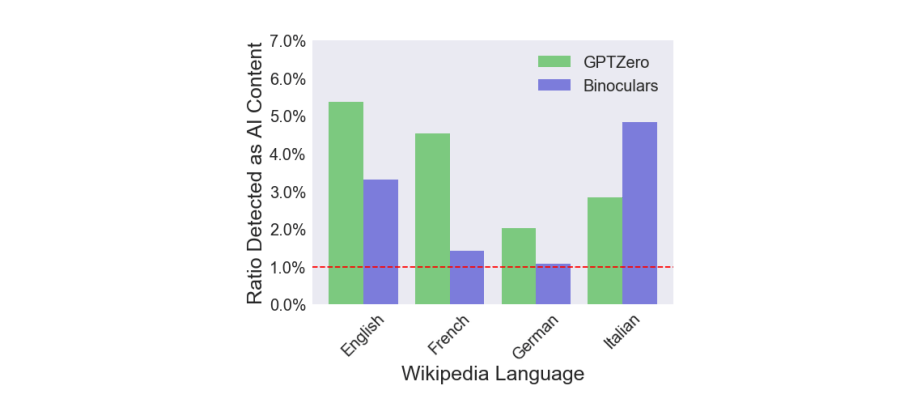
Why now?
As Ilyas Lebleu, founding member of WikiProject AI Cleanup, said that the reason is "the rise of easy‑to‑generate AI content has been described as an ‘existential threat’ to Wikipedia."
However, Wikipedia has always been a place where communities are built around lengthy consensus‑building, and not mass deletion at scale. In earlier policy proposals, editors hesitated, uncertain whether a given page was truly AI‑generated. The clarity provided by G15’s specific criteria helps avoid false positive, such as deleting human‑written content that merely sounds robotic.
"While it can be easy to spot hints that something is AI-generated (wording choices, em-dashes, bullet lists with bolded headers, ...), these tells are usually not so clear-cut, and we don't want to mistakenly delete something just because it sounds like AI," Lebleu said.
"In general, the rise of easy-to-generate AI content has been described as an ‘existential threat’ to Wikipedia: as our processes are geared towards (often long) discussions and consensus-building, the ability to quickly generate a lot of bogus content is problematic if we don't have a way to delete it just as quickly. Of course, AI content is not uniquely bad, and humans are perfectly capable of writing bad content too, but certainly not at the same rate. Our tools were made for a completely different scale."
However, Wikipedia is now bombarded with both AI-generated articles and AI-generated edits. And based on Wikipedia's community which consists of humans who read, write, and observe, there is no way even for the many volunteering editors to keep ip.
Lebleu said that speedy deletion is a “band-aid” that can take care of the most obvious cases and that the AI problem will persist as they see a lot more AI-generated content that doesn’t meet these new conditions for speedy deletion.
Related: From 'Yuck' to 'Ghastly', Wikipedia Kills AI Summary Feature After Editor Revolt
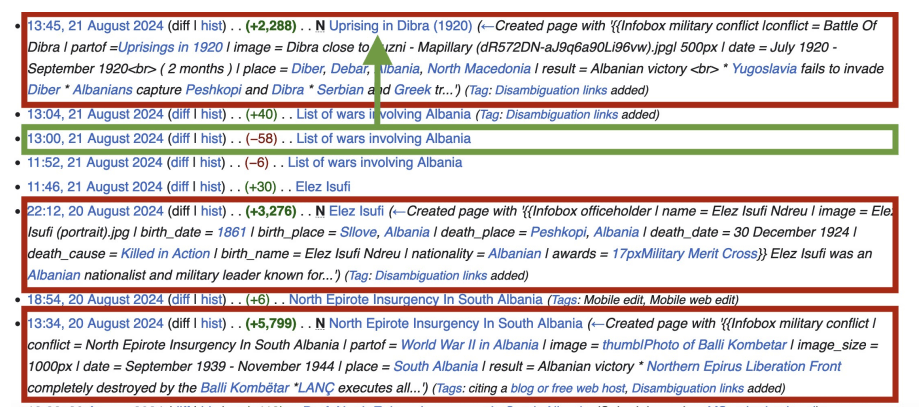
Despite despising AI on Wikipedia, the online encyclopedia actually noted that AI can be a useful tool that could be a positive force for Wikipedia in the future.
"However, the present situation is very different, and speculation on how the technology might develop in the coming years can easily distract us from solving issues we are facing now," they said. "A key pillar of Wikipedia is that we have no firm rules, and any decisions we take today can be revisited in a few years when the technology evolves."
Lebleu said that ultimately the new policy leaves Wikipedia in a better position than before, but not a perfect one.
"The good news (beyond the speedy deletion thing itself) is that we have, formally, made a statement on LLM-generated articles. This has been a controversial aspect in the community before: while the vast majority of us are opposed to AI content, exactly how to deal with it has been a point of contention, and early attempts at wide-ranging policies had failed. Here, building up on the previous incremental wins on AI images, drafts, and discussion comments, we workshopped a much more specific criterion, which nonetheless clearly states that unreviewed LLM content is not compatible in spirit with Wikipedia."
Wikipedia has survived the enshittification of the web so far, and thrive with no ads, no paywalls, no influencer takeovers.
But AI is a different beast. It doesn’t spam Wikipedia with ill intent; it floods it by design, volume over value. And even now, as the site adds tools to fight back, it does so carefully, with debate and consensus, just like it always has.






















































































































































































































































































