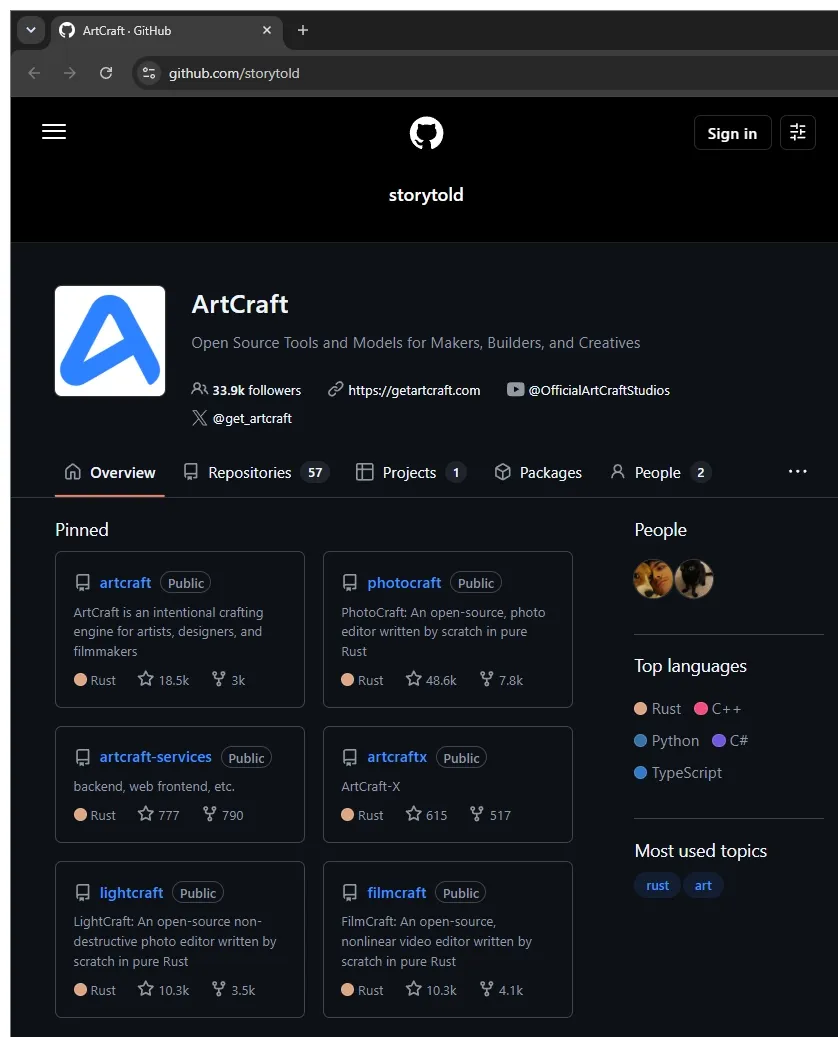
A software engineer with fifteen years of experience, including a stretch at Square, has spent the past several weeks releasing a series of free, open-source applications that recreate the interfaces and core behaviors of some of the most widely used commercial creative and productivity tools.
Brandon Thomas began the work after repeatedly encountering Adobe's early-termination fees, the same category of charges that led Adobe to settle a $150 million federal case alleging that the company had obscured those fees and made cancellation difficult.
Rather than simply switching to existing alternatives, he started creating a replacement.
Using pure Rusk, he used Anthropic's Claude Opus 5.5 as a major co-author to accelerate implementation, in order to replicate some fo the most widely-used software in the world.
The method is straightforward in outline and technically demanding in practice.
Thomas observes the commercial software directly, consults publicly documented file-format specifications, and directs the model to generate Rust code that matches the observed behavior, menu structures, keyboard shortcuts, and file-handling details.
He then tests the output, corrects discrepancies, and iterates.
Because the code is written from scratch rather than derived from any proprietary source, the projects are described as clean-room reimplementations.
Rust was chosen for its performance, memory safety, and ability to compile the same codebase to native binaries for Windows, macOS, and Linux as well as to WebAssembly for browser use.
The resulting applications require no account, collect no telemetry, and impose no subscription checks. Many operations are exposed as structured commands so that scripts or AI agents can drive them through an MCP server without a graphical interface.
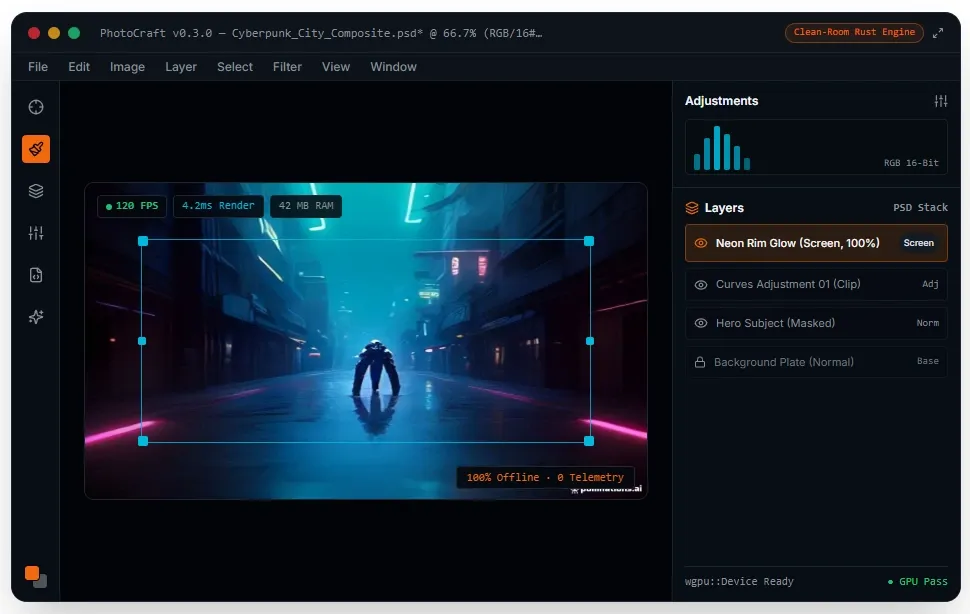
The first wave covered Adobe's Creative Cloud lineup.
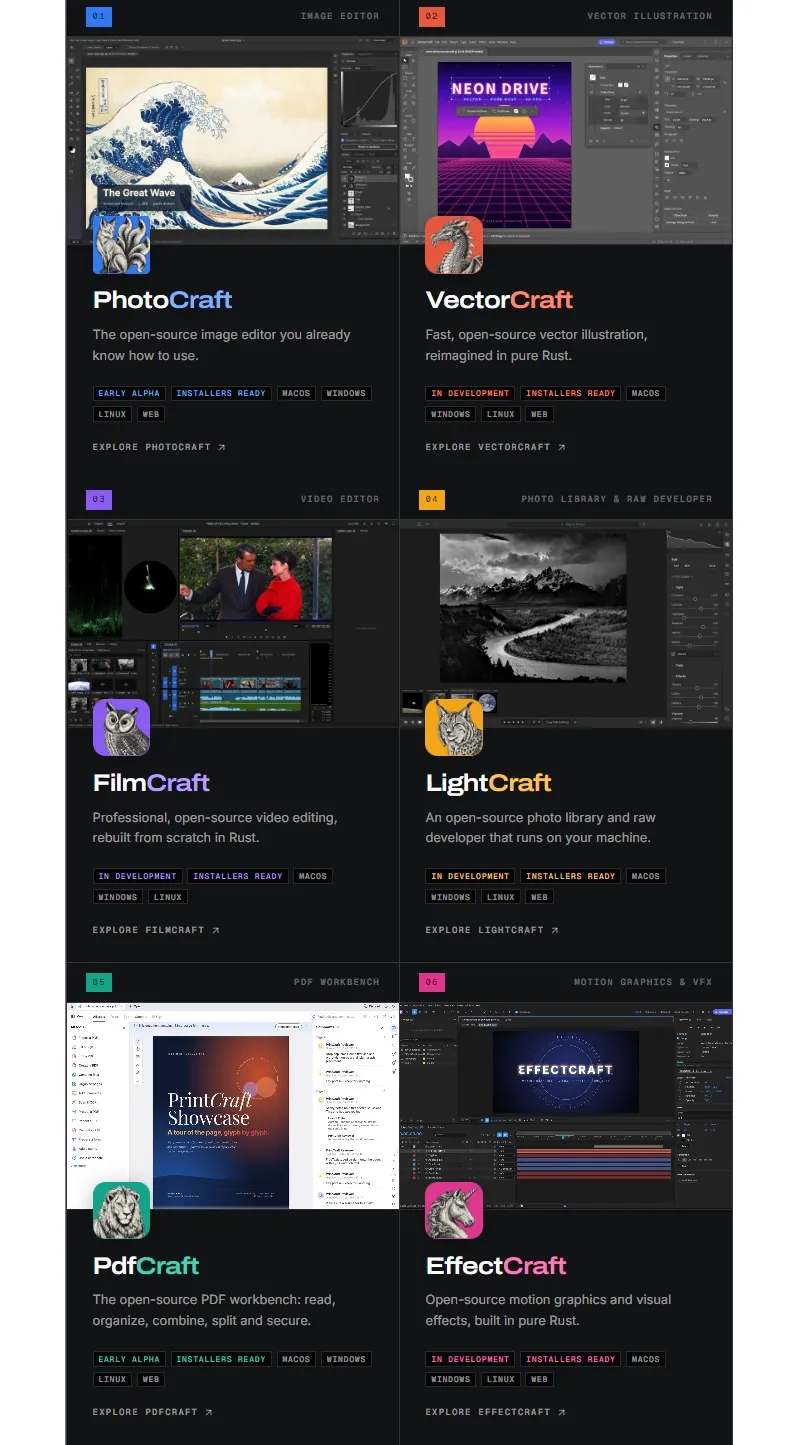
"PhotoCraft" stands in for Photoshop, "VectorCraft" for Illustrator, "FilmCraft" for Premiere Pro, and additional tools address Lightroom, After Effects, InDesign, and Acrobat.
Each is dual-licensed under MIT or Apache terms and ships with installers for the three major desktop platforms plus a browser build.
Early users reported that the interfaces feel familiar and that basic workflows function, while also noting missing features, occasional glitches, and incomplete parity with the commercial originals.
Thomas initially suggested that full feature parity might arrive within a month; he later revised that estimate to months rather than years. The repositories have accumulated tens of thousands of GitHub stars in a short period, and the team has been pushing frequent updates based on community reports.
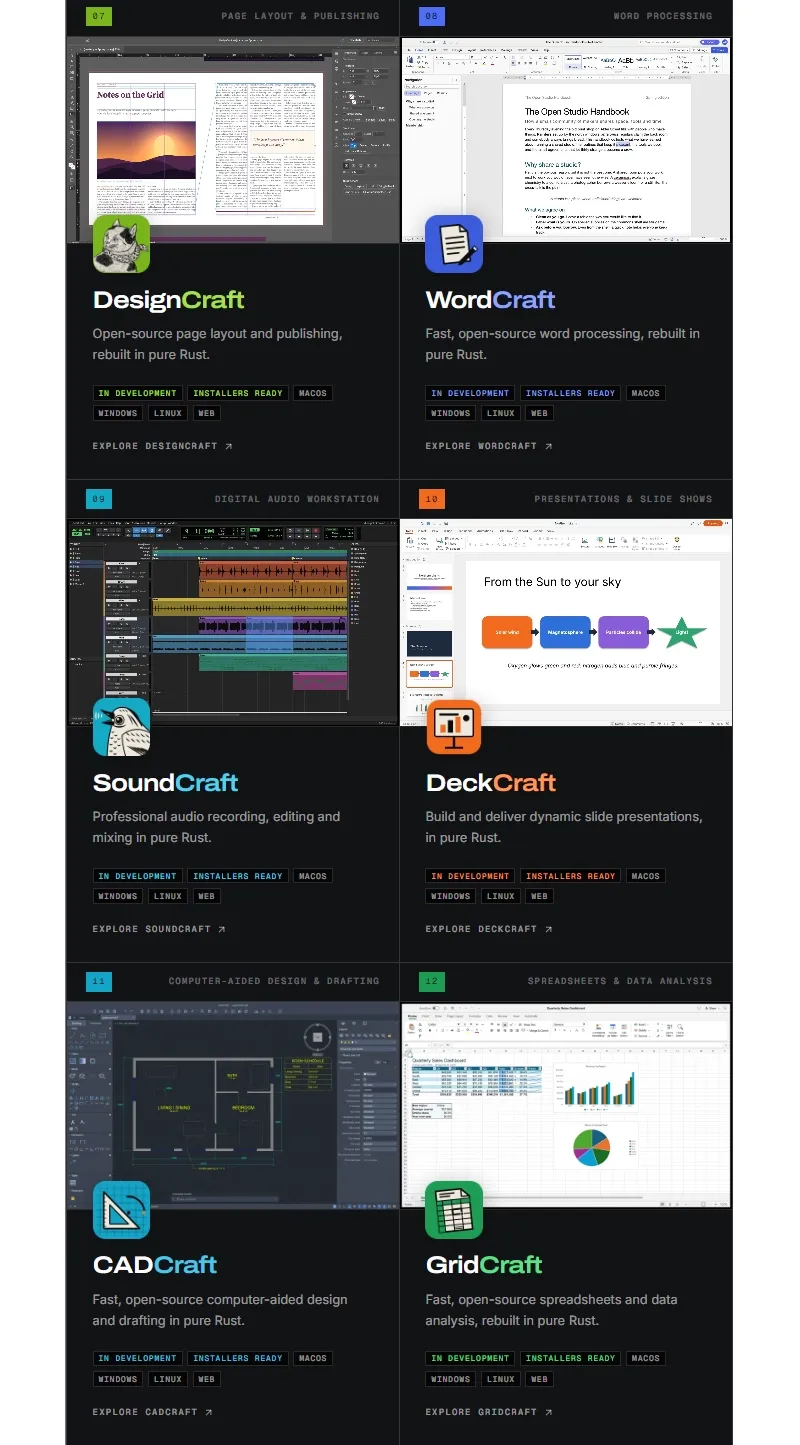
Within days the same approach produced equivalents for Microsoft Office.
"WordCraft," "GridCraft," and "DeckCraft" are Rust applications that read and write the actual DOCX, XLSX, and PPTX formats.
GridCraft, for instance, implements a large share of Excel's ribbon commands and the majority of its worksheet functions, including relatively recent additions such as XLOOKUP, LET, and dynamic arrays.
Like the Adobe clones, these remain early.
Surface-level command coverage has advanced quickly, but deeper formatting logic, calculation edge cases, and perfect interoperability with existing files still lag.
The projects include no license servers and no telemetry, and their developers have been explicit that they are not yet ready to replace Microsoft 365 for production work.
Engineering software has followed the same pattern.
The ArtCraft group released "CADCraft," a clean-room AutoCAD-style drafting application also written in Rust. It recreates the command-line workflow, object snaps, layers, dimensions, hatches, and blocks that drafters have used for decades, and it can open and save DXF files natively while handling DWG through an open-source library.
Separately, another developer released "SolveCraft," later renamed "SolidCraft," an open-source parametric 3D CAD system in pure Rust. It supports constrained sketches on planes, a feature timeline that rebuilds when dimensions or parameters change, and solid operations including extrude, revolve, sweep, loft, fillet, chamfer, shell, and patterns.
The author has described it as a clean-room effort informed by Fusion 360-style workflows and reported that a set of reference parts rebuilt with matching volumes and surface areas. Like the other projects, it includes an MCP server so that AI agents can create and modify models, and it runs on desktop platforms as well as in the browser.
While AI tools have helped many vibe coders (and real programmers) in their work, tools from Adobe are not just immensely popular, but also complex.
For example, professional CAD, CAM, and simulation packages contain specialized geometry kernels, robust manufacturing toolpath generation, and advanced solvers that the new projects do not yet match. Established open-source alternatives such as FreeCAD, LibreCAD, and LibreOffice already cover overlapping ground with larger communities and more years of development.
Because of this, all of these applications remain in pre-alpha or early alpha stages.
What makes these efforts different, is mainly in the speed in which they're able to replicate recognizable interfaces and basic functional parity. In other words, the closeness of their visual and interaction match to the commercial products, and their explicit design for agent control.
The clean-room approach addresses copyright concerns by avoiding any use of original source code, though patents on specific algorithms or interface methods remain a potential legal risk if any of the projects become widely adopted.
For the moment the code is public, the installers exist, and the rate of change is visible in the commit histories and daily updates.
The practical question is how far community testing, continued AI-assisted development, and contributions to the harder technical layers will carry these early versions before the gap with mature commercial or long-standing open-source tools becomes small enough for everyday professional use.






















































































































































































































































































