Among the things BlackBerry is known for, is its encryption.
All data transmitted between a BlackBerry Enterprise Server and BlackBerry smartphones is encrypted with a highly secure AES or Triple DES algorithm. Here, unique private encryption keys are generated in a secure, two-way authenticated environment, where they can then be assigned to each BlackBerry smartphone user.
But things have went further than that, when a Canadian company 'Phantom Secure Communications' enhanced the encryption to create custom PGP-encrypted BlackBerry phones for more than a decade.
Vincent Ramos from Richmond in the Vancouver area, the CEO and founder of the company, was sentenced to nine years in prison, according to the U.S. Department of Justice, because he sold those custom encrypted phones to aid criminal gangs in the U.S., Mexico and Australia.
Phones provided by Phantom Secure gave criminal gangs the ability to encrypt communications through a secure network based in Panama and Hong Kong, and remotely wipe devices when arrested members had their devices seized by law enforcement.
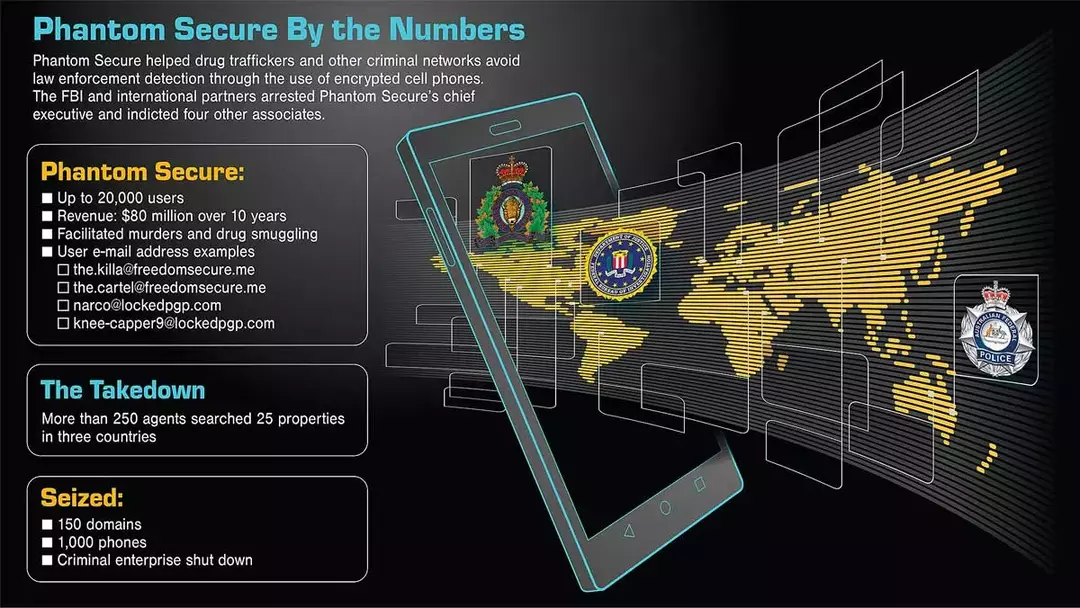
A criminal probe began into Ramos' business in 2017.
At that time, Phantom Secure Communications was already 9 years in business, and the authorities learned of Ramos' products during the investigation of Owen Hanson. The former University of Southern California football player and the Sinaloa drug cartel of Mexico was caught when moving over a ton of cocaine from Mexico into the U.S. in their global drug-trafficking business.
During an undercover mission, a police agent recorded Ramos bragging about his company's ability to hide illegal operations from police officers, to even admitting that he intentionally provided services to help criminal in their illegal operations.
In following times, Ramos had also boasted about his hardware after seeing a news report that said use of his encrypted devices by a suspect in one high-profile murder had hampered the investigation.
Following a joint investigation with the Canadian and Australian police that included some 250 law enforcement agents, the FBI arrested Ramos in Washington, in March 2018.
He pleaded guilty in October of the same year.
“I am sorry and accept responsibility for my actions that have led me here today,” said Ramos to Judge William Hayes. He said he turned “a blind eye” to the use of his phones – which were marketed as a tool for business executives – for international drug sales.
According to court documents, among Phantom Secure's clients include the Sinaloa cartel, and members of the Hells Angels motorbike gang in Australia where the custom-encrypted BlackBerry phones were used to arrange several murders.
“The scope of this case is staggering,” said Assistant U.S. Attorney Andrew Young, calling Ramos’ clients “some of the most sophisticated criminals in the world using some of the most sophisticated technology in the world.”
After Ramos' arrest, authorities dismantled Phantom Secure's network, and learned of the company's servers that span all over the world, in locations such as Australia, Canada, Hong Kong, Panama, Thailand, and the U.S..
Investigators said there were at least 7,000 Phantom Secure devices in use at the time of Ramos' arrest, and said that the company has sold over 20,000 devices during its lifetime, half of which were sold in Australia.
Authorities also charged four of Ramos' employees and co-conspirators, but they initially remain at large.
As part of his sentence, Ramos also also told to forfeit $80 million in earnings, which included real estate, international bank account holdings, cryptocurrency and gold coins.
Ramos' case was considered the first U.S. conviction involving someone who provided encryption technology to criminal organizations.
Previously in 2016, the Dutch police shut down a similar service called Ennetcom, which also provided PGP-encrypted BlackBerry phones to criminal gangs in Europe.






















































































































































































































































































