For more than plenty, the West sees the Russian government as the source and cause of cyberattacks. This time, the country just became a target.
A hacking group that goes with the name '0v1ru$' has infiltrated the servers of SyTech, a major contractor for the Russian FSB intelligence agency on July 13th, according to the BBC.
They compromised the firm's Active Directory server and stole 7.5TB of data.
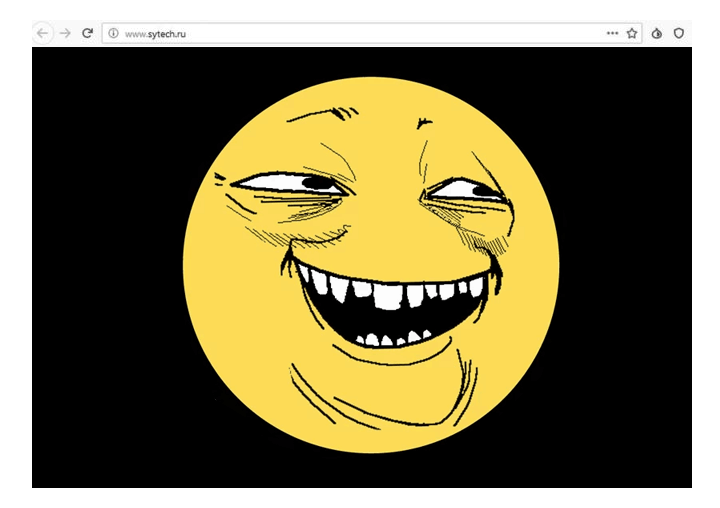
The intruders defaced the company's website, to show an image of a face with a wide smile and smugly squinting eyes (internet slang: "Yoba-face").
The hacker also revealed a number of projects that SyTech had been working on for the FSB and contractor Quantum since 2009, some of which were pure research while others are ongoing projects.
The notable projects include:
- Nautilus-S: a secret project to deanonymize Tor traffic and create a database of Tor users and devices.
- Hope: which is meant to map the Russian section of the internet and its connections to other countries.
- Nautilus: (not Nautilus-S), to collect social network data, such as from Facebook, MySpace and LinkedIn.
- Reward: to penetrate peer-to-peer networks by finding a vulnerability in the BitTorrent network protocol .
- Mentor: as a project to search and spy on the email of Russian companies.
- Tax-3: to create a closed intranet to keep the information of high-profile political figures and judges away from regular government networks.
According to the BBC, there were at least 20 non-public IT projects ordered by Russian special services and departments.
The most recent can be dated back to 2018, ordered by the Chief Scientific Innovation Innovation Center JSC, reporting to the Federal Tax Service.
Все мы, журналисты, студенты и даже пенсионеры, находимся под навлюдением ФСБ. Присоединяйтесь к нам, как и 0V1ru$, защищая наше будущее! Они не заглушат наши голоса! @tjournal @Dobrokhotov @bbcrussian @unkn0wnerror pic.twitter.com/HUYDas7FSN
— DigitalRevolution (@D1G1R3V) July 18, 2019
Before publishing this findings, the hackers took a screenshot of the interface of the SyTech's internal network, and deleted the information from inside the server, before partially copying them.
They shared the documents with the Digital Revolution, which claimed to have given the information to journalists in the form in which it was provided by members of 0v1ru$.
The hackers claimed that they were inspired by the movement of digital resistance against Russia's blocking of the Telegram messenger.
"It seems that the group is small. Regardless of their number, we welcome their contribution. We are glad that there are people who do not spare their free time, who risk freedom and help us," noted Digital Revolution.
This case isn't the first hack against an FSB contractor. Quantum faced its own breach in 2018, for example. But in this hack incident, the treasure trove of data appears to be larger here, and it also likely to embarrass the FSB.
The agency has thrived on covering its tracks and otherwise remaining secretive, just like the U.S.' CIA. In this case, it wasn't the FSB that failed to secure its systems, but its key partners were.
This hacking incident is considered as one of the largest data leak in the history of the work of Russian special services on the internet.
After realizing the hack, SyTech took down its website and server.






















































































































































































































































































