Late September has a way of dragging half-forgotten campus stories back into the open, and this one arrived with a civil filing, a student newspaper editorial, and a group chat that people could not stop reading.
Within days the names were everywhere, the university was answering questions it had hoped to keep inside a Title IX file, and a prosecutor who had closed the matter in 2024 was explaining why he was looking at it again.
The woman in the court papers is identified only as Jane Doe.
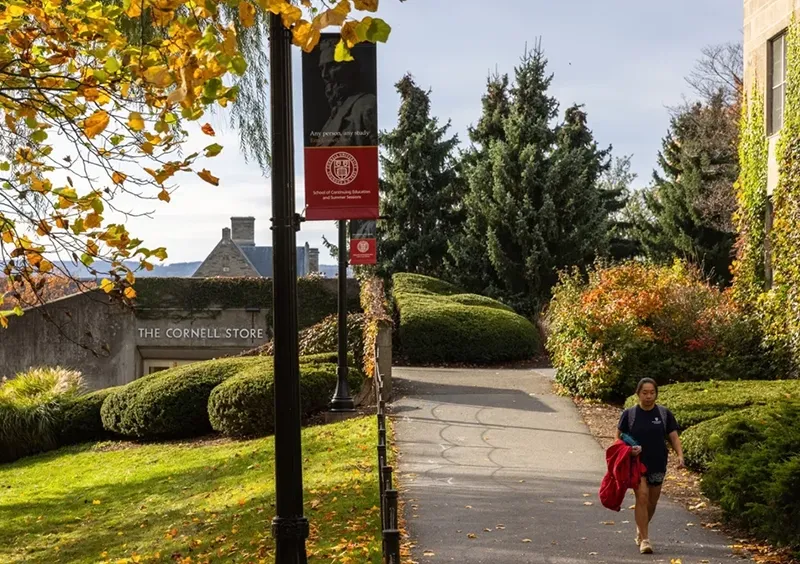
She was a 20-year-old junior at Cornell and a member of Delta Delta Delta when, according to her lawsuit, the night of October 19, 2024, turned into the early morning of October 20 inside the Chi Phi house in Ithaca.
She says she had already been drinking at her sorority and at bars downtown, that she was under 21, and that at least one bar marked her hands and served her anyway.
She went to the fraternity to meet someone she considered a friend.
However, things went south after that.
The complaint says she was already intoxicated, and that she was pressured into a threesome. She was also pressured into snorting ketamine, a drug she says she had not used before, along with marijuana and even more alcohol.
From there the allegations get graphic.
The suit claims she became incapable of consenting, that men had sex with her, and that ketamine was snorted off her body.
She says she told some of them she was uncomfortable or tired and tried to push or swat a hand away.
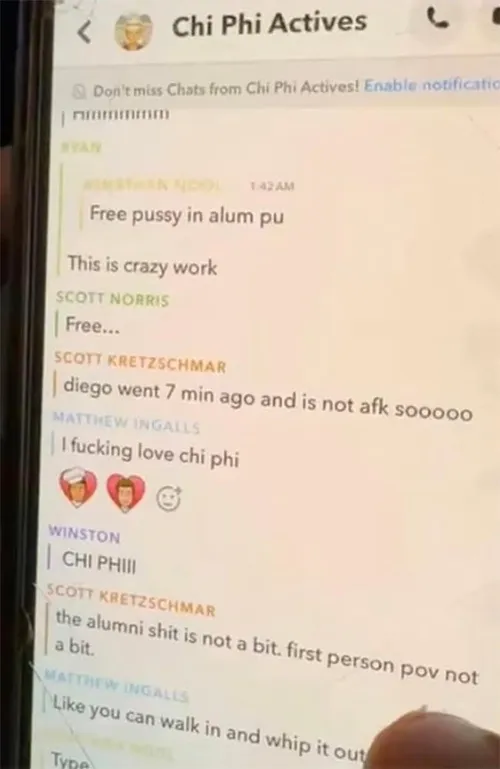
Past midnight, a message in the Chi Phi Actives Snapchat group, a chat reported to have held roughly 50 to 57 members, announced that there was "free pussy upstairs."
Replies included lines to the effect of loving Chi Phi and being able to walk in and whip it out.
A later message asked whether the shop was still open and got a yes.
More men allegedly entered, and more men joined.
The complaint places the end of the ordeal near 5:45 a.m.
In other words, the drugs- and alcohol-fueled sex marathon lasted about six hours.
She reported the night to Cornell University Police on or about November 8, 2024.
In a later interview, she is quoted saying she could state with 100% confidence that she was raped, that it felt like coercion, and that she had been completely and totally incapacitated.
A separate ketamine overdose at the same house, on or about October 18, appears in Cornell's own hearing materials. None of this has been tested as a criminal conviction. It is the account in a civil complaint and in leaked messages.
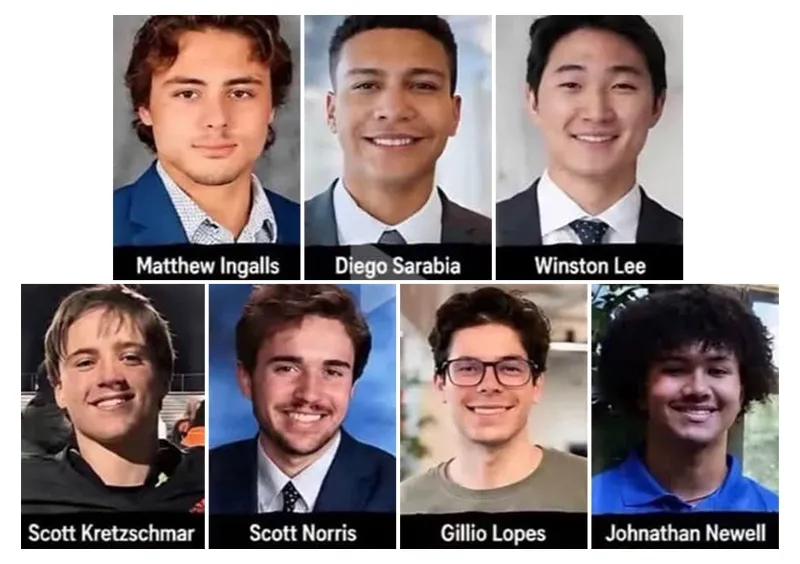
The seven men named in the suit, and then published by The Cornell Daily Sun, are Matthew Ingalls, Jonathan Newell, Winston Lee, Gillio Lopes, Diego Sarabia, Scott Norris, and Scott Kretzschmar.
Spelling of the second name varies slightly across filings and coverage.
The complaint also names Cornell, the Chi Phi national organization and its Xi chapter, the chapter president, sorority entities, and an Ithaca bar. Lawyers for at least Kretzschmar, Norris, and Lopes have denied the sexual assault claims against their clients.
Rumors suggest that one of the rapists, Winston Lee, is the grandson of Lee Hong-koo, a man who was none other than the 28th prime minister of South Korea, served under President Kim Young-sam.
Winston's father, Barton Lee, also identified as Lee Hyun-woo, is a managing director and head of Asia at the energy investor EIG, and that his mother is Ji Young Hwang (Hwang Ji-young), described as chair or president of the Korean American or Hong Kong Korean women's association.
Cornell suspended the chapter the day she reported it and later closed it. The house remains barred from campus. The national fraternity said the accused members were removed from the chapter within days.
A Title IX process followed, with a formal complaint around January 2025 and at least 12 hearings in May 2025, drawing on about 50 interviews with 32 witnesses.
President Michael Kotlikoff later told student government that the panel expelled two students, suspended two for at least two semesters, that one had already graduated, and that two were found not responsible for sexual misconduct.
The lawsuit claims students were allowed to soften temporary suspensions by writing essays.
Cornell says no one was offered essay writing as a sole consequence. One internal finding described in coverage was responsibility for attempted sexual exploitation rather than sexual assault, paired with an apology that included not being able to tell whether she was under the influence.
The criminal side stalled for nearly two years.
Tompkins County District Attorney Matthew Van Houten's office reviewed a six-page sworn statement in November 2024 and did not charge anyone.
After the lawsuit, he reopened the file.
His public explanation was that the statement he first saw did not allege she was drugged against her will, physically forced, or physically helpless. He said it described the drug use and the sex as voluntary, conscious, and consensual, and that his office is bound by the elements of New York penal law rather than by a civil pleading filed later.
New York's treatment of voluntary intoxication has been widely argued over in the coverage, with critics calling it a loophole and a state senator pushing to close it.
Later reporting said the full police interview ran about 120 pages and contained stronger language that the short summary left out.
The public phase began when the Sun's editorial board ran "Cornell Won’t, We Will" on September 21, 2026, after months of reporting that included work by senior editor Cereese Qusba.
The piece named the seven men and accused the university of concealment.
South Park writer Toby Morton then put up a site posting names, photos, and documents, and talked about billboards. The Snapchat lines did the rest. Florence Pugh and Jameela Jamil posted.
Memes and boycott talk followed.
The pile-on also hit the wrong person. Court papers were served on a 23-year-old Marine Corps sergeant named Matthew Ingalls who never attended Cornell.
His family’s upstate New York address landed on the docket. Phone numbers and addresses circulated. The family reported threats. Camp Lejeune confirmed he is not the defendant, and the plaintiff’s firm said it was arranging service on the correct Matthew Ingalls.
Texts from the days after the night, reported by ABC, add another layer that the lawsuit does not erase.
Doe told one of the men her reputation was destroyed and that she was ashamed. Other messages included a line about sexuality changing and a "love u king." Later she wrote about being uninvited to events, about rumors she had been gang banged, and about being done talking because she believed he had lied.
She also told a doctor she had a urinary tract infection in a traumatic way and sought testing. A rape kit is not described as having been done at that visit.
In the end, the case sits in two places at once: a civil suit seeking damages, and a criminal review that a special prosecutor is now supposed to carry to a grand jury.
The university already split the seven into expulsions, suspensions, a graduate who left before punishment, and two findings of not responsible. The group chat is real enough that news outlets published it.






















































































































































































































































































