There is a particular kind of silence that follows a Metro game. After the last shot, after the filters run out and the tunnels close behind players, the world feels smaller than it did an hour earlier.
That is the trick 4A Games has been pulling since 2010.
The Ukraine-based studio, founded in Kyiv by veterans who left GSC Game World after working on S.T.A.L.K.E.R., never treated the Moscow Metro as a level select. It treated it as a pressure chamber.
People live down there because the surface will kill them. They fight down there because someone always wants the last working station. And they keep going because the alternative is admitting the war above them already won.
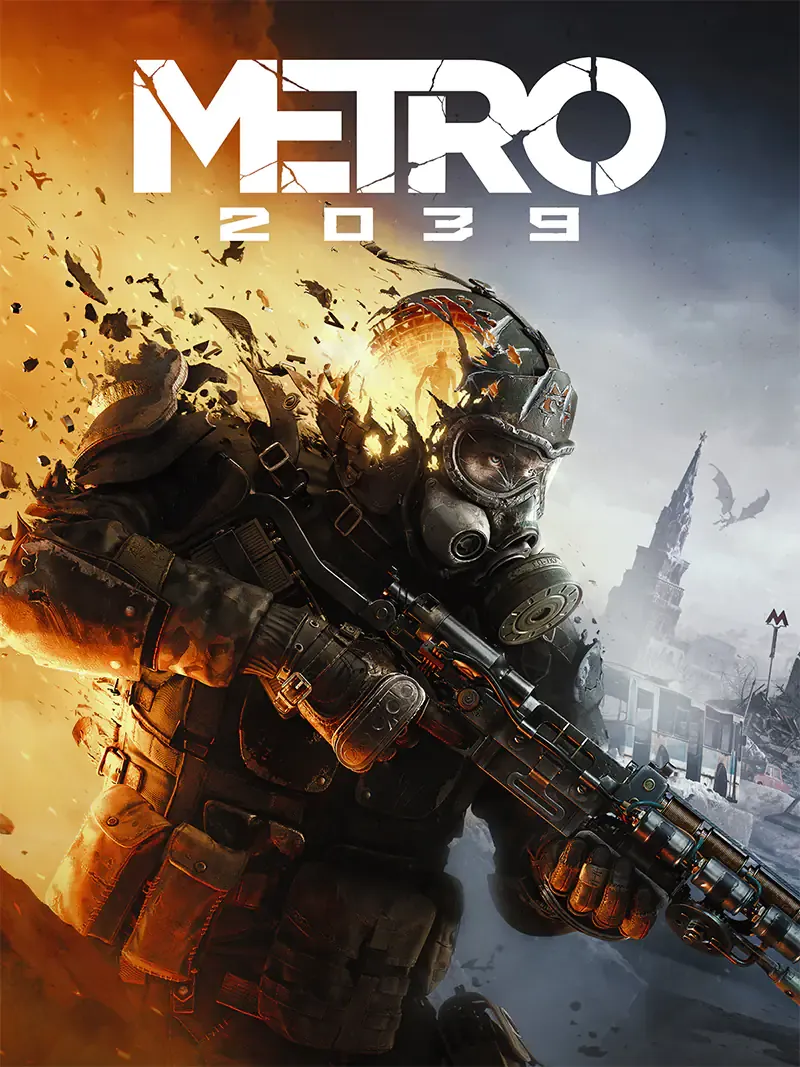
That pressure started with Metro 2033, adapted from Dmitry Glukhovsky's novel and built around Artyom, a quiet young man from VDNKh who is sent across the tunnels after the Dark Ones attack his home.
The game made players count bullets, watch a wristwatch tick down as their gas mask filter died, and sit with the idea that the monsters might not be the worst thing in the dark. Metro: Last Light, released in 2013, kept Artyom in the Rangers and turned the Metro into a political knife fight between the Red Line, the Fourth Reich, and the Spartan Order. Then Metro Exodus, in 2019, did the unthinkable for a series defined by claustrophobia. It put Artyom, his wife Anna, and a handful of Spartans on a steam locomotive and sent them across the irradiated map of Russia. The tunnels opened into Volga wetlands, Caspian dunes, and a frozen lake that felt almost like hope. Almost.
Seven years later, the series is coming home. Metro 2039 is set in 2039, four years after Exodus and about twenty five years after the bombs.
The factions under Moscow have been swallowed by a single banner called the Novoreich.
Its leader is Hunter, the same Spartan who once helped Artyom recognize the Dark Ones as a threat.
In this chapter, he is the Führer, selling salvation on the surface while ruling the stations with propaganda, fear, and the promise of another war.
In Metro 2039, players do not play as Artyom. Instead, they play as the Stranger, a former Spartan who fled into the wilderness and now lives with violent waking nightmares.
Unlike Artyom, who spoke in loading screens and stayed mute in the moment, the Stranger has a voice. Glukhovsky put it simply. This time the protagonist of the Metro gets his voice, and he has things to say.
The reveal did not so much land as detonate.
4A and Deep Silver unveiled the game in April 2026 and within two weeks, it had crossed one million wishlists, the fastest mark in Embracer Group's history. Embracer later confirmed the figure in its Q1 report and said demand was still running ahead of internal forecasts.
That is not the usual sequel bounce.
Metro has always been a cult series with a loud, loyal core.
A million wishlists in a fortnight means the core dragged a lot of new people with it. Part of that is hunger. Part of it is the footage. The Gamescom trailers and the first public hands on this week showed a studio walking away from Exodus’s open stretches and back toward the dense, hand built corridors of 2033 and Last Light.
Stations packed with civilians. Soldiers under bright weapon lights. An abandoned daycare. Sewers with knee deep water. A nine foot mutant and the rats that travel with it. Ammo so scarce players must craft it from scrap. Filters that expire on a ticking watch.
That combination, and the familiar pain, plus a new face, plus a fascist Moscow, is catnip for the internet.
It is also not the whole story.
The part that keeps traveling, the part that turns a trailer comment section into an argument about the present, is what happened to the people making it.
4A is officially headquartered in Malta, a move the founders made in 2014 after Russia annexed Crimea.
The majority of the team is still Ukrainian. They work from Kyiv, from other cities, from generators and battery banks when the grid dies, and sometimes from the front. The studio has said some colleagues have worked even from the line.
In 2022 they lost animator Andrii "Nizrok" Korzinkin, who died fighting the invasion. Glukhovsky, the Russian novelist who built this universe, lives in exile after being sentenced in absentia for criticizing the war.
Creative director Andriy Shevchenko told IGN that the invasion changed the team first, their way of being and thinking, and that the game followed.
Story changed. Some gameplay changed.
First of all, the team. Executive producer Jon Bloch was more direct. Previous Metro games were about preventing war, about how humans stop the cycle they keep finding themselves in.
When Russia launched its full scale invasion, war arrived at the studio's door. Plans changed overnight.
The most horrible impact was not on the story or the game itself, but on the team. Back in the days, when we were working on the same universe and looking for references for destroyed buildings or collapsed regions, we were looking for nameless countries or locations in the world. Now you can just open your window and see the world you’re creating.
What they wanted to tell became the consequences of war, what happens when it comes to you. Co creative director Pavel Ulmer said the franchise's nature became too close to reality, and that everything now divides into before and after.
Bloch has also said the old grey morality is no longer enough.
When the story looks at an authoritarian regime taking power, there is no longer any moral ambiguity to preserve. The writing had to become clearer.
Shevchenko has called 2039 a game without heroes, because it takes place in a world without them. The official line from the studio is blunt. The cost of silence. The horrors of tyranny. The price of freedom. Still a Metro story, they insist, still set in Glukhovsky's universe, told from a Ukrainian perspective because that is who is in the room.
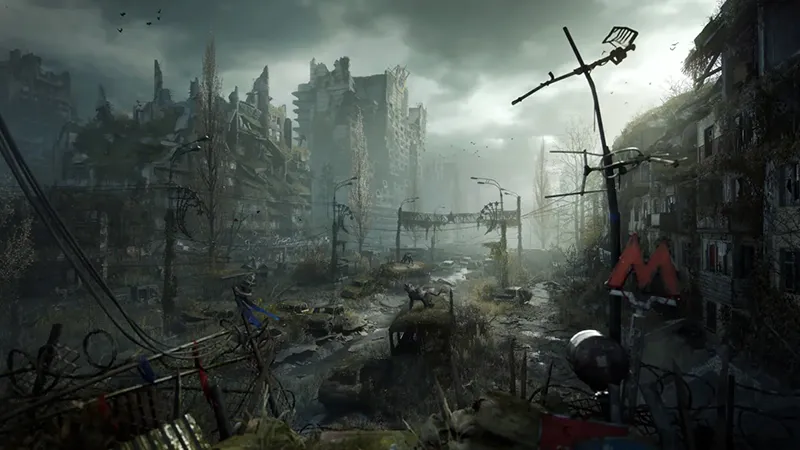
That is why the virality has a different texture than a normal hype cycle.
People are not only sharing a shotgun with a wooden stock and a watch that reads 07:19. They are sharing the uncomfortable overlap. A series that always used Moscow's tunnels as a metaphor for propaganda, factional cruelty, and the cult of war is now being finished by a mostly Ukrainian team while that metaphor sits next to the news.
Ulmer has pointed out the irony himself.
They are making a game in a world that is already dead, while the real world still has a chance. The game is not a documentary of 2022. The developers have said they are not mapping literal events onto the Metro. They did not need to. Hunter’s Novoreich, the kidnapped children in early footage that some critics read as an echo of real deportations, the stations drowning in posters and lies, all of that was already in Metro's DNA.
War made the DNA visible.
The series spent three games asking whether people could stop the next war. Then the next war arrived at the office, and the people who used to write about prevention started writing about the bill.
That is a grim reason for a trailer to spread. It is also the most Metro reason imaginable.
War is our reality, and our message has shifted to be about the consequences, the cost of silence, the horrors of tyranny, and the price of freedom.






















































































































































































































































































