For 217 years, a letter meant for one of Napoleon Bonaparte's generals sat unread. It opens with a single line of ordinary French, the kind of courtesy a staff officer still bothered to write in clear, and then the page turns into something else: 24 rows of 2-digit numbers, Greek letters, typographic marks, and signs that exist nowhere except on that sheet.
The first line says the recipient must already have had the letters of the 8th, the 14th, and the 20th. Everything after that was meant for him alone.
The man it was written for was Auguste de Marmont, then still a general, later a Marshal of the Empire, and at that moment in command of about 13,000 men in Dalmatia.
He was a personal friend of Napoleon and also badly placed.
His corps sat on the far side of Austrian territory, cut off from the main French armies, just as Vienna was preparing to reopen the war.
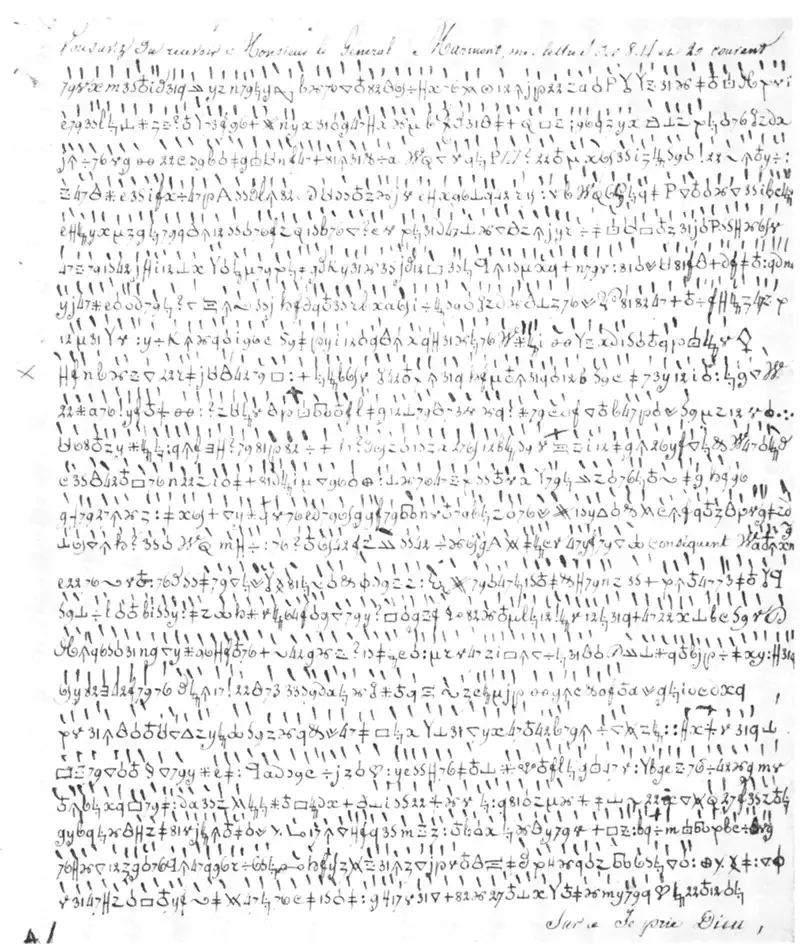
It was on 16 March 1809, when Napoleon ordered Eugène de Beauharnais, his stepson and Viceroy of Italy, to send Marmont a ciphered account of where the French and allied armies actually stood.
An officer at Eugène's headquarters wrote it in late March, after Eugène's own letter of the 20th and about 2 weeks before Austrian troops crossed into Bavaria on 10 April and the War of the Fifth Coalition began.
It was made cryptic for the oldest military reason there is.
The dispatch had to travel through or around a country that was about to become the enemy, and if it was taken, frequency analysis was not supposed to be enough to read it.
The system was a homophonic substitution, the standard French military method of the period.
Roughly 155 distinct signs covered the job: about 115 for letters, with the common ones repeated so that E alone had nine interchangeable marks, twenty-nine for whole words such as de, que, and les, and a handful of nulls and punctuation. Draw the same letter nine different ways and a clerk counting symbols learns nothing. No key survived with the letter.
For a long time, neither did a transcription.
The ciphertext was known from a single plate in a 1969 article by J. Vilcoq in the Revue historique des Armées, a scan of 1,202 by 1,836 pixels, filed under the wrong year.
Satoshi Tomokiyo, the Tokyo cryptologist who has spent decades keeping the public list of unsolved historical ciphers on his site Cryptiana, carried it as "Encoded Letter to Marshal Marmont (1807)."
A table compiled by the French historian Daniel Tant supplied values for 33 of the signs, about a third of the text. The rest was a blank.
In September 2026, Carter Church, a staff AI engineer, handed that one image and a single goal to OpenAI's GPT-6 Astra.
And with the help of the AI, he solved it.
According to Church in a website post, the model spent about six hours of execution time and did the whole job without a prepared transcript.
It cut the plate into rows, read something like 1,300 hand-drawn signs, decided which of 175 lookalike marks were the same symbol written twice, pulled in Tant's partial key, and then attacked the remainder with a simulated-annealing solver scored against French letter patterns.
It tested signs that broke ordinary French until they resolved as whole words.
It checked each assignment back against every occurrence on the plate.
Run again without Napoleonic texts in the scoring, it recovered the same reading. Tomokiyo reviewed the solution, marked the entry solved, and accepted the corrected date of 1809.
Five signs are still best guesses. None of them change what the letter says.
What it says is a war briefing.
The Duke of Danzig is at Munich and Passau with forty thousand Bavarians. Poniatowski is on the Vistula with 30,000 Poles, threatening Kraków. Bernadotte has the Saxons before Dresden. Davout is at Bayreuth with 80,000 French. Masséna has 60,000 at Ulm and Donauwörth. Oudinot’s elite corps, 40,000 men, is at Augsburg and along the Lech. The Russians are marching. Friuli has 80,000. Add the Dalmatian corps and the reserves forming in the rear, the writer tells Marmont, and Austria is about to be hit from every side at once. She is hastening toward her ruin. When the order to march arrives, he is not to be intimidated by a few troops or a gathering of rabble.
That last phrase closes a hole that had sat in print since the 1860s.
Napoleon's order to Eugène, as published in the correspondence, breaks off in the middle of the sentence: Marmont must not let himself be held back by "a handful of," and then a row of dots.
The cipher carries the rest, intact.
Quelques troupes ou un rassemblement de canailles. A few troops, or a gathering of rabble. The Austrians, the letter goes on, are still at Ljubljana, Klagenfurt, Villach, and Salzburg, and seem to threaten the Tyrol by way of Linz, though they may also be thinking of Galicia and the Russians. Nothing is definite yet. The militia have been called out. It has not been proved that the levies will amount to much.
Church is careful about what the result does and does not prove. The cipher itself is not a monster.
A specialist with the time could have broken it. What had not happened, for two centuries, was the unglamorous sequence in front of the break: find the plate, transcribe 1,300 invented signs by hand, connect a partial key that had never been tied to this letter, correct a published date, and check the reading against the surrounding correspondence.
That is several disciplines and a kind of patience archives do not have on staff. Astra did it from one picture.
This is the part that is hard to shrug off.
A message written so that an Austrian patrol in the spring of 1809 could not read it stayed unread through the empire, the restoration, two world wars, and the entire digital age, and then fell in an afternoon to a model that had been asked, in ordinary language, to solve it.
The same weeks have brought other cracks of the same kind, old Enigma traffic and a German radio message from 1918 among them, worked by systems that search, transcribe, write their own solvers, and check the plaintext against a logbook. The Marmont letter is the cleanest of them.
Nobody had to invent a missing archive. The plate, the partial table, and Napoleon's broken sentence were all already public.
What was missing was someone, or something, willing to do the whole dull chain.
Every field has a drawer like Cryptiana's list.
Letters nobody transcribed. Tablets nobody collated. Lab books nobody re-ran. The specialists who could finish them are busy with the problems that already have a funding line. The Marmont briefing did not need a new theorem.
It needed a curious outsider and a machine that does not get bored at row fourteen. 217 years is a long time for a sentence to wait. It is a short time for a tool that can finish the sentence.
Cryptiana maintainer Satoshi Tomokiyo confirmed the solution and marked the cipher solved, illustrating how advanced AI enables outsiders to efficiently clear specialized historical backlogs through integrated multi-modal workflows.
Further reading: How OpenAI's GPT-6 Astra Solved World War-Era German Messages: A Century-Old Mystery Decrypted in Just Hours






















































































































































































































































































