BYD, founded in 1995, is best known worldwide for its mass-market family cars, small cars, and practical SUVs.
It does not carry the Ferrari price tag, the BMW motorsport pedigree, the Bugatti history in top-speed challenges, the Porsche heritage in endurance racing, the Rolls-Royce luxury, or the Lamborghini prestige.
Yet on November 1, 2026, its ultra-premium Yangwang brand sent the limited-production U9 Xtreme electric hypercar down a closed stretch of Abu Dhabi's Sheikh Khalifa Bin Zayed International Road and recorded 503.17 km/h.
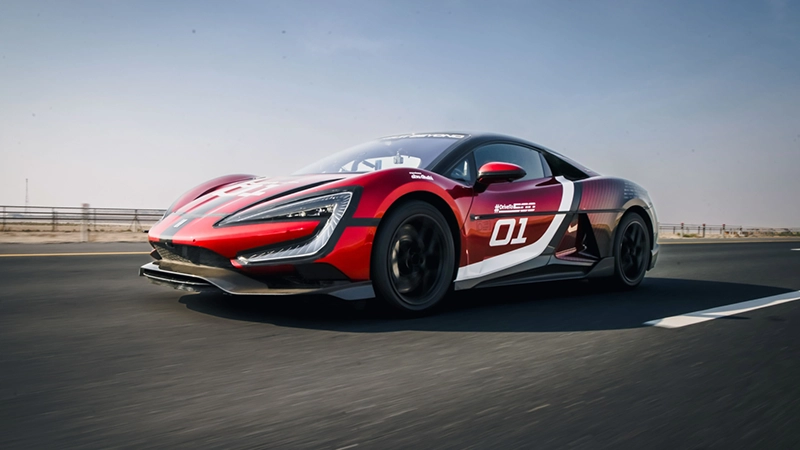
Driven by German racing driver Marc Basseng, that single-direction run on the E11 highway in the Al Dhafra Region made it the first production car ever to officially go over 500 km/h.
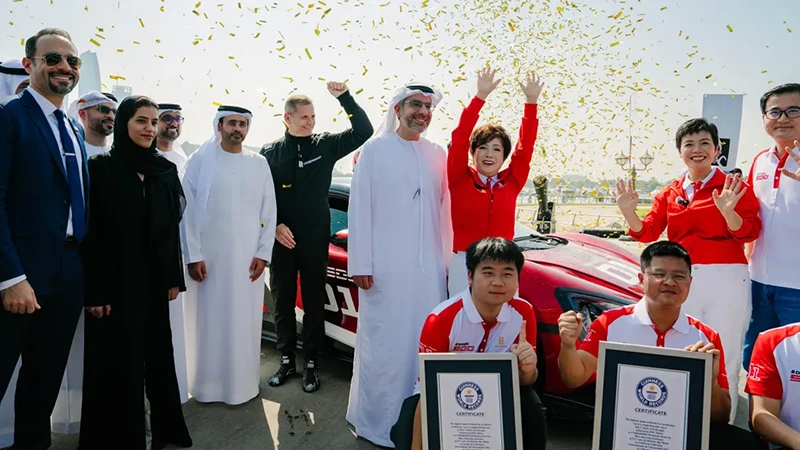
The Fédération Internationale de l’Automobile recognized the speed, and Guinness World Records gave titles for the highest single-direction speed by both a production car and an electric production car.
To achieve this feat, the numbers behind it are extreme even for a hypercar.
While the car is considered heavy (more than 2 tons), it managed to mitigate that with its four independent electric motors. With each able to spin to 30,000 rpm, the car produces a combined output of roughly 2,220 kW, or more than 3,000 PS (about 3,000 horsepower).
This gives it a power-to-weight ratio of about 1,200 PS per tonne.
Some other hypercars with similar ratio include the Hennessey Venom F5 variants, Koenigsegg Jesko Absolut, and SSC Tuatara. Many of the cars that match or beat it on paper are lighter combustion or hybrid machines built for pure performance rather than road-legal production cars.
The car uses a 1,200-volt system rather than the 800-volt setup in the standard U9, paired with a high-discharge Blade battery.
Earlier that year the same car had already set a production electric vehicle lap record at the Nürburgring Nordschleife of 6 minutes 59.157 seconds.
It had also claimed the previous production-car top-speed mark of 496.22 km/h on a German proving ground in September 2025, a figure that itself had beaten the long-standing record of the Bugatti Chiron Super Sport 300+, which reached 490.48 km/h in 2019.
After the first Abu Dhabi runs peaked around 490 km/h, engineers adjusted the rear wing angle, increased rebound damping in the active suspension, and fine-tuned tire pressures overnight.
The next attempt delivered the record, going past both the Bugatti and the U9 Xtreme's own earlier mark.
Among pure electric rivals, the Rimac Nevera R had previously set a high-water mark around 431 km/h, a speed the Yangwang now exceeds by a wide margin.
A notable addition is Tesla, which is credited for helping popularize the idea of high-performance electric cars with models like the Model S Plaid. But even its fastest model is not designed to break extreme top-speed records the way these limited hypercars have.
Read: 417 Km/h On A Public Road, And How A Billionaire And His Bugatti Chiron Run Broke The Internet
What made the achievement travel so far so fast was the internet itself.
Official announcements from BYD accounts carried video and stills that racked up thousands of likes and hundreds of reposts within hours.
Onboard footage of the run circulated widely, along with promotional graphics declaring the U9 Xtreme the fastest production car on the planet.
Clips appeared across automotive sites, social platforms, and regional accounts from the Middle East to Europe, turning a closed-road test into a shared moment.
The fact that it happened on a public highway, albeit closed and carefully prepared, added another layer of spectacle that pure test-track runs often lack. Viewers could watch the speed build in real time and share the disbelief in comments and quotes.
This kind of performance from an electric powertrain points to a broader shift in the automotive landscape.
For decades the absolute limits of speed belonged to large-displacement combustion engines with decades of refinement. Now pure battery-electric cars are taking those titles.
What makes this unique is that BYD, a company better known for volume vehicles, has taken the crown in a single-direction production-car record.
The same battery chemistry and motor technology that power everyday family cars can, when scaled and optimized, deliver the kind of instantaneous torque and high-rpm capability once thought exclusive to internal combustion.
That does not erase the engineering challenges of heat, aerodynamics, tires, or stability at these speeds, but it does show that pure electric platforms are no longer limited to efficiency or acceleration benchmarks.
They can also claim the outright velocity titles.
The titles (highest single-direction speed by a production car and by an electric production car) are confirmed in BYD's announcement and by the FIA's post.
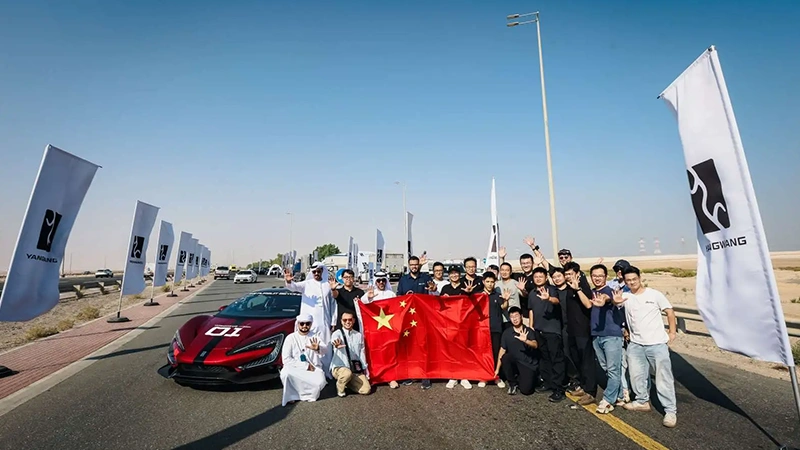
The limited run of only 30 cars keeps the U9 Xtreme firmly in the realm of statement machines rather than products that move volume.
Its real value lies in the public demonstration that an electric powertrain can dominate even the most traditional measures of automotive performance, taking a title long held by combustion-engined hypercars.
When the onboard videos, official graphics, and the 503.17 km/h figure spread across social feeds, the discussion quickly expanded beyond one Chinese brand into broader questions about what the next generation of hypercars will look like and which companies are now capable of setting the standards.
It is worth noting that a world record of this kind does not dramatically lift overall sales.
The U9 Xtreme itself will sell in tiny numbers at a multi-million-dollar price, and any commercial benefit arrives indirectly through improved brand perception rather than direct orders.
At the same time, BYD's after-sales reputation remains a recurring weak point in many overseas markets.
Inside China the company benefits from massive scale and dense service coverage. Abroad, parts lead times, workshop capacity, and customer support have often lagged behind rapid sales growth.
BYD is expanding dealer networks and local parts supply in several countries, yet the existing reputation for slow repairs and limited availability is still a genuine limitation outside its home market.
A top-speed record strengthens the technical image, but does not shorten service wait times or guarantee parts are in stock when owners need them.