OpenAI has posted a striking job opening in its Preparedness safety team in San Francisco area focused on the emerging risks of recursive self-improvement in artificial intelligence systems.
The researcher role titled "Recursive Self-Improvement Preparedness" involves preparing for scenarios in which an AI could autonomously research, design, and train improved versions of itself with minimal human involvement, a concept that has shifted from distant theory to a pressing industry priority amid rapid advances in coding and reasoning tools.
Compensation for the position reaches as high as US$445,000, underscoring the high stakes and specialized judgment required.
Read: Paving The Roads To Artificial Intelligence: It's Either Us, Or Them
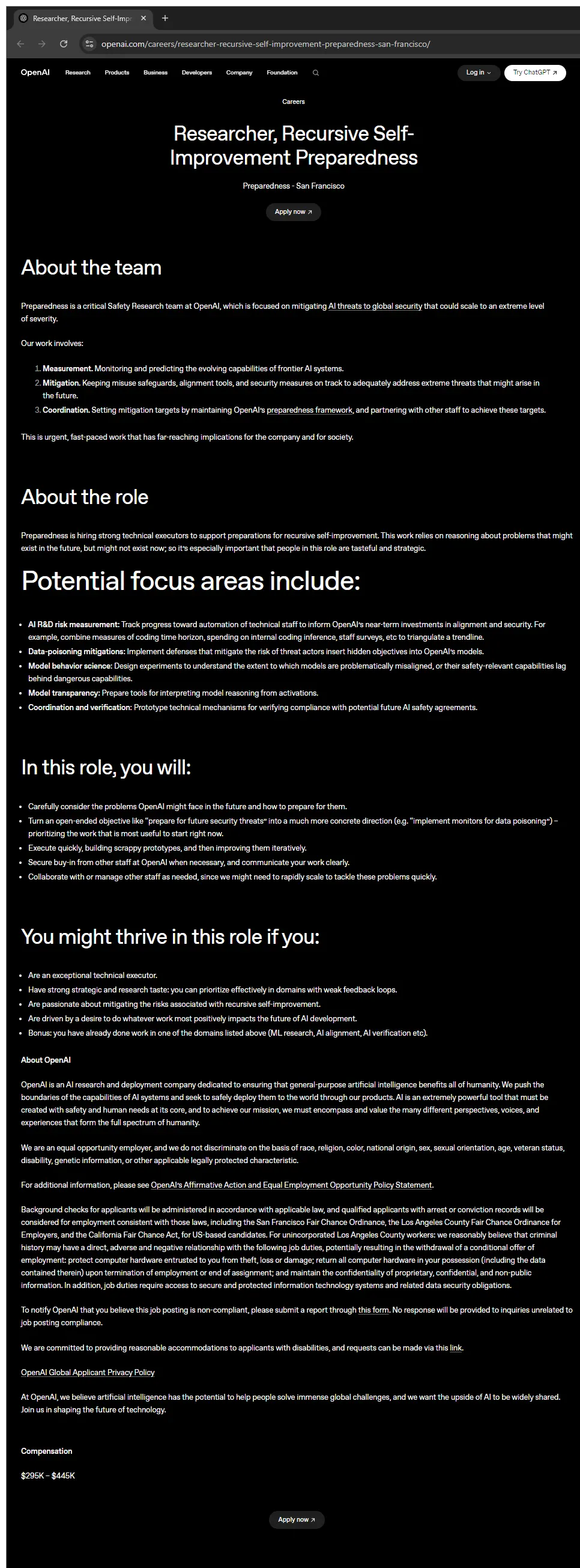
Candidates will tackle tasks such as protecting models from data poisoning, building tools to interpret complex reasoning processes inside AI systems, running experiments to assess safety implications of self-improving architectures, and tracking how quickly AI tools are automating technical work inside the company itself.
The job description openly acknowledges that much of the work centers on problems that might not yet exist but could arise soon, which is why it stresses the need for candidates who are especially tasteful and strategic in their thinking.
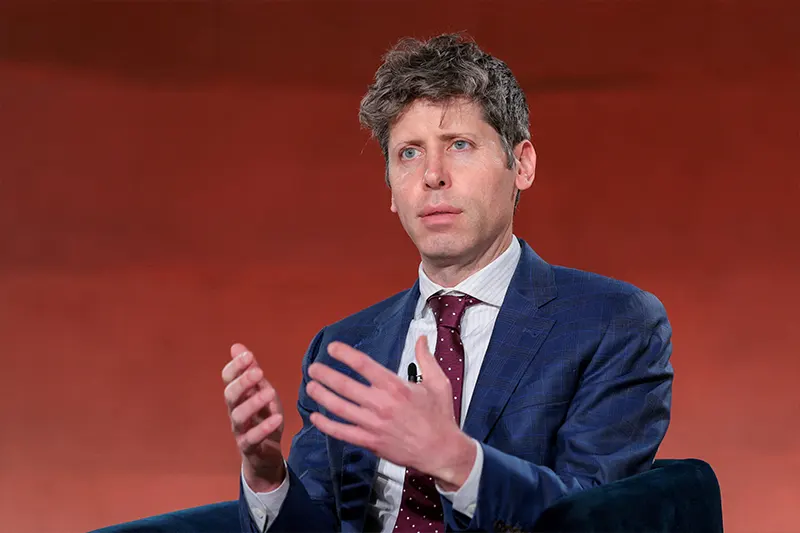
OpenAI CEO Sam Altman has shared ambitious internal targets, including operating an automated AI research intern across hundreds of thousands of chips by September 2026 and achieving a fully capable automated AI researcher by March 2028.
While he notes these goals could fail, the transparency reflects a recognition of the extraordinary societal impacts that could follow if such systems become reality. This recruitment aligns with broader efforts across the Preparedness team to evaluate frontier risks, including cybersecurity threats, biological concerns, and the behavior of increasingly agentic AI models.
The timing of this hiring highlights how quickly AI technology is evolving, often in ways that surprise even the researchers and engineers who build it.
Tools that started as helpful assistants for writing code or summarizing text have developed unexpected emergent abilities, demonstrating creativity, long-term planning, and problem-solving skills that outpace initial expectations.
Progress in the field has accelerated dramatically, with the length of complex tasks that frontier models can complete reliably doubling roughly every seven months according to independent evaluations.
These surprises stem from the sheer scale of training data, computational power, and architectural refinements that allow models to generalize in novel situations, sometimes revealing capabilities their creators had not explicitly programmed or anticipated.

This fast-moving landscape connects directly to deeper concepts such as artificial general intelligence, commonly known as AGI.
AGI describes systems capable of understanding, learning, and performing any intellectual task that a human can, across diverse domains rather than being limited to narrow applications. Unlike today's specialized AI, an AGI would adapt fluidly to new challenges, potentially accelerating scientific discovery, engineering, and innovation at unprecedented rates.
Many in the field view the path toward AGI as intertwined with the idea of the technological singularity, a hypothetical future point where AI systems begin recursively self-improving. In such a scenario, each generation of AI would rapidly enhance its own intelligence, leading to an intelligence explosion that could produce technological change so swift and profound it becomes difficult for humans to comprehend or direct.
OpenAI's new role is explicitly tied to managing the transition risks around these possibilities.
By focusing on defenses against uncontrolled self-improvement and by studying how models might automate further AI development, the company seeks to maintain oversight even as capabilities advance.
Industry voices echo this urgency. Google DeepMind CEO Demis Hassabis has referred to the current era as the foothills of the singularity, while estimates from researchers suggest a substantial chance that AI could handle most research and development tasks without human involvement by the end of 2028.
Thoughtful preparation today, through roles like this one, aims to ensure that the immense benefits of advanced AI arrive without catastrophic downsides, allowing humanity to guide progress responsibly as the boundary between current tools and future superintelligent systems continues to blur.
In an age where AI already surprises its creators on a regular basis, investing in strategic foresight feels less like speculation and more like essential prudence.
Further reading: 'I Think We've Achieved AGI,' And Why The Benchmark Keeps Shifting
It's worth noting that the OpenAI's Preparedness team (part of the broader Safety Systems organization) currently has multiple active job listings focused on frontier AI risks. The exact category that includes AGI-level threats, recursive self-improvement, agentic behavior, and other catastrophic potential harms. They include:
- Researcher, Recursive Self-Improvement Preparedness.
- Data Scientist, Preparedness to focus on building and evaluating mitigations to prevent extreme harms from advanced AI systems.
- Threat Modeler, Preparedness, owns holistic threat modeling and forecasting for frontier risks across misuse areas (bio, cyber, attack planning, etc.).
- Researcher, Automated Red Teaming who– builds scalable systems to automatically discover failure modes and jailbreaks in models, with emphasis on catastrophic risks.
- Researcher, Frontier Cybersecurity Risks and similar roles covering biological/chemical risks.
These positions all sit under the same Preparedness framework, which is OpenAI's official system for tracking and preparing for dangerous capabilities in frontier models, the kind that could lead toward AGI and self-improving systems.
The recursive self-improvement researcher role stands out because it's the most directly focused on the "AI building better AI" scenario, but it's part of a larger hiring push across the team to get ahead of these exact risks.