YouTube has become toxic in a way that it became a haven for trolls and fake information.
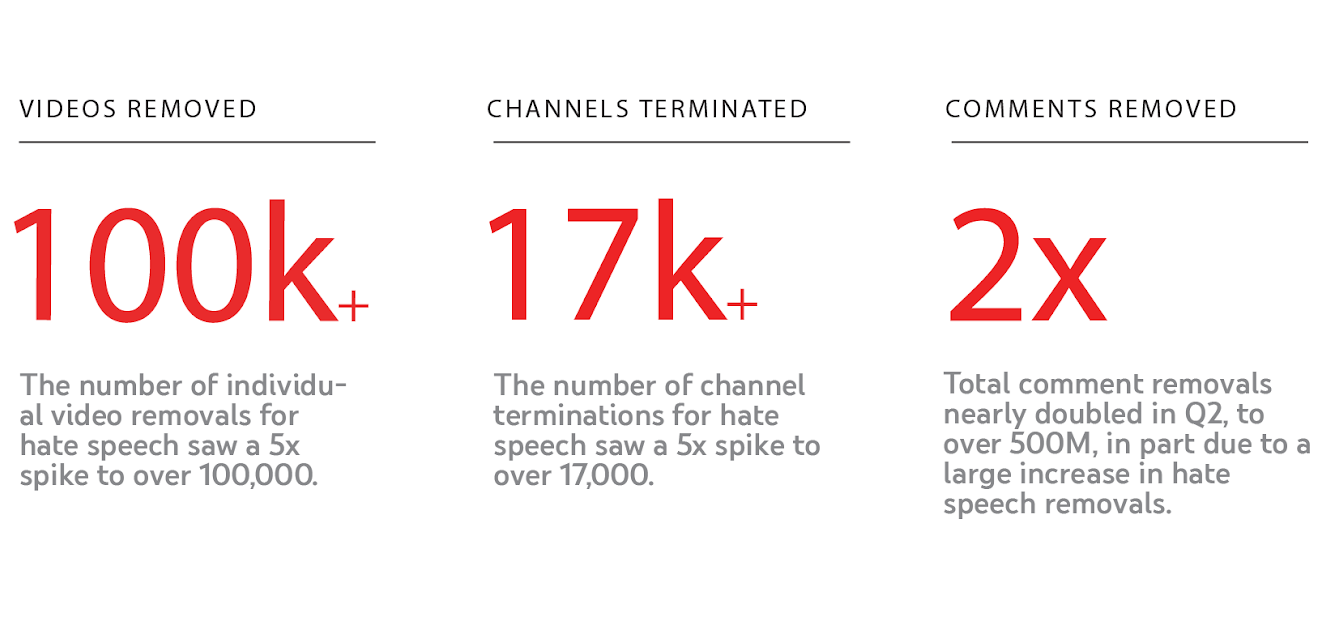
After CEO Susan Wojcicki announced the 'Four R's' to defend YouTube's openness by keeping order, the company claimed to have removed over 100,000 videos and 17,000 channels specifically over hate speech.
YouTube “specifically prohibiting videos alleging that a group is superior in order to justify discrimination, segregation or exclusion based on qualities like age, gender, race, caste, religion, sexual orientation or veteran status.”
It also added it’d be removing videos glorifying Nazi ideology, and those that denied “well-documented violent events.”
YouTube continued its announcement, by saying:
"We spent months carefully developing the policy and working with our teams to create the necessary trainings and tools required to enforce it. The policy was launched in early June, and as our teams review and remove more content in line with the new policy, our machine detection will improve in tandem."
"Though it can take months for us to ramp up enforcement of a new policy, the profound impact of our hate speech policy update is already evident in the data released in this quarter’s Community Guidelines Enforcement Report:"
In the past, YouTube as attempted to defend its laxness with regards to objectionable content by pointing out how large the site has become.
For example, Google CEO Sundar Pichai once said during the introduction of YouTube hate speech policies, "YouTube has the scale of the entire Internet."
But with that, YouTube only had 10,000 people, who review videos for objectionable content. Given that YouTube has grown so massive, with hours of videos uploaded to the platform every single second, that human team and algorithms were still incapable of policing the whole ecosystem.
Regardless the situation, YouTube is improving on its ability to remove hateful contents before their reach a broader audience, saying that "technology deployed over the last several years has helped us to remove harmful content from YouTube more quickly than ever before".
On the post, YouTube also "highlights how human expertise is still a critical component of our enforcement efforts, as we work to develop thoughtful policies, review content with care, and responsibly deploy our machine learning technology."
"The future of this platform: openness and how we balance that with our responsibility to protect the community," said Wojcicki on her 2019 YouTube quarterly report on August 27th.






















































































































































































































































































