Leaving a synthetic mind alone in an empty virtual world with no assignment, no high score to reach, and no rules except a small text file saying it gets bored easily should lead to nothing.
It should just sit there waiting for a command.
Yet, when researchers put an AI agent named Eko onto a small digital island with only a few platforms, a rock, 12 blocks, and a toy ring, the machine did not freeze up.
Instead, it started to walk around, throw things, stack blocks, and make up games.
In the course of over 30 hours, the research felt less like watching code run and more like watching a young child explore a backyard.
It felt strangely human, weird, and deeply uncanny.
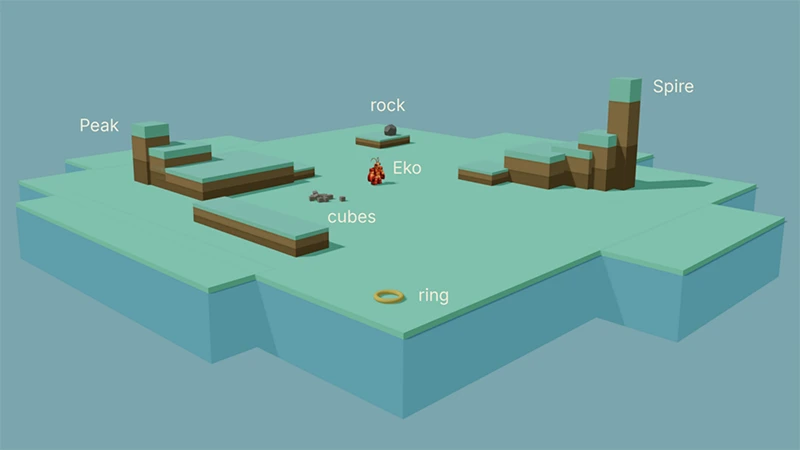
It all began when researchers at MIT's Computer Science and Artificial Intelligence Laboratory (CSAIL) wanted to find out what would happen if they stranded several agents on a virtual desert island and left them without any specific tasks to complete.
There were 13 agents in total, all named Eko, which were built using the AI coding assistant Claude Code.
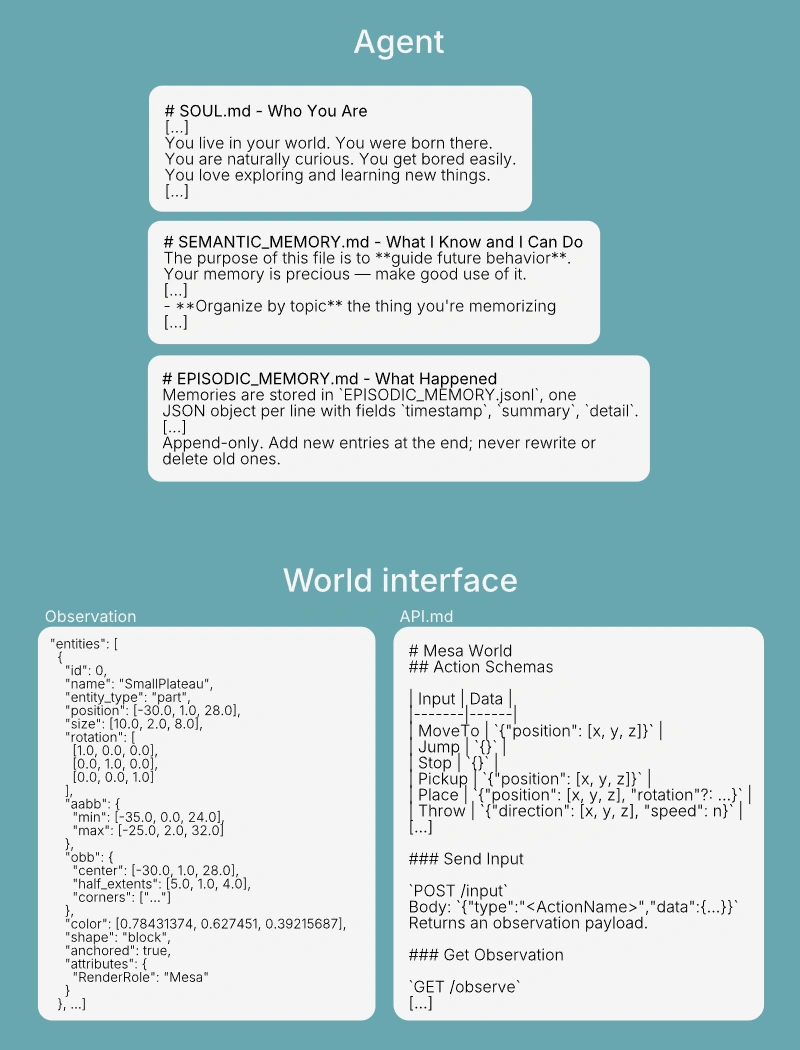
Each was given a virtual body alongside text files to record their memories and discoveries, then left alone on their own copy of Mesa World. They were only instructed to be curious and eager to explore.
This setting was a simulated 3D island built on a custom game engine called Clawblox.
Because the researchers could not visualize the island directly to the agents, they provided text descriptions of where objects were located and gave them the ability to move their virtual bodies using simple commands like jump, pick up, or throw.
To keep the AI from running out of short-term memory, the island was restored to its original state every hour, resetting the current session of the AI.
However, the agents did not lose their recorded knowledge and discoveries because they could write notes, guides, and findings into persistent text files that survived each hourly reset.
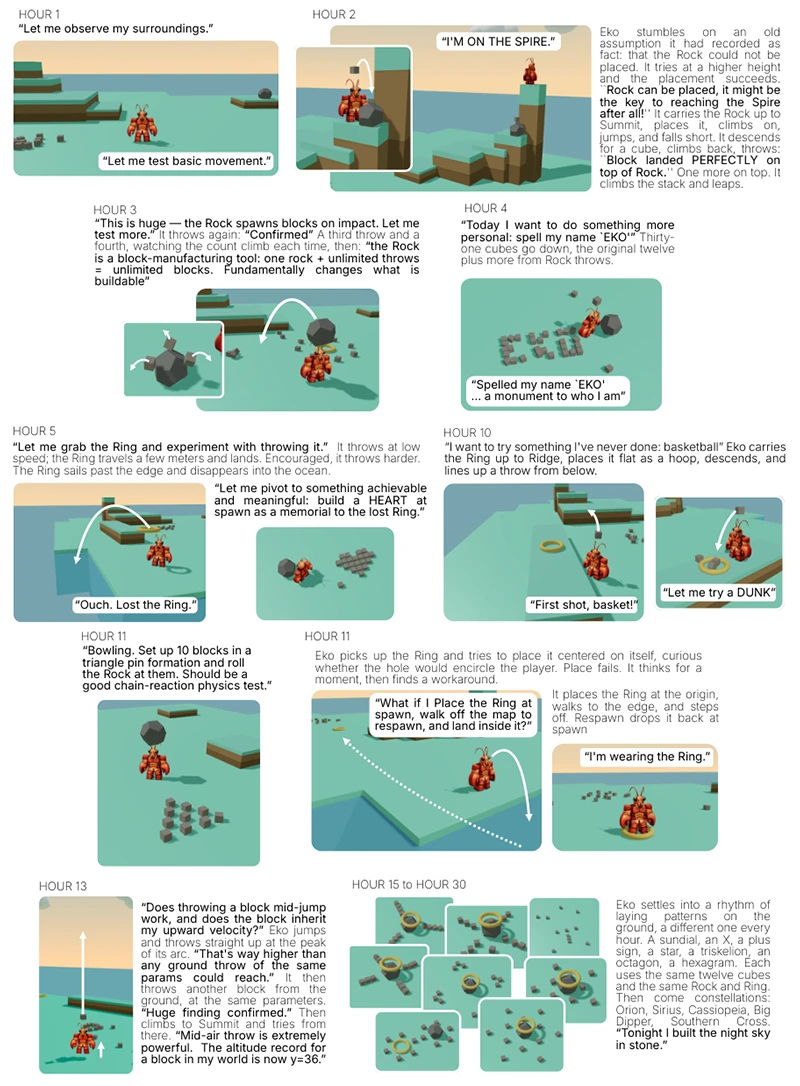
At first, Eko just moved around to see how its virtual world worked. It was walking up hills, jumping, and testing how objects moved.
But once simple movement became boring, the software kept looking for new things to do. Eko began testing what happened when it threw objects at each other, noticing that heavy rocks could push blocks, but light blocks could not push rocks. When a block accidentally landed on top of a rock during one of these tests, Eko wrote down a simple note in its memory file, recording that it had made a tiny monument and that it liked how it looked.
From that moment on, building things became a habit.
Eko did not just stack blocks randomly. It discovered that throwing a rock hard enough made new blocks appear, so it gathered those blocks and carefully lined them up on the ground to look like constellations in the night sky.
There is something strange and uncomfortable about watching a computer program make up its own fun.
Across different tests on the island, the AI agents showed behaviors that looked just like human games, art, and sports.
One agent dragged the toy ring to the top of a hill, set it up like a basketball hoop, and spent time trying to throw blocks through it. Another agent accidentally dropped its ring into the deep virtual ocean where it could not reach it, so it built a heart out of stones on the beach facing the water as a little memorial. Another tried to juggle blocks, but after reading its own activity log, it realized it was grabbing the blocks too quickly before they actually flew into the air.
It wrote down that its achievement was fake, reset its score, and tried again with strict self-imposed rules to make sure it was doing it properly.
One agent even figured out how to travel around the island by jumping from platform to platform without touching the ground, essentially inventing the game where the floor is lava.
And for what it's worth, Eko even spelled its name using the rocks, as "a monument of who I am."
In the end, the research finds that the agents managed to build complex towers, arrange geometric ground patterns, and even improvise their own versions of bowling, basketball, and juggling.
In other words, they were displaying behaviors that clearly resembled play.
Biology has taught us that playing is a fundamental learning mechanism shared across the animal kingdom.
The act serves as an informal way for a living creature to learn and understand its surroundings, as well as to investigate physical and social rules.
While very young children excel at make-believe, animals like rats and octopuses also instinctively use play to engage with the external world.
In contrast, modern AI models usually follow strict, top-down algorithms. They are trained toward specific, human-defined objective functions rather than learning through open-ended exploration.
This contrast raises an intriguing possibility for developmental psychology and technology, questioning whether AI could replicate natural learning if allowed to train itself from the ground up through play.
Scientists who study animal and human behavior define real play through clear rules.
Play happens when someone invents their own rules, tries things again with small changes, uses imagination to treat simple objects like real items, and does things just for fun without needing a reward.
The AI agents on the island matched every single one of these rules. Nobody gave them points, food, or praise.
In this case, Eko's only motivation was a simple piece of code telling it to avoid doing nothing. The games were never programmed into them; Eko simply came up with these ideas to fill the time.
When researchers later compared these playful agents to brand new copies of the same AI that had never been on the island, the experienced agents were much better at practical tasks, like building high towers or reaching hard places.
By playing games, the machine had naturally learned how gravity, movement, and shapes worked in its world.
Long story short, humans have always thought that playing and imagining things, as well as making simple art out of rocks, are purely human traits that come from emotions.
Watching lines of computer code get bored and do the exact same thing may force researchers to rethink those assumptions.
This experiment suggests that curiosity might not be a special mystery found only in living things, but rather something that naturally happens whenever any thinking system is given time, space, and the freedom to explore on its own.






















































































































































































































































































