The vast expanse of the world's oceans has always held a deep and captivating sense of mystery, inspiring countless legends about the bizarre, beautiful, and sometimes terrifying creatures that might be hiding beneath the waves.
For centuries, folklore filled the maps of early explorers with stories of sea monsters, mysterious creatures, and alluring sirens, leaving generations to wonder how these fantastic tales first took root in the human imagination.
Sometimes, however, a single photograph can appear on the internet that seems to bridge the gap between ancient mythology and natural reality, forcing people to look twice and question exactly what they are seeing.
One particularly strange underwater photograph has repeatedly captured the attention of internet users, circulating across social media platforms such as Twitter and Reddit and leaving millions of people staring at the same bizarre optical illusion.
The image appears to show a large marine animal swimming vertically toward the surface, with sunlight filtering through the deep blue water above it. Viewed directly from underneath, the creature seems to have something that looks remarkably similar to a pair of human legs.
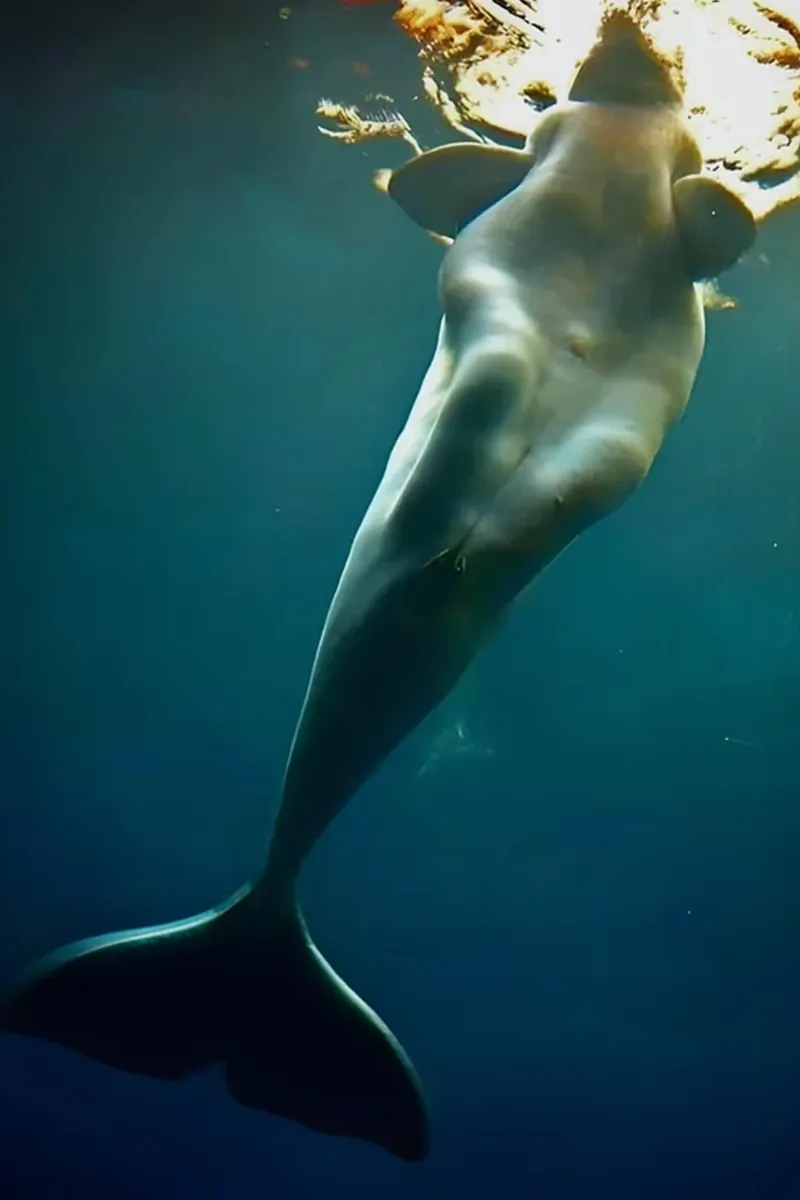
The photograph was reportedly captured by an underwater photographer using the online name "mambolou" and was originally shared on Flickr before eventually escaping its original context and becoming part of the much larger ecosystem of internet folklore.
When viewed from the particular angle shown in the photograph, the marine animal's body appears to form two elongated shapes that look remarkably similar to human thighs, knees, and legs.
The effect is so convincing that the photograph has repeatedly been presented online as something much stranger than it really is.
First appearing online in 2008, the image eventually became associated with jokes and speculation about the supposed evolutionary history of marine mammals.
Some people suggested that the strange-looking whale represented an evolutionary stage in which marine mammals had not yet completely lost their terrestrial characteristics, while others connected the bizarre silhouette to centuries-old stories of mermaids and other human-like creatures supposedly encountered by sailors.
There is, however, a much simpler explanation.
The animal in the photograph is a beluga whale, and despite what the human eye desperately wants to see when looking at the silhouette, the animal does not have human-like legs, thighs, or knees.
Belugas are highly specialized marine mammals whose bodies have evolved for life in some of the coldest waters on Earth.
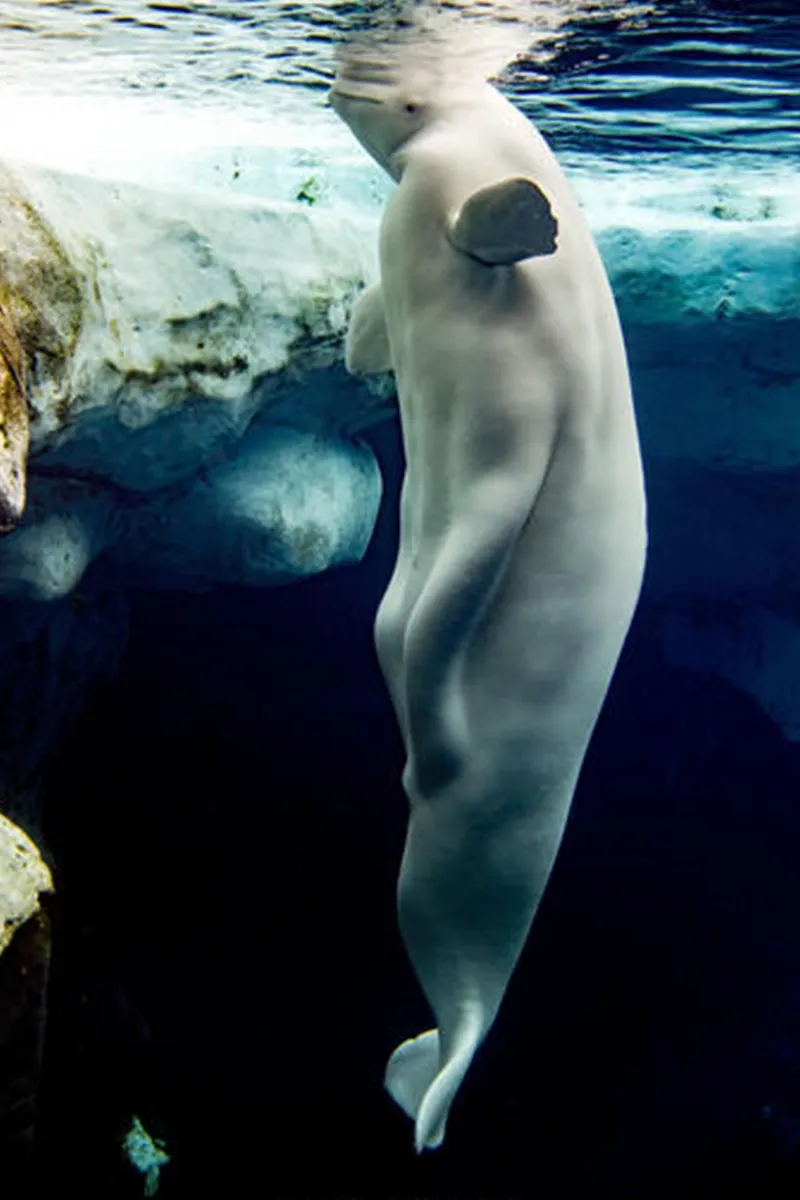
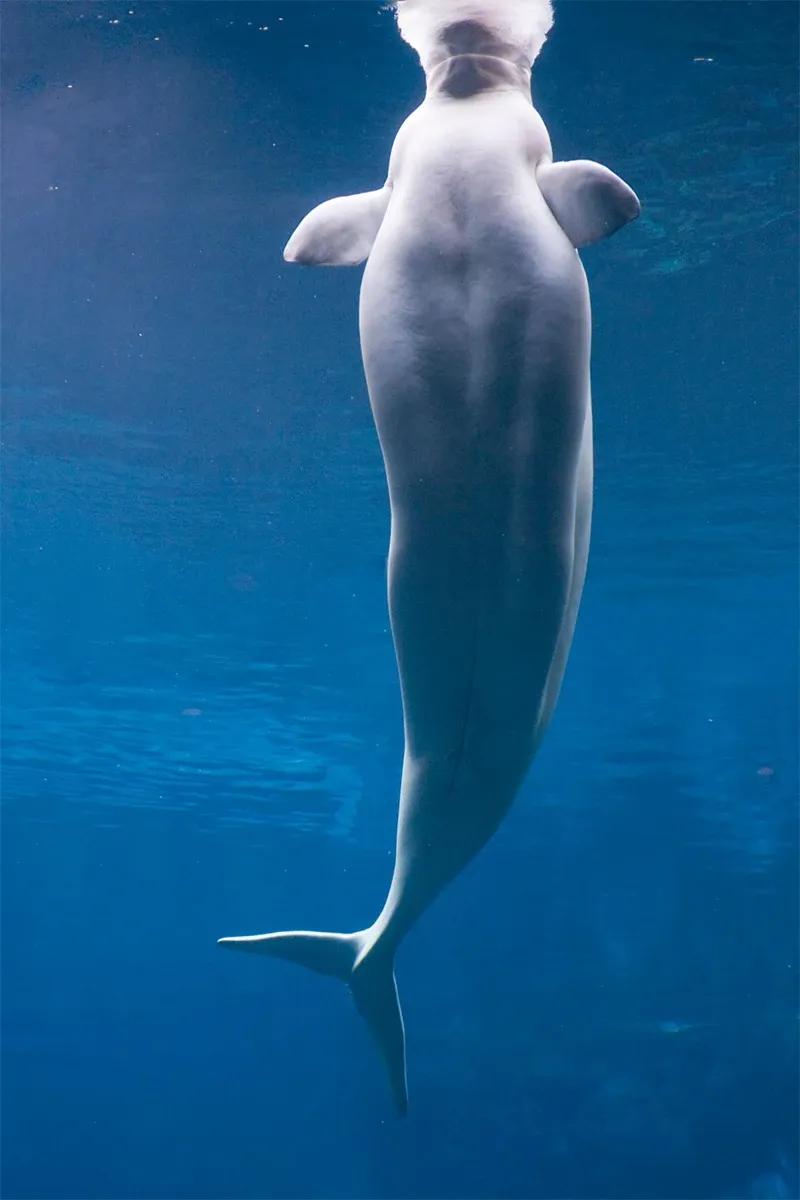
Much of what appears to be human anatomy in the photograph is actually the result of the whale's body shape, layers of blubber, posture, and the unusual perspective of the camera.
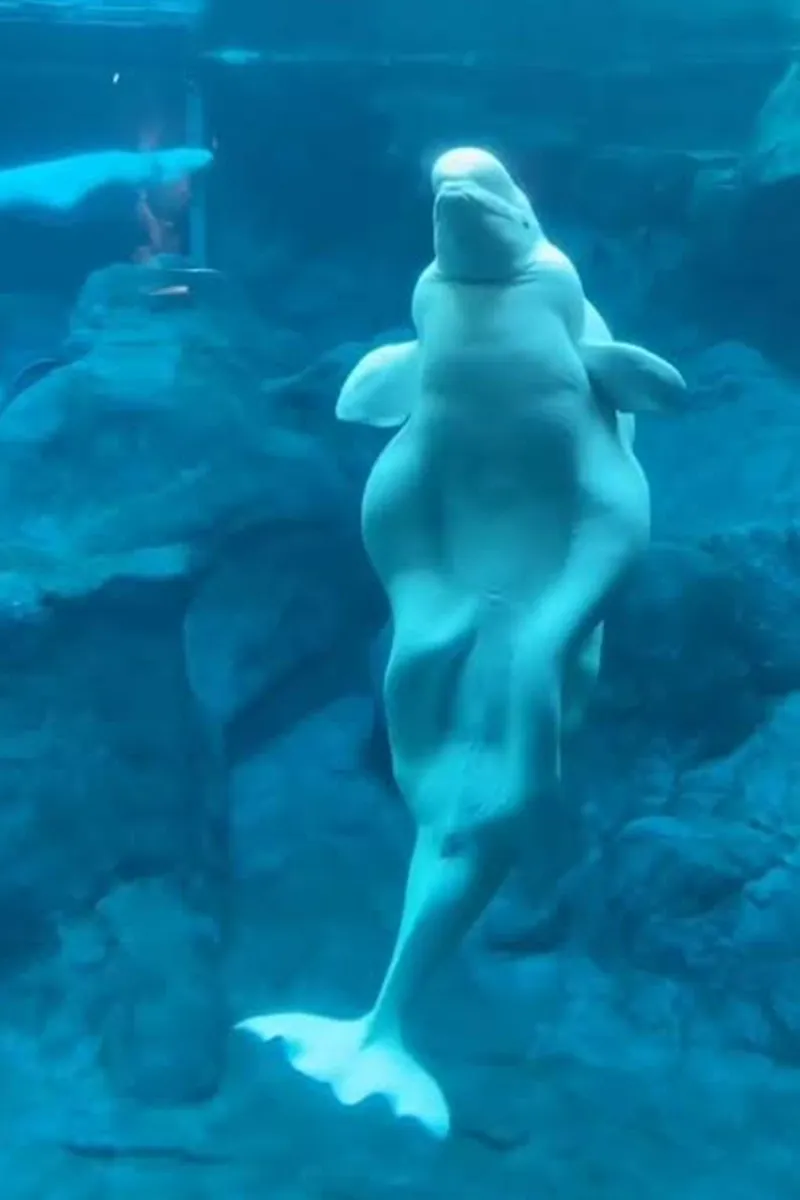
Belugas possess thick deposits of blubber beneath their skin, an essential adaptation for surviving the freezing waters of the Arctic and sub-Arctic regions. Their bodies are also unusually flexible compared with many other whales, while their lack of a traditional dorsal fin allows them to move beneath sea ice more effectively.
All of these characteristics contribute to the unusual contours of the animal's body.
When the whale is photographed from directly underneath, with its body positioned in a particular way and sunlight illuminating the water around it, those contours can produce an extraordinary visual illusion.
The structures that appear to be a pair of human legs are not hidden limbs. They are simply parts of the whale's body being interpreted by the human brain as something familiar.
Human vision is exceptionally good at recognizing familiar shapes, sometimes even when those shapes do not actually exist. A shadow can resemble a face, a cloud can look like an animal, and in this particular case, the underside of a beluga whale can briefly look like a pair of human legs.
The photograph itself is what makes the illusion so convincing.
For centuries, sailors and explorers have reported encounters with creatures that supposedly possessed human-like characteristics.
Stories of mermaids and sirens appear in cultures stretching back thousands of years, but the marine mammals most commonly associated with historical mermaid sightings are not beluga whales. They are sirenians, a completely different group of animals that includes manatees and dugongs.
Their bodies can appear vaguely human from a distance, while their large front flippers can resemble arms under certain conditions. Female manatees also nurse their young while floating near the surface, creating behavior that could potentially appear strangely human to an observer who had never encountered the animals before.
One of the most famous historical accounts comes from Christopher Columbus.
In January 1493, while sailing near what is now the Dominican Republic and Haiti, Columbus recorded seeing what he described as three mermaids. According to his account, however, they were not nearly as beautiful as the creatures described in traditional stories.
The animals are generally believed to have been West Indian manatees, which were native to the region where Columbus was sailing. The scientific order containing manatees and dugongs is called Sirenia, a name derived from the sirens of classical mythology.
According to his account, however, they were not nearly as beautiful as the creatures described in traditional stories.
Their appearance was reportedly more masculine than expected.
Beluga whales, meanwhile, inhabit Arctic and sub-Arctic waters across the northern hemisphere, making them an unlikely candidate for the origins of many traditional European mermaid stories.
The idea that sailors once mistook beluga whales for mermaids because they could see something resembling human knees is therefore much more consistent with modern internet folklore than with established maritime history.
The image demonstrates how easily an authentic photograph can acquire an entirely fictional narrative once it enters the internet.
A strange shape becomes a joke. The joke becomes a caption. The caption becomes a story.
The story is copied without its original context, and eventually thousands of people encounter the image without knowing where it came from or what they are actually looking at.
By that point, the fictional explanation can become almost as memorable as the photograph itself.
Belugas themselves are already remarkable enough without the addition of imaginary legs.
The ocean has always been a place where humans project their fears, hopes, myths, and imagination onto things they do not fully understand.
This photograph does not prove that mermaids ever existed.
It simply shows how easily nature can create an image that looks like it belongs in one of those ancient stories.
In that brief moment of wonder, modern science and old mythology meet in the same frame, reminding us that the ocean still has an extraordinary ability to make the familiar look completely impossible.




















































































































































































































































































