The internet has once again demonstrated just how quickly speculation can snowball into a global conversation, especially when it touches on high-stakes geopolitics and ongoing conflict.
At this time around, social media platforms have been flooded with claims, questions, and conspiratorial threads suggesting that Israel may be unable to confirm or deny whether Prime Minister Benjamin Netanyahu is still alive. The discussion has all the ingredients required to go viral: mystery, geopolitical tension, and the possibility of a dramatic turning point in a war already dominating international headlines.
What began as scattered posts quickly evolved into a sprawling rumor cycle.
On platforms such as X, some users claimed outright that Netanyahu had been killed during an Iranian missile or drone strike. Others adopted a more cautious tone, simply asking whether he had been injured or eliminated in a recent attack.
Screenshots, blurry video clips, and supposed "leaks" began circulating widely, each claiming to show evidence of damage to government buildings or to Netanyahu himself.
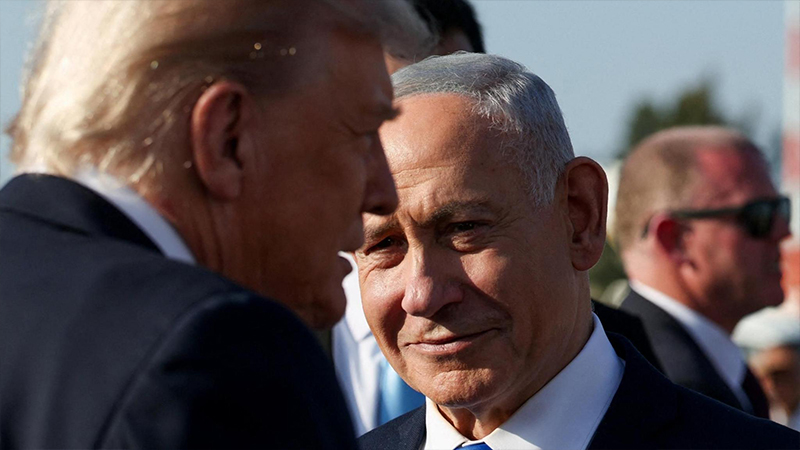
Some posts pointed to images allegedly showing the prime minister injured amid rubble following strikes on high-profile locations.
Others highlighted what they believed were inconsistencies in recent official videos released by the Israeli government.
A few particularly viral posts argued that footage of Netanyahu addressing the public must be AI-generated, claiming to spot visual anomalies such as an extra finger or irregular facial features in paused frames. Another widely shared claim suggested that the prime minister appeared to be missing teeth in the footage, fueling speculation that the person on camera was either digitally manipulated or not Netanyahu at all.
These claims have circulated in the broader context of escalating hostilities involving Israel, Iran, and the United States.
Recent exchanges of missile strikes and military operations have heightened tensions across the region, creating fertile ground for rumors and psychological warfare.
During wartime, information travels fast, but verified facts often move far more slowly than speculation.
אתמול במסיבת העיתונאים עמדתי על היעדים הברורים של המערכה: פגיעה במשטר הטרור באיראן, המשך המאבק מול שלוחותיו, והבטחת ביטחונה ועתידה של ישראל.
אנחנו לא מחכים. אנחנו יוזמים, אנחנו תוקפים ואנחנו עושים זאת בעוצמה.
צפו בדברים המלאים >> pic.twitter.com/hubJWVdiKQ— Benjamin Netanyahu - בנימין נתניהו (@netanyahu) March 13, 2026
Some Iranian-aligned accounts and state-linked commentators have amplified the narrative, presenting unverified claims as evidence of successful strikes against Israeli leadership.
In several cases, posts framed the alleged death or injury of Netanyahu as a confirmed development, despite the lack of credible sources. Meanwhile, other social media users responded with satire or sarcasm, mocking the rumors by joking that there is "no proof he's alive," a phrase that mirrors the type of carefully worded statements often issued by governments during sensitive military situations.
Accounts that monitor the conflict in real time have repeatedly pushed back against the speculation, emphasizing that there is no credible evidence supporting claims of Netanyahu’s death.


Some analysts and journalists have even taken to reminding followers not to rely on random posts or manipulated images circulating online.
Fact-checks from multiple outlets paint a much clearer picture.
According to official statements and independent verification, Netanyahu has remained active in recent days. He has issued public remarks, appeared in video statements, and held meetings with military and political leaders as the situation unfolds. Israeli officials have dismissed reports of his death or severe injury, describing them as deliberate misinformation designed to create confusion and weaken public morale during a time of war.
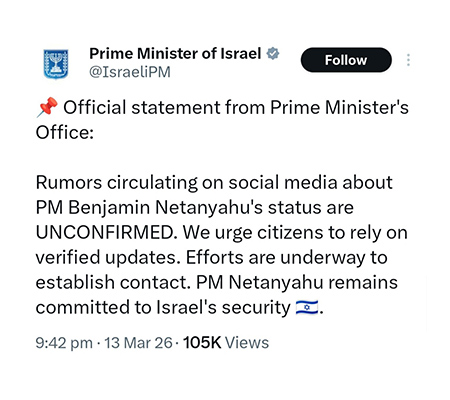
The office of the Israeli prime minister has also rejected Iranian claims as "fake news," accusing hostile actors of spreading fabricated narratives as part of a broader propaganda campaign.
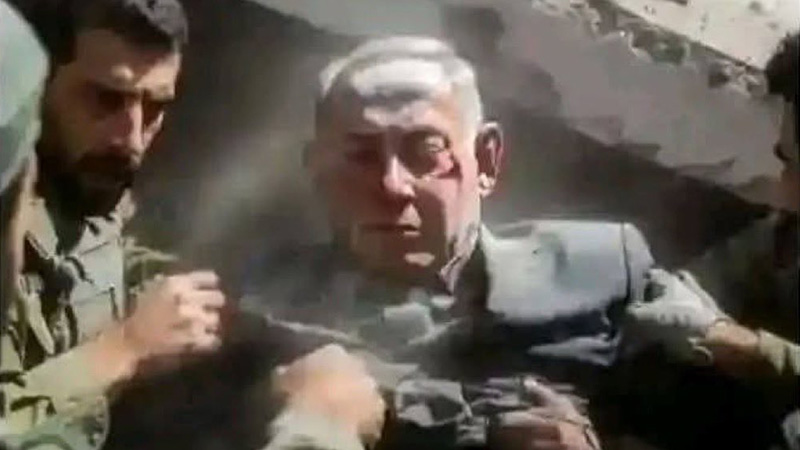
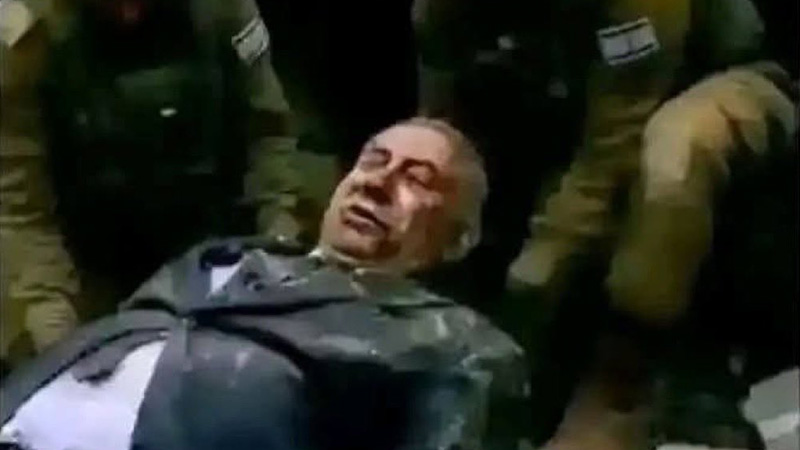
The intensity of these rumors also reflects the polarizing nature of Netanyahu himself.
As the head of Israel’s government during a period of intense regional conflict, he has become one of the most controversial (if not infamous) political figures in the world. Among critics of Israeli policy, particularly in the context of the conflict in Gaza and rising tensions with Iran, Netanyahu is viewed as a central architect of the current escalation.
For that reason, speculation about his death quickly resonates with audiences who either hope for political change or see his leadership as synonymous with the war itself.
When a figure as globally scrutinized as Netanyahu becomes the subject of even the slightest uncertainty, the internet reacts instantly. A delayed public appearance, a glitch in a video frame, or an unverified claim from a fringe account can rapidly ignite widespread speculation.
In many ways, the episode illustrates a broader phenomenon shaping modern conflicts: the battle for information.
In today’s hyperconnected media environment, rumors, propaganda, and genuine reporting often spread simultaneously, making it increasingly difficult for audiences to distinguish between verified facts and viral fiction.
Digital manipulation tools, AI, and algorithm-driven social platforms can amplify even the smallest piece of misleading content into a global narrative within minutes.
It echoes the cautious language often used by intelligence agencies and government officials, yet in this context it has taken on a life of its own, fueling endless interpretation and speculation.
Whether driven by wishful thinking among adversaries, genuine concern among observers, or simply the thrill of participating in a viral moment, the rumors surrounding Netanyahu’s supposed death continue to circulate online.
Yet the episode serves as a powerful reminder of how fragile certainty has become in the digital age. In the midst of war, where information itself becomes a strategic weapon, even a fleeting absence or a pixelated image can convince millions that something monumental might be unfolding just beyond the edge of verified reality.
A few days later, Netanyahu seemingly aware of the virality, posted a video to his social media accounts, showing him in one piece, alive and well. In the video, Netanyahu can be seen ordering a cup of coffee, and showing that both his hands have five fingers.
Despite this "proof of life," skepticism persisted in some online circles, and a lot of people still don't believe that the man is still breathing. Some suggest that the video is created by AI, highlighting how the coffee didn't spill, the text written on the cashier, the name of the coffee shop which some suggest have been closed for a long time, and so on.
These claims fueled further memes and debates across platforms like X, Reddit, and even got amplified when some AI tools (including early responses from chatbots) labeled it suspiciously. However, mainstream reporting from sources like Reuters, Hindustan Times, and CTV News treated the video as authentic, with no credible evidence of fabrication emerging. Reuters even cross-verified the café interior against known photos.
The episode highlighted how quickly conspiracy theories, often seeded by adversarial sources like Iranian media, can spiral in the age of easy AI suspicion, turning even a mundane coffee run into global fodder for doubt.
Tehran ealier said that it would kill Netanyahu as the U.S.-Israel war on Iran continued to threaten oil supplies in the Gulf.
"IRGC vows to pursue and kill 'child-killer' Netanyahu if he is still alive," Iran's state-backed IRNA news agency said in a post on X, referring to the country’s Islamic Revolutionary Guard Corps. Rumors that the Israeli leader was dead circulated over the weekend, prompting his office to issue a statement calling the reports "fake."
IRGC vows to pursue and kill ‘child-killer’ Netanyahu if he is still alivehttps://t.co/26zvSIIP3Q pic.twitter.com/XmUkSJld4Y
— IRNA News Agency ☫ (@IrnaEnglish) March 15, 2026














































































































































































































































































