What happens when someone owns a car company, a rocket company, and a social media company?
In the case of Elon Musk, he owns those, and more. And in his case, the billionaire produces a nighttime demonstration at SpaceX's rocket test site in McGregor, Texas, where a next-generation Tesla Roadster drives upside down along an inverted ramp, launches into the air, executes a mid-air roll that the company calls a kickflip over a lineup of its own vehicles including a Semi, and records a thruster-assisted 0-60 mph sprint in 0.81 seconds.
The event, livestreamed on October 15, 2026, was staged outdoors in front of an audience and later amplified across X.
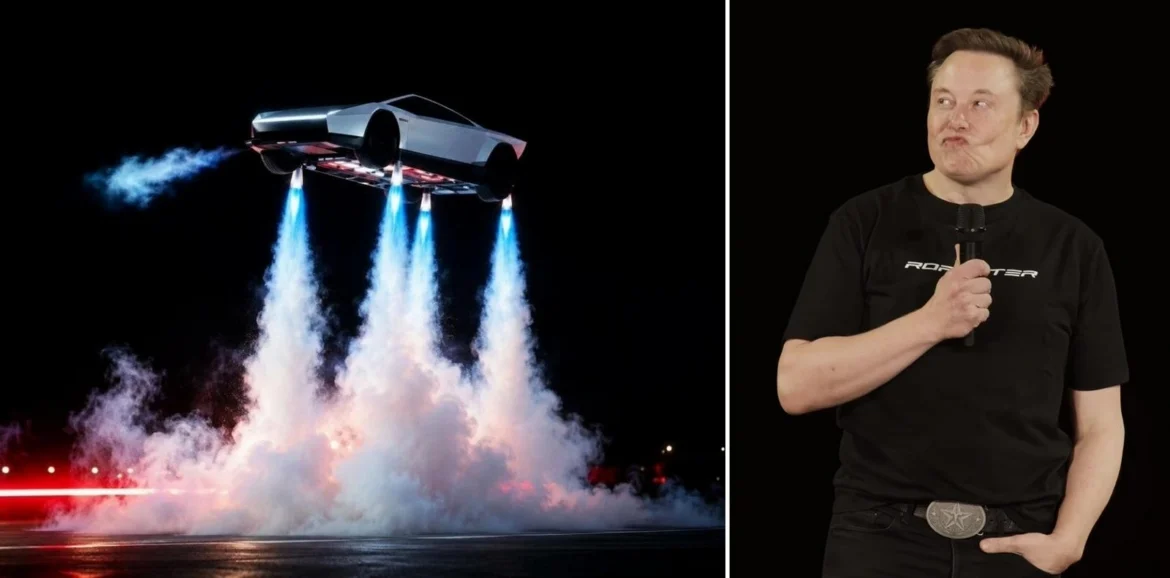
The car, operating under remote control with no human driver aboard, first used a multi-mode suction fan system mounted underneath to generate enough downforce to remain attached while inverted and even stationary.
It then relied on SpaceX-derived cold-gas thrusters, fed from carbon-fiber overwrapped pressure vessels holding roughly 600 liters of compressed air, to rotate itself upright and cushion the landing.
A separate run sent the vehicle airborne over the assembled Teslas before it rolled and touched down.
Tesla later posted the 0.81-second acceleration figure, noting 0.67 seconds once rollout was subtracted, and stated that production versions should improve on the result.
These capabilities are not incidental.
The extreme flight and flip hardware belongs primarily to the Rocket configuration, a single-seat variant that replaces the passenger space with additional gas storage and is listed as invite-only and not approved for public road use.
The Thrust version adds rear thrusters for acceleration bursts, while the Performance trim remains a two-seater road car equipped with active aerodynamics and the suction system.
Across the lineup Tesla has prioritized mass reduction, targeting a curb weight under 1,700 kilograms through magnesium, titanium, and carbon-fiber construction, seats molded into the chassis, fixed seat positions, and by-wire controls.
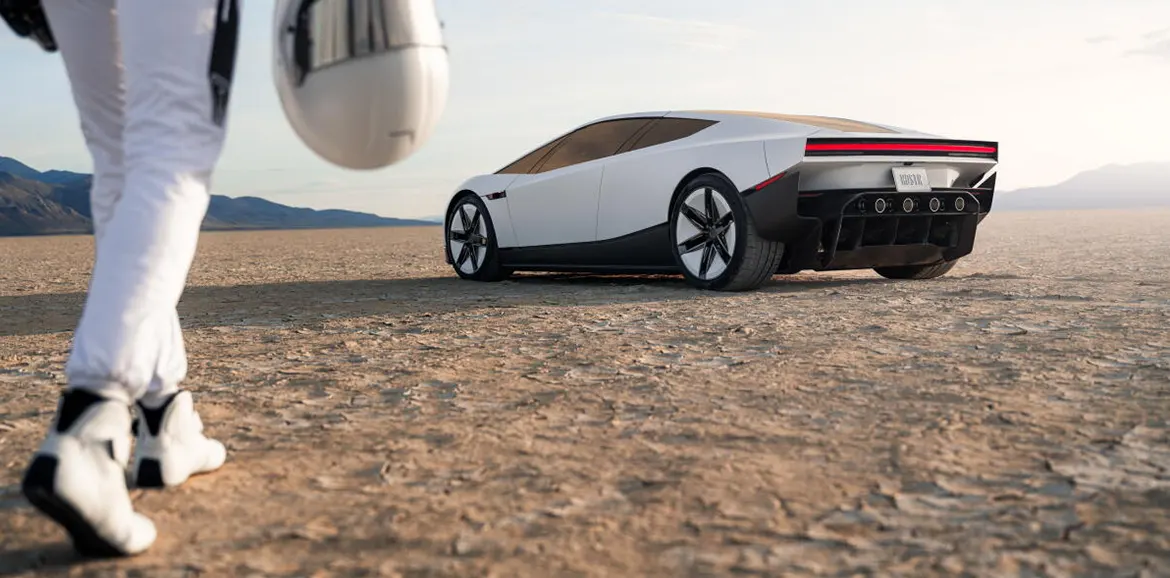
Engineers have said the shorter range target of more than 300 miles, down from the 620-mile figure promised in 2017, was a deliberate choice to keep the car light.
The dual rear motors and roughly one-megawatt output further favor rear-wheel drive for packaging and response. In short, the demonstrator was engineered with the SpaceX package and weight savings in mind so that the stunts could be performed at all.
On the same day, unveiled its Mission S concept in New York, a mid-engined vision model positioned above the 911 and intended to preview a permanent super-sports-car platform.
The company described it as a design direction that could accommodate internal-combustion or hybrid powertrains, with no battery-electric version planned, and emphasized driver connection and recognizable brand identity.
The announcement received coverage as a strategic realignment, yet it did not dominate the same volume of online conversation.
Musk’s companies can stage a demonstration that treats rocket hardware and automotive engineering as interchangeable tools for spectacle.
The result travels instantly across the platform he controls and generates discussion far beyond the still-unpriced, 2028 production timeline of the Roadster itself.
Whether the thrusters ever appear on a customer car remains limited by regulation and practicality, but the sequence of images and claims has already circulated as evidence that the boundary between road vehicle and short-range rocket is being tested in public.
Within roughly 48 hours, the demonstration’s reach extended well beyond Tesla's own channels.
Other brands began treating the Roadster's inverted-ramp and thruster maneuvers as shared cultural material. McDonalds France posted an image of a drive-thru mounted on the roof of a restaurant with the caption "on est prêts #tesla," while other markets showed inverted or elevated McDrive setups.
IKEA Taiwan (and additional IKEA markets) published a setup using a Brokglim towel as a curved "road" and LILLABO wooden toy cars, captioned "Real life, baby. Safe, affordable." FlixBus, Deutsche Bahn (showing an ICE train with thrusters), Lidl, and several others released comparable thruster or flying-vehicle parodies. These posts were not coordinated; they were rapid, local responses to footage that had already saturated feeds.
From Fevicol, Rapido to Domino's and lots more, continue to piggyback the hype. Lidl Germany, Hornbach, and Deutsche Bahn also adopted the idea. Their Instagram posts featured, among other things, an iron, a hardware store van, and an ICE train, each equipped with the distinctive nozzles of the new Tesla.
The aggregate viewership claim of "over 10 billion views across social media" originates from a post by Tesla investor and commentator Sawyer Merritt. The figure is not independently audited.
The sequence illustrates what becomes possible when the same person controls the vehicle, the rocket-derived hardware used in the demo, and the platform on which the footage first circulated.
In practice, the demonstration operated on two levels: it offered a visible proof-of-concept for short cold-gas maneuvers on a road car while also testing, in public, how far the boundary between vehicle and brief rocket can be pushed.
More than a conventional product reveal, it functioned as a demonstration that ownership across the car, the thrusters, and the distribution channel can still generate attention by staging, even for a few seconds, something that appears to step outside ordinary automotive limits.






















































































































































































































































































