 The social network Facebook‘s instant messaging service, Messenger, isn't just a place for chatting and sending smiley faces or photos anymore. On March 17th, 2015, the company is announcing a feature in which users can send money instantly to friends.
Starting in the U.S., the Messenger app can be linked to users' debit cards so they can send money to others just as easy as they send snapshots or text messages.
The feature is highly anticipated by Wall Street, especially after Facebook hired PayPal's President David Marcus to be its Vice President of Messaging Products. With Facebook's massive number of users, influence and reach, the introduction of the payment feature is Facebook's answer to peer-to-peer payments.
By using debit cards to handle the transfer, money can move fairly quickly between the two bank accounts while allowing Facebook to offer the service free to users.
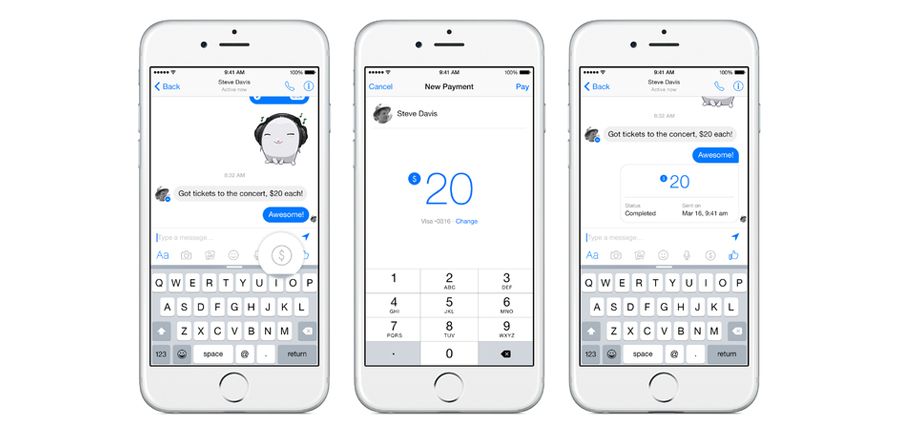
To use the money transfer feature, right next to the Like button on the Messenger screen above the keyboard, there's a dollar-sign "$" icon which opens a payments screen where users can type the amount they wish to send. If the user's debit card number is already saved in the app, they can send money to the others in the conversation by just clicking the dollar sign and entering an amount.
Since Facebook keeps the payment and conversation in one message, the company is trying to make the threaded message to serve also as a record. As both users see a confirmation message detailing the transfer status and time, the whole conversation can be saved for later reference. Users can also see the Payments History section by accessing the Messenger's settings.
To reduce the risk of unauthorized transactions, Facebook said, users must enter a PIN or use Apple's fingerprint identification system before they can send any money. For further protection, in case anything looks weird, Facebook will ask users some extra financial security questions before initiating the transfer. Users can opt-out of this extra authentication in the settings.
Initially, the service is limited to sending money between people who are Facebook friends. This makes it not competing directly with Apple Pay and the likes that offer mobile payment system allowing people to purchase things with their devices.
Any money that is wished to be transferred through Messenger, is held by Facebook before sending it along to other user. Facebook, holds the money for "seconds" before sending it along to the other user's bank account, according to Facebook Product Manager Steve Davis. If the recipient doesn't have a card attached to his or her account, Facebook will hold the money until they've set one up.
Instant Messaging: Putting All Talks in One Place
Instant messaging has eaten away emails to become the preferred form of electronic communication. Especially for the younger generations.
Facebook's Messenger app is one of the largest platforms in the world, with more than 500 million monthly users. And if that isn't enough, in 2014, Facebook acquired WhatsApp, a separate messaging platform that has 700 million active users and counting.
In the U.S., a host of peer-to-peer money transfer services have emerged and are trying to capture the wallets of messaging enthusiasts. Facebook's new feature in Messenger is making it compete directly with other similar services, such as Venmo, a mobile payments app owned by PayPal, Square and even Snapchat, which rolled out a similar pay-through-text service in November 2014 called Snapcash.
Mark Zuckerberg, Facebook's CEO and founder, said that he expects Messenger and WhatsApp to be contributing much more to Facebook's platform.
"I'm a big fundamental believer that these are going to be very big contributors to our businesses over time, but we just have to do it right," he said.
But since Facebook is making much money on advertisements, it doesn't need to monetize payments directly. With the service, Facebook just wanted to simplify the process as much as possible, according to Steve Davis.
The initial goal for the feature is to make more people use Facebook, and make Messenger as helpful as possible. "We're not building a payments business here," said Davis. The goal is to offer P2P payments for free to make Messenger "more useful, expressive and delightful."
People have used instant messaging more than often to chat with others. And as people use these platforms more, there are times when conversations lead to money. And that also happens on Messenger.
"Conversations about money are already happening on Messenger," said Davis. People chat about splitting bills or others, for example. "What we want to do is make it easy to finish the conversation in the same place you started. You don’t have to switch to another app."
"We know that conversations about money are happening all the time," he explained. "But most conversations begin in one place and end in another place."
"We realized that there were all these conversations [on Messenger] that were forced to go somewhere else in order to actually finish," he continued. "You had to go to another platform to actually pay another person."
"It's obviously not a feature you're going to use 10 times a day, but when you do need to send money, this is probably going to be the best way to do it."






















































































































































































































































































