In the ever-evolving landscape of AI, designing something to represent it presents a unique challenge, and Google Google likens it to uncharted design territory.
Since ChatGPT debuted by OpenAI and others followed, Google was one of the very first that was shocked in disbelief.
It scrambled fast, and it responded with Gemini. Whereas OpenAI opts for a darker-toned colors, Google is taking quiet the opposite.
According to Google in a post on its website, its design language for Gamini echoes the groundbreaking work of Susan Kare in 1984, when she crafted the original Macintosh graphical user interface. Using simple visual metaphors, she made abstract digital processes tangible and intuitive for new users: a trash can, a paintbrush, a smiling computer face.
Her icons weren’t just pixels; they were bridges between human understanding and machine logic.
But to design Gemini's interface, Google faced a similar challenge around accessibility, visibility, and alleviating potential concerns.
This stems in part from its always evolving nature and the general conceptual gaps around AI.
How do make Gemini invite users to explore, play, and interact confidently with a tool that constantly learns and adapts? Google's design team set out to make Gemini feel intuitive, immersive, approachable, aspirational, and, above all, trustworthy.
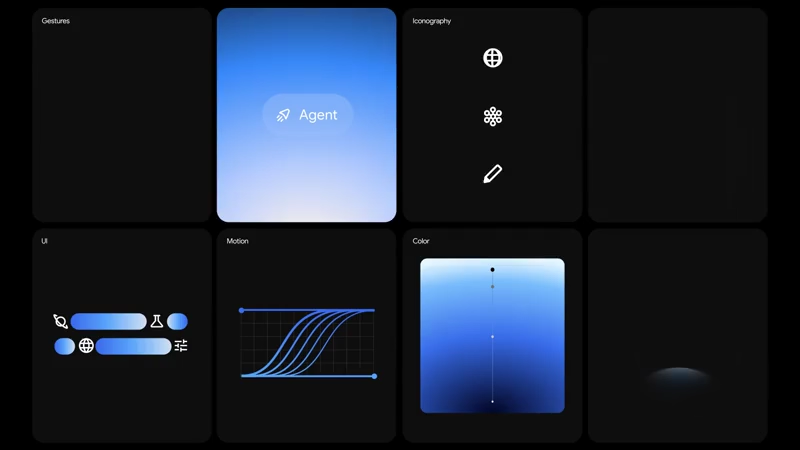
Google's eequivalent of Kare’s smiling computer face, is a design that focuses on gradients, which animates to gently guide users into the new collaborative world with Gemini and offer an amorphous, adaptable approach.
Gradients might be much more about energy than “objectness,” like Kare’s illustrations (a trash can is a thing, a gradient is a vibe), but they infuse a spirit and directionality into Gemini.
In Gemini, gradients are used to “…convey a transfer of energy and directional momentum, they feature sharp, almost opaque leading edges that diffuse at the tail, acting as clear visual pointers to direct user attention toward what’s most important.” They also “…make the system feel alive, our designers wanted to visualize Gemini’s process of active thinking and synthesis, which helps personify the AI assistant rather than rendering it impenetrable.”
Prominent examples shine through in Gemini Live, the interactive Android overlay, and the app's iconic sparkle emblem itself.
These elements bring the gradients to life, turning static screens into responsive, breathing experiences.
The design philosophy extends beyond color alone.
There's a deliberate focus on the fundamental shape of the circle, chosen for its connotations of simplicity, harmony, and comfort. Even Gemini’s logo is thoughtfully constructed from the negative space of four adjoining circles, creating a subtle yet powerful symbol of connection and wholeness.
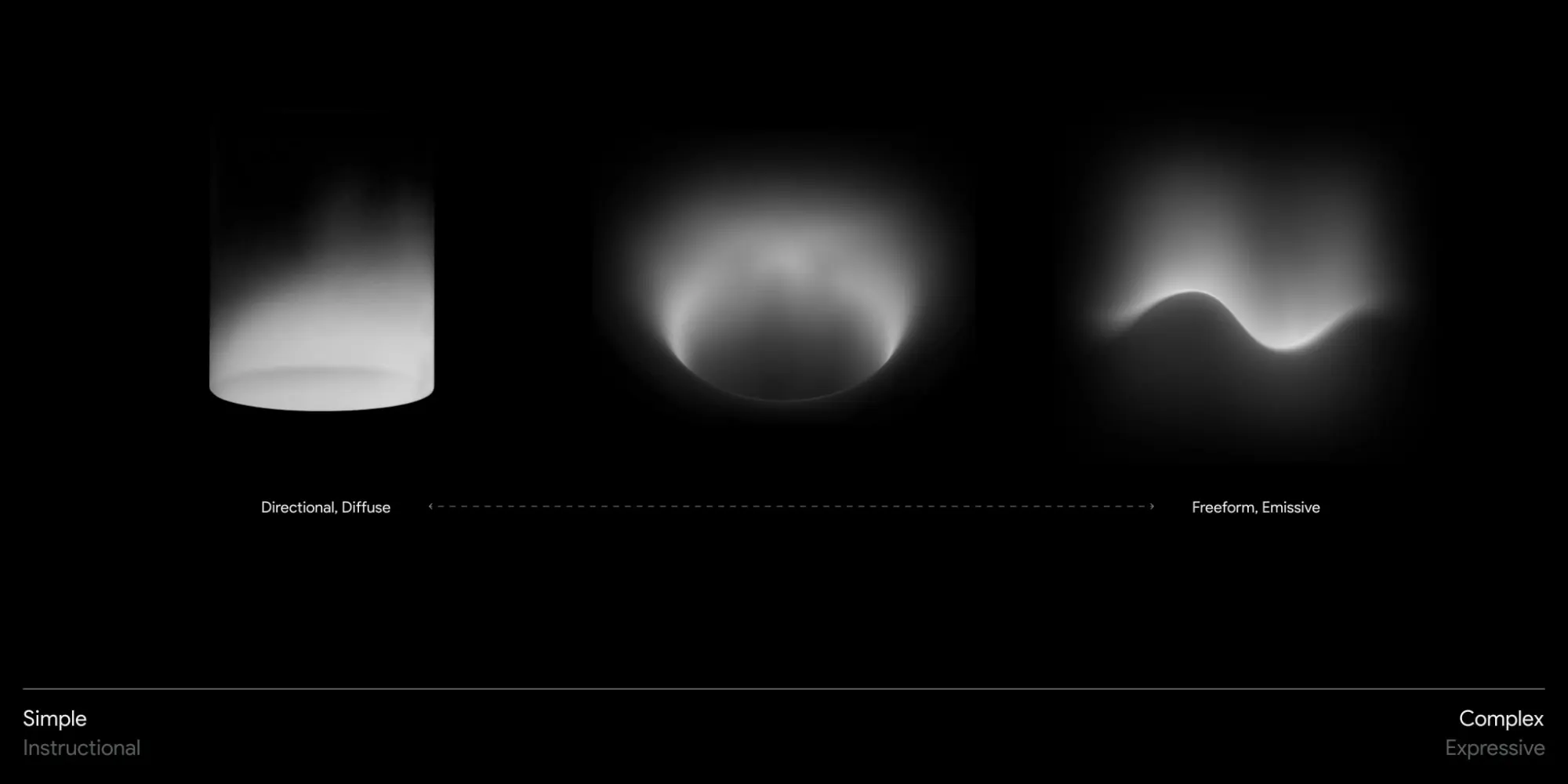
Motion serves as an essential guiding element.
Each animation features a defined start and end point, establishing a sense of directional flow that mirrors user actions.
This responsiveness helps users intuitively grasp that the system is working with them. Inner activity within the motion conveys thinking, analysis, and intelligence, making Gemini’s processing feel more transparent and allowing users to see information coming together—visualizing conversations and listening abilities in real time.
Another key quality is softness.
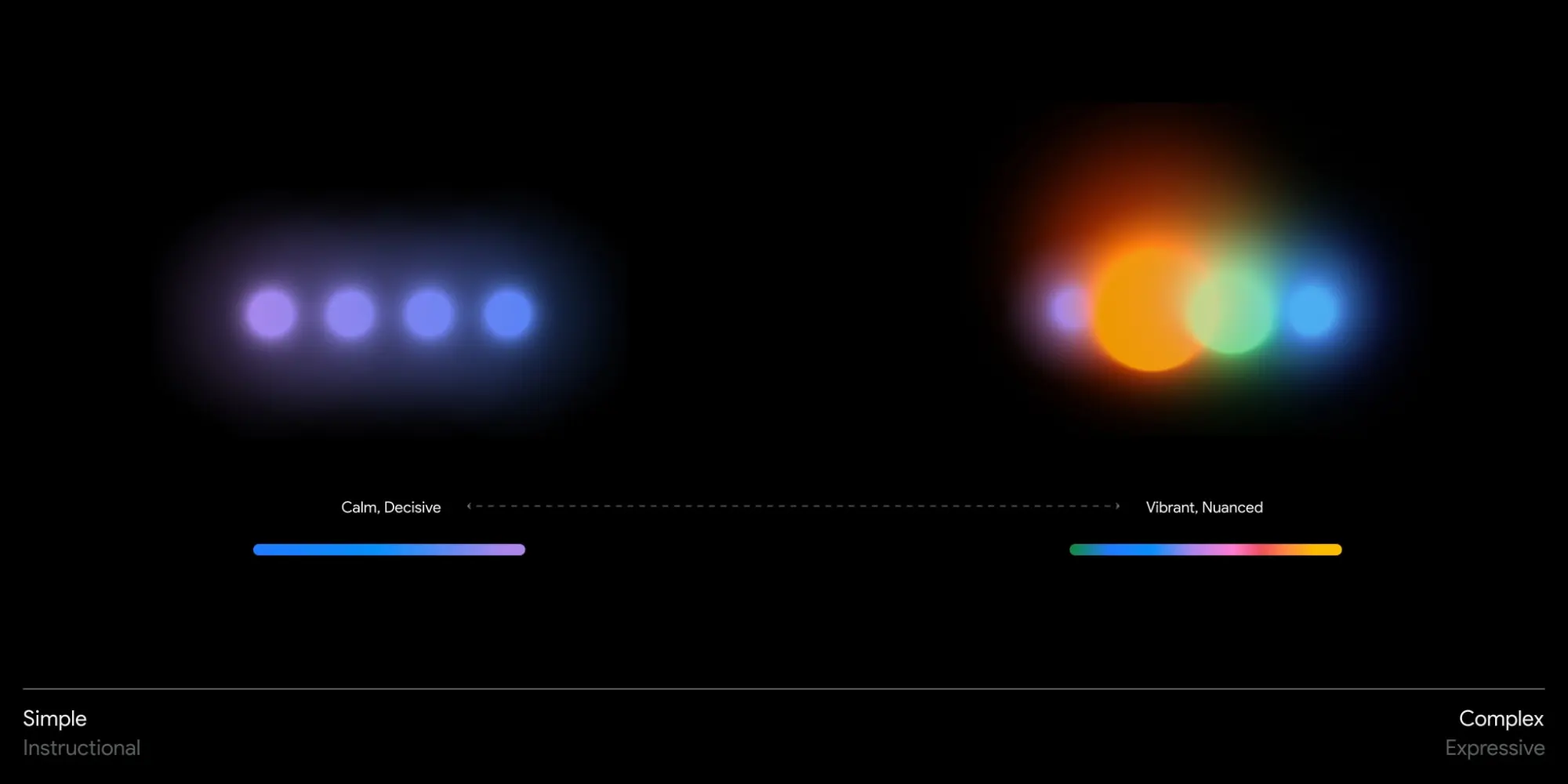
When a system is hard to approach, the design must be soft.
This softness, conveyed through guided, pulsing gradient shapes, clear language, and transparent signaling, allows users to engage feeling secure and supported.
The gradient can be many things through its animations: aspirational and uplifting, directional and instructional. But they remain soft and direct, always looking forward; they’re deeply connected to the Google brand with room to grow, like the personified gradient, rippling and responding to voice.
These thoughtful choices, from fluid gradients and circular foundations to purposeful motion, are designed to work in harmony to bridge the gap between human intuition and advanced AI.
By drawing inspiration from design history while forging new paths, Google aims to demystify Gemini, transforming an abstract technology into something welcoming, alive, and truly collaborative.






















































































































































































































































































