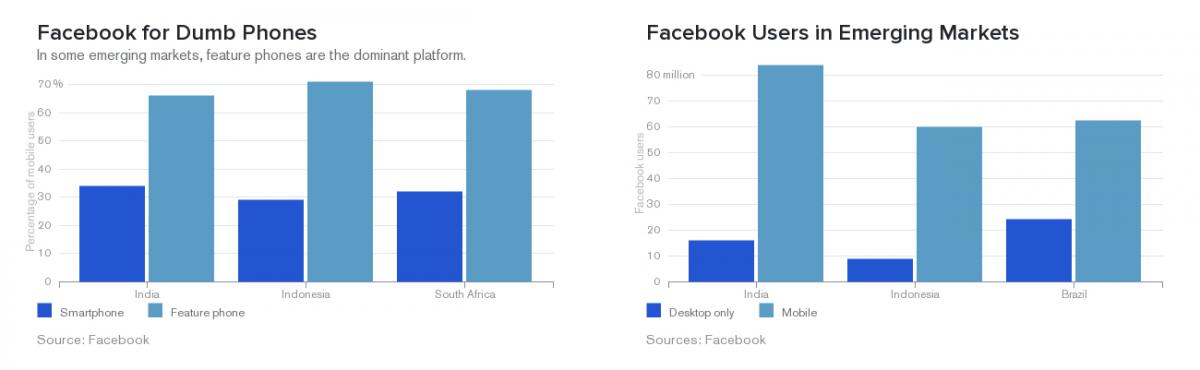
 From over one billion people that have smartphones in the world, about seven out of ten of them still use low-end phones. People in India, Indonesia, South Africa and in other developing nations, still use low-end budget phones as a primary device for accessing the internet. And as its nature to become larger and to seek the next billion user, the social media is trying to reach more of them.
India (66 percent), Indonesia (71 percent) and South Africa (68 percent) use Facebook. These translate to massive number of users, and Facebook sees this as a huge opportunity for advertisers to deliver unique set of tools to these high potential markets.
Facebook had already introduced the ability for advertisers to place and target ads on low-end phones for more than a year by optimizing its delivery system for low-bandwidth connections. However, these ads were just a minimally modified versions of what the company was delivering to developed countries. To reach more of its users, especially in less developed countries, Facebook needed to adapt, and advertisers have been clamoring for new ways to reach these "hottest" markets. To make that happen, on July 2nd 2014, Facebook is testing an advertising tool that involves missed calls, starting in India.
In India, many people use missed calls to inform others by using a workaround from the high costs of voice calls. Dialing a number and hang up before connecting to the other end can save voice minutes costs. This workaround is a signal to inform their family/friends/relatives about something that was already specified beforehand. In India, placing calls and hanging up while it's ringing is a common way to get a friend's attention or for young people to request a call back from their parents to conserve their mobile minutes.
Since using missed call is common, some companies send recorded ads or SMS messages promoting a service to people who place a missed call to capitalize on this opportunity.
Facebook is testing out an advertising unit in India that corresponds to this behavior. When a person sees an ad on Facebook, they will be able to place a "missed call" from it using a button. After that, mobile device users can click the button that will call the advertiser. Users can then be able to request cricket scores, celebrity updates or music by placing a "missed call" and receiving a recorded call or text message back.
The low-end version of Facebook's mobile service will advertise the new feature.
This ads strategy would not consume any airtime or data for its consumers. Facebook tested this advertising strategy, and it has prove that the method can actually be a campaign that embraces culture. The company's advertising team is working on more geo-targeting enhancements for India, Indonesia, Nigeria, South Africa, Turkey and Latin America.
"There's an opportunity for us to get much more localized with what we're building and developing," said Kelly MacLean, Facebook's business lead for emerging markets. "That's an area we're really going to invest in."
Facebook Inside the Developing Markets
The social network giant Facebook is heavily focused on growth in emerging markets. This is because on the already developed countries where most people are already connected to the internet, Facebook user has a higher ratio. This makes deeper penetration more difficult than targeting less developed places. One of the strategy Facebook did to target developing nations is by acquiring WhatsApp.
At the time of the deal, WhatsApp was claiming 419 million mobile monthly active user accounts that most come from developing countries.
During a conference call about the deal, Facebook CEO Mark Zuckerberg said that WhatsApp does not "get as much attention in the U.S. as it deserves." WhatsApp is the primary messaging tool in certain areas of Mexico, Europe, South America, Africa, the Middle East and India. WhatsApp's performance is not that good in China because its in-house product WeChat from Tencent is more popular.
In 2013, Zuckerberg announced an initiative called Internet.org, a partnership between Facebook and six mobile phone companies that have a goal of bringing affordable internet access to people that live in emerging markets by increasing telecommunication efficiency. Another goal is to make the internet 100 times more affordable and reliable by beaming connection from drones and satellites from its Connectivity Labs.
Facebook - Connectivity Labs and Internet.org, that is discovering new ways to bring internet to more places will both benefit the 5 billion unconnected people, and not to mention, advertisers where money is coming from.




















































































































































































































































































