 Many things have been said and done, and in a people's life many things come and go. Human's mind has limits, and with technology, those limitations can somehow be compromised. Google has been awarded a patent that outlined a method of recording video that can be searched at a later date.
On July 21st, 2015, Google has been awarded the patent in using a video camera that is mounted on wearables to record things so users can search for it at later times. This could make forgetting a thing of the past.
The wearable would send its video to a user's paired mobile device, which then would send the video to a server. Whenever the user wishes, they can access their online repository to check all their recordings in the cloud, and use keywords to search for specific instances they want to re-watch.
The method is like exporting memories to the cloud.
Google has been long known to index to web and make it searchable. The internet provides an almost limitless amount of knowledge of everything thinkable. Google takes the role as a search engine to dig into all the arrays of knowledge, and deliver the detailed information whenever it is asked.
The background of the project is that search engines return results to users, based on the query by knowing relevant content found when they crawl the web. The retrieved content is often generated by others, and unconnected to the user's real-world experience.
The method for enabling a searchable history of the user's real-world experience is to retrieve contents that were previously made by the user who asks for it, not others.
When the data about one's real-world experience is captured and recorded by a mobile computing device, it is then transmitted to a server computer system. The server performs one or more recognition processes on the captured media data and adds it to a history of real-world experiences of a user of the mobile computing device when the one or more recognition processes find a match.
The end results are contents that are relevant to the query that include data indicative of the media data in the history of real-world experiences.
Indexing The World
Replaying the past was once achievable by media captured manually. But there isn't a way to index them, at least efficiently. What Google wants is to make all those captured memories archived, and can be seen whenever the user wants, all with ease.
The patent suggests recordings would be tagged by time and location, and that video recording could start automatically if the wearable detects the user is at a popular location if the user has set it to do so.
According to the patent, users could also replay memories on their wearables, and asking it questions to trigger videos. Like for example, the user can ask "What were the paintings I saw when I was on vacation in Paris?" or "How many books did I read in May?"
Despite this is just a patent, Google is granted the ability to turn this into reality. And for the search engine Google that is always aiming for moonshot projects, this could be a logical step to widen its wings.
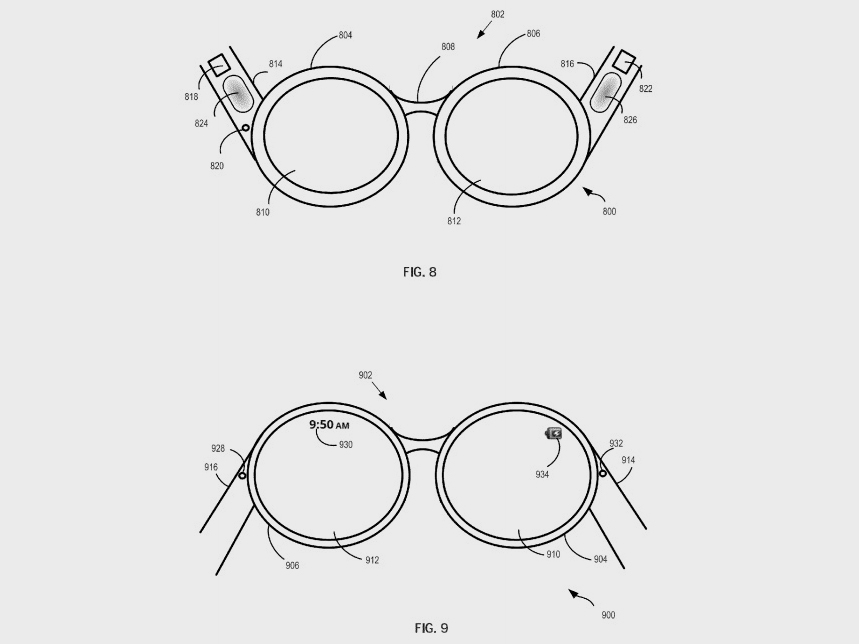
The patent is granted for Google to be implemented on wearables, but not limited to Google Glass. It shows the processor and data storage mounted onto a spectacles similar to the one Harry Potter uses.
Tony Fadell from Nest Labs and his team have been working on an "Enterprise Edition" of Google Glass, an offshoot of the original Explorer Edition, but with a hardware improvements. With the original Glass has an awful debut, Google is trying to make the next one a bit better, and more consumer-friendly by tweaking its appearance to better match its intended audience.