
OpenAI has taken another confident step toward transforming ChatGPT from a solitary digital assistant into a shared space where people and AI collaborate together.
The company announces a new group chat feature, now piloting in Japan, New Zealand, South Korea, and Taiwan, to show how quickly generative AI is evolving from a private tool into a social experience.
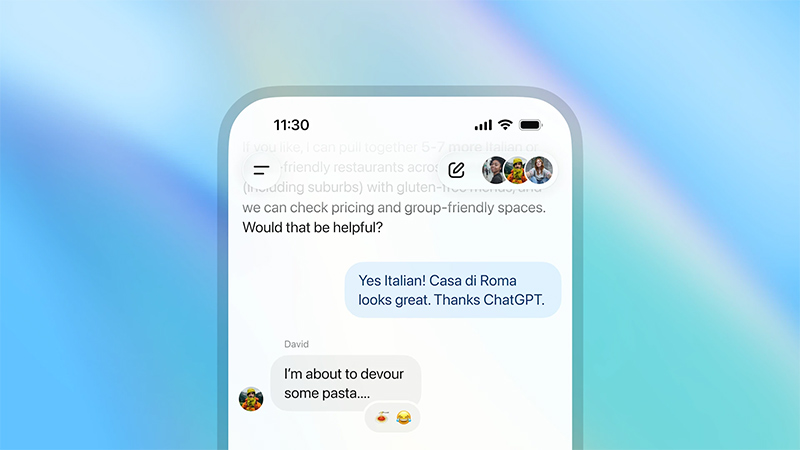
Instead of typing into a quiet chat box alone, users can now bring friends, coworkers, or even entire study groups into one room, with ChatGPT quietly observing until the moment it is needed.
The experience begins with something simple: users can simply open a chat like they normally would, to then tap the little people icon, and choose who to invite.
Up to twenty participants can join, either through a direct invite or a link.
Everyone can create a short profile so the group knows who is speaking. After that, the environment resembles the chats people already use every day, though there is an unusual presence lingering at the table. The AI is always there, watching, ready to help, yet polite enough to stay silent until someone asks or the context clearly calls for support.
Group chats in ChatGPT are now piloting in Japan, New Zealand, South Korea, and Taiwan.
A new way to collaborate with friends, family, or coworkers and ChatGPT in the same conversation. pic.twitter.com/UQKhqjcnQQ— OpenAI (@OpenAI) November 14, 2025
Groups have been designed to feel natural.
Messages between users flow freely without any effect on ChatGPT’s usage limits. Only the AI’s own responses count toward rate caps, which keeps teamwork comfortable and uninterrupted. The GPT-5.1 Auto model allows ChatGPT to search the web, generate images, process files, and even take voice dictation, all within the same group environment.
The underlying system, powered by GPT 5.1 Auto, decides which model is the most suitable for each request and makes sure the experience remains fast for everyone, whether they are free users or on premium plans.
What gives the feature its charm is the way ChatGPT behaves socially.
Because the AI exists in the group chat, it can reacts to certain messages, responds to tags, and expresses itself with emojis when the moment feels right.
It can even use a participant’s profile photo to generate personalized images for fun or for practical visualization.
These choices reflect OpenAI’s attempt to make the AI feel less like a machine sitting in the corner and more like a member of the group who knows when to lean forward and when to keep quiet.
Privacy plays a central role in the design.
OpenAI keeps group chats completely separate from a user’s personal conversations, and ChatGPT’s memory does not spill over. Nothing from a private chat carries into the group, and nothing discussed within the group is remembered later in personal interactions.
For younger users, OpenAI activates extra filtering and parental controls to make sure the environment stays safe and age appropriate.
Groups are invitation only, participants can leave at any time, and while anyone can remove most members, only the creator can choose to remove themselves from the group entirely.
The pilot also reveals some thoughtful engineering choices.
When new people are added to an existing chat, ChatGPT duplicates the conversation into a clean group environment so the original stays intact.
This prevents private messages from accidentally being shared with newcomers, though it may create a few extra chat folders in the sidebar. OpenAI says it is experimenting with ways to make this feel less cluttered over time.
Rolling out now to Free, Go, Plus, and Pro users in Japan, New Zealand, South Korea, and Taiwan on both mobile and web.
Make sure you’re on the latest iOS or Android app.https://t.co/jusfSiaEPf— OpenAI (@OpenAI) November 14, 2025
The broader implications are what make this rollout important.
For years, generative AI systems were designed around one to one interactions. Users asked. The AI answered. ChatGPT started the whole trend.
But group chats should be able to change the dynamic entirely. Instead of switching tabs or showing screenshots of AI suggestions to friends or coworkers, people can simply bring the AI into the room. It becomes a shared reference, a mediator, an explainer, a researcher, a planner, or a creative partner depending on what the group needs in the moment.
This move also aligns with OpenAI’s growing interest in social products.
Earlier this year, the company launched Sora 2, a standalone video platform featuring algorithmic feeds, personal profiles, and messaging tools. Group chat in ChatGPT feels like the next piece of that puzzle, a step toward a future where AI is not simply an assistant living in your pocket but a participant in the kinds of conversations people normally keep among themselves.
It signals the direction OpenAI is moving.
The company wants ChatGPT to become more than an answering machine. The company wants it to be a work environment, a study partner, a creative space, and a place where people come together with the help of an intelligent companion that can understand the flow of human conversation. It is an early experiment, limited to a small set of high engagement markets that tend to adopt new technologies quickly.
OpenAI calls this a small first step, but the movement beneath it feels larger. Group chats hint at an AI future that blends personal assistance with shared experience, where intelligence is not a single voice but something that sits comfortably within the rhythm of human conversation.
Lastly, OpenAI also released a quiet, yet useful update: the ability to eliminate those em-dashes in ChatGPT's responses.
Small-but-happy win:
If you tell ChatGPT not to use em-dashes in your custom instructions, it finally does what it's supposed to do!— Sam Altman (@sama) November 14, 2025
An em dash is a long horizontal punctuation mark used in English writing. It looks like this: —
It’s longer than a hyphen and longer than an en dash. Writers use it to create a strong pause, insert extra information, or replace commas, parentheses, or colons.
Writers and models like ChatGPT rely on em dashes because they are designed create a smooth, flexible pause that feels natural in modern English. For more than often, models can let em dashes in as an extra thought without breaking the flow, also to make the sentences feel lighter than parentheses while still giving emphasis.
This is why em dashes are frequently used in in digital writing, journalism, and tech commentary. It is a convenient way to add clarity or emotion without rewriting a sentence from the ground up.
However, some readers (as well as users) may find that rhythm uncomfortable while interacting with ChatGPT.
This is why OpenAI is finally giving users the ability to make it stop.




















































































































































































































































































