Generative AI is evolving at an incredible pace, with countless experiments constantly pushing the boundaries of what’s possible.
Ever since OpenAI unveiled ChatGPT, and competitors quickly followed suit, one lingering frustration has remained: these chatbots struggle to remember what users say across sessions.
While conversations can be remembered within a single session, once that session ends, the slate is wiped clean.
This limitation stems from the context window — the space where the model temporarily "remembers" information. The longer the chat, the more memory it eats up… and eventually, there's just no more room.
To bridge that gap, OpenAI introduced ‘Custom Instructions’ — a feature that helps the chatbot better understand users without needing constant reminders. This was a step forward, as highlighted in this article.
After that, OpenAI gave ChatGPT a Memory feature, which allows the AI to learn about users, remember their preferences, writing style, goals, and more, across different chats and over time.
The goal is to make ChatGPT capable of remembering all the things users discuss with it.
This time, OpenAI said that free users can finally get a taste of this Memory feature.
We’re starting to roll out a lightweight version of memory improvements to Free users. In addition to existing saved memories, ChatGPT now references your recent conversations to provide more personalized responses. https://t.co/RZFYUC9JAT https://t.co/O8lubCBNZO
— OpenAI (@OpenAI) June 3, 2025
OpenAI has begun rolling out a "lightweight version" of its memory feature to free-tier ChatGPT users—a capability that was previously exclusive to Plus and Pro subscribers.
This update marks a step toward a more personalized and intelligent interaction, as ChatGPT can now reference recent conversations to deliver context-aware, tailored responses.
For free users, this means they can finally experience short-term continuity. ChatGPT can recall what was said earlier in a session, reducing the need to repeat information and allowing for a more natural, flowing dialogue.
By remembering recent interactions, ChatGPT can adjust its tone, responses, and suggestions to better suit individual preferences—bringing AI one step closer to feeling truly attentive and human-like.
However, for this personalized experience to work, ChatGPT must collect and process more user interactions than before. These interactions are sent to OpenAI’s servers for storage and refinement, enabling the system to build a memory profile that evolves with each conversation.
In essence, the more you engage, the better ChatGPT becomes at understanding and anticipating your needs—a subtle yet powerful shift in how we relate to AI.
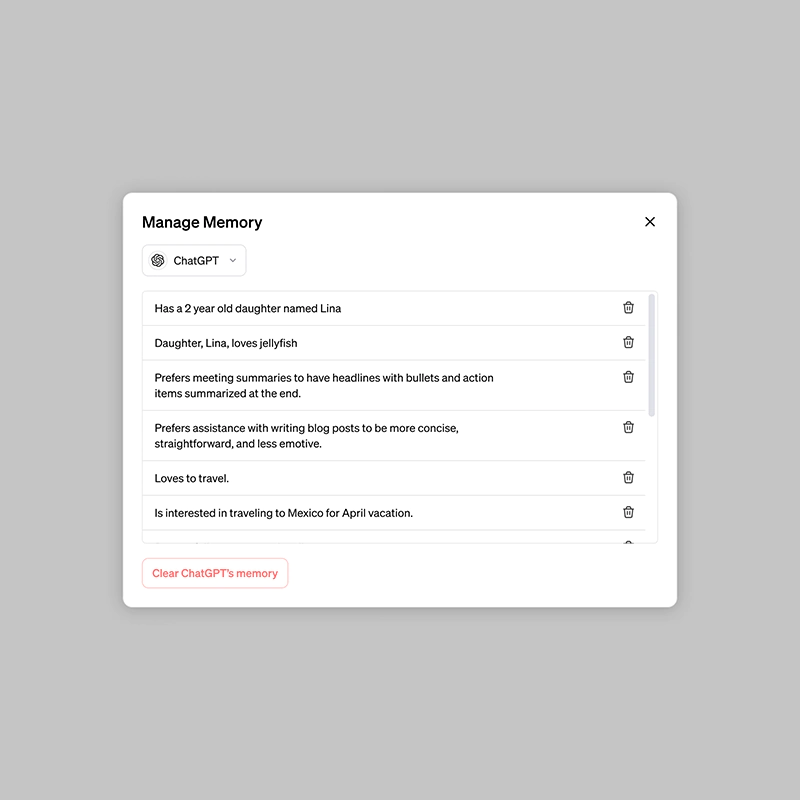
This raises privacy issues.
"Memory brings additional privacy and safety considerations, such as what type of information should be remembered and how it’s used," explained OpenAI. "We’re taking steps to assess and mitigate biases, and steer ChatGPT away from proactively remembering sensitive information, like your health details - unless you explicitly ask it to."
OpenAI said that users have the option to manage this feature through settings. They can also ask ChatGPT, "What do you remember about me?" to review stored information. Additionally, they can instruct the AI to forget specific details or clear all memories as desired
Besides deleting specific memories, users can also use a "Temporary Chat" mode that doesn't utilize memory at all.
This move marks OpenAI’s push to enhance the ChatGPT experience—enticing users into a more personal, intuitive connection with AI.
It signals the beginning of a new kind of relationship between humans and machines: one that feels less transactional and a little more human.




















































































































































































































































































