
Voice assistants have spent more than a decade sounding useful in ads and then stalling at the first real task. They could set a timer, read the weather, or pretend to understand a calendar, but the moment a request needed an inbox, a Slack thread, or a document that actually existed, the conversation usually ended and the user went back to typing.
That gap between talk and work is the quiet story of consumer AI in the 2020s: speech got smoother, models got larger, and the software still lived in a box that could chat about your tools without touching them.
OpenAI has been circling that problem since ChatGPT Voice first appeared, and again this summer when GPT-Live made turn-taking feel less like a walkie-talkie.
The company has also spent 2026 building ChatGPT Work, an agent layer that can sit on connected apps, draft files, and run longer jobs in a browser.
Those two tracks did not fully meet. Voice could talk. Work could act. Users kept asking why a spoken request still could not open mail or post in Slack the way a typed one could.
Now, the company said that split is closing.
In a post and a two-minute film of older people cooking, throwing clay, driving a convertible, and talking to a phone or a car screen, OpenAI said ChatGPT Voice can now call plugins such as email, calendar, and Slack, run on the GPT-6 family of Astra, Sol, and Luna, and operate inside ChatGPT Work on web and mobile.
The pitch is not a new personality.
It is that speaking can start the same class of jobs people already start in text: look up a slot, draft a message, build a deck, open a spreadsheet, or push a multi-step task through a browser. The update is rolling out globally in the latest app.
The plugin piece is the one that matches the oldest complaint.
Coverage and OpenAI staff posts describe Voice using the same connector layer as Work, so a spoken request can read a Gmail thread, find calendar time, or act in Slack without forcing a switch back to the keyboard.
Some reports mention a broader directory, including GitHub and other workplace tools, and note that paid plans (Plus, Pro, Business, Enterprise, Edu) gate much of the connector access.
Multiple accounts on one inbox or calendar are described in at least one write-up.
None of this is magic.
It is the same permission model already used in text, now reachable while the microphone is open. That is also why security questions appeared within hours: a voice interface that can send mail has to decide whose voice counts, what nearby speech should ignore, and how an admin still sees what the model did.
The model names matter because Voice is no longer tied to a single backend.
Astra is the high-capability GPT-6 model that arrived earlier in the month. Sol and Luna were introduced later as cheaper and faster siblings, aimed at Work, Codex, and the API, with list prices cut in half from the prior generation.
Reports say a session can sit on Astra for heavy computer use or coding, Sol for mid-weight agent work, and Luna when speed and cost matter more than depth.
Sol and Luna are still not in ordinary Chat for many users, a point that showed up immediately in replies asking when the new models leave Work and land in the main product.
Voice getting them first is consistent with OpenAI’s recent habit of shipping capability into the agent surfaces before the general chat tab.
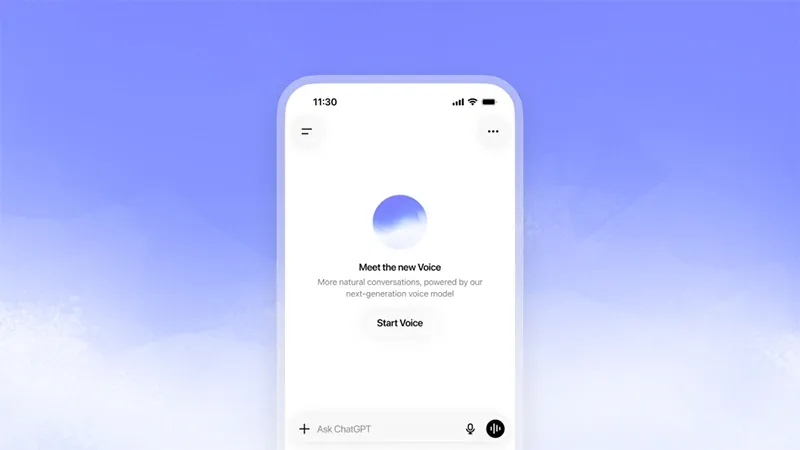
In summary, OpenAI's latest Voice update aims to turn conversations into actual work across web and mobile. Voice can now interact with documents, presentations, websites, spreadsheets, and longer browser tasks, extending the earlier desktop integration.
The update also connects Voice more closely with plugins and existing tools, reflecting the growing demand for assistants that can complete tasks rather than simply talk about them.
The bigger shift is practical: speech becomes another way to operate software, from sending messages to creating files or managing schedules.
However, AI is about more than just capabilities and intelligence.
More intrinsic details, such as latency, reliability when speech is interrupted, confirmation requirements, plan-based availability, differences between models and products, and the permissions required for connected plugins, cannot be overlooked.
In the end, the real test of an AI that can speak is whether a spoken request can reliably turn into a completed action, at any time and anywhere.
Further reading: ChatGPT Has A Scarlett Johansson Problem: 'Shocked, Angered And In Disbelief'






















































































































































































































































































