In the digital age the most contested currency is not money but the simple act of looking. Platforms turn that glance into a number, and the number decides which voices grow loud and which fade.
For years every major service invented its own rules for what counted as a view. Some registered the moment the first frame appeared on screen. Others demanded a few continuous seconds. A few still required longer stretches of attention before the counter moved.
Creators who worked across platforms found themselves translating figures that never meant the same thing. Brands comparing opportunities struggled to know which metric reflected real reach and which simply reflected the easiest path to inflation.
YouTube carried a stricter tradition for most of its life.
Industry consensus held that a regular video needed roughly thirty seconds of watching before a view was recorded.
The exact threshold was never published in full detail, yet the practice became part of the platform's identity.
A view on YouTube was widely understood to represent something more than a momentary click. It suggested the person had stayed long enough to receive at least part of the message.
That understanding shaped how creators measured success, how they pitched themselves to sponsors, and how audiences judged the weight of popularity. Shorts had already moved to a lighter first-frame standard the previous year, but the rest of the platform held the older line.
That separation is about to close.
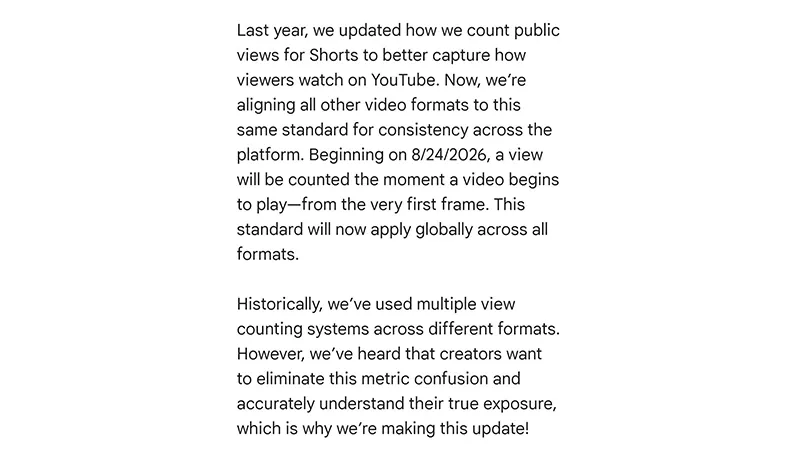
Starting the 24th of August, the public view count across every format will register the instant a video begins to play.
The first frame is enough. No minimum watch time is required.
The same rule will apply to long form videos, live streams, and Shorts. The company presents the change as a move toward consistency, a way to give creators a clearer picture of their true exposure and to make it easier to demonstrate value to brand partners.
The older, stricter measurement will not vanish. It will live on inside YouTube Analytics under the name engaged views, available in advanced mode so channel owners can still see how many people chose to keep watching.
According to YouTube in the announcement, earnings and eligibility for the Partner Program will continue to rest on those engaged metrics and on engaged watch hours. The public number that appears beneath every video will simply climb faster.
The practical effect is immediate.
View counts will rise more quickly than before, especially for videos that capture attention only briefly. A misclick, an autoplay closed within a second, a thumbnail that promises more than the content delivers, all of these will now add to the public total.
Historical counts on existing videos remain unchanged. Only new plays after the change take effect follow the first-frame rule.
The reactions already circulating reveal the tension. Some creators welcome the alignment with platforms that have long counted every play.
Others worry the new standard rewards the shallowest forms of attention and makes it easier for low-effort or machine-generated content to inflate its apparent popularity. The public counter becomes less selective.

















































































































































































































































































