Government websites are usually the last place anyone expects to hear pixelated sound effects. They exist for press releases, forms, and the kind of language that makes eyes glaze over.
That is part of why a new corner of whitehouse.gov landed so strangely this week.
On September 3, the White House opened an official online arcade, later promoted from the administration’s own account as 'Trump Arcade,' and invited the public to play policy instead of only reading about it.
The project lives at whitehouse.gov/arcade and also at arcade.gov.
It is a free, browser based collection of five low resolution mini games styled after 1980s and early mobile classics.
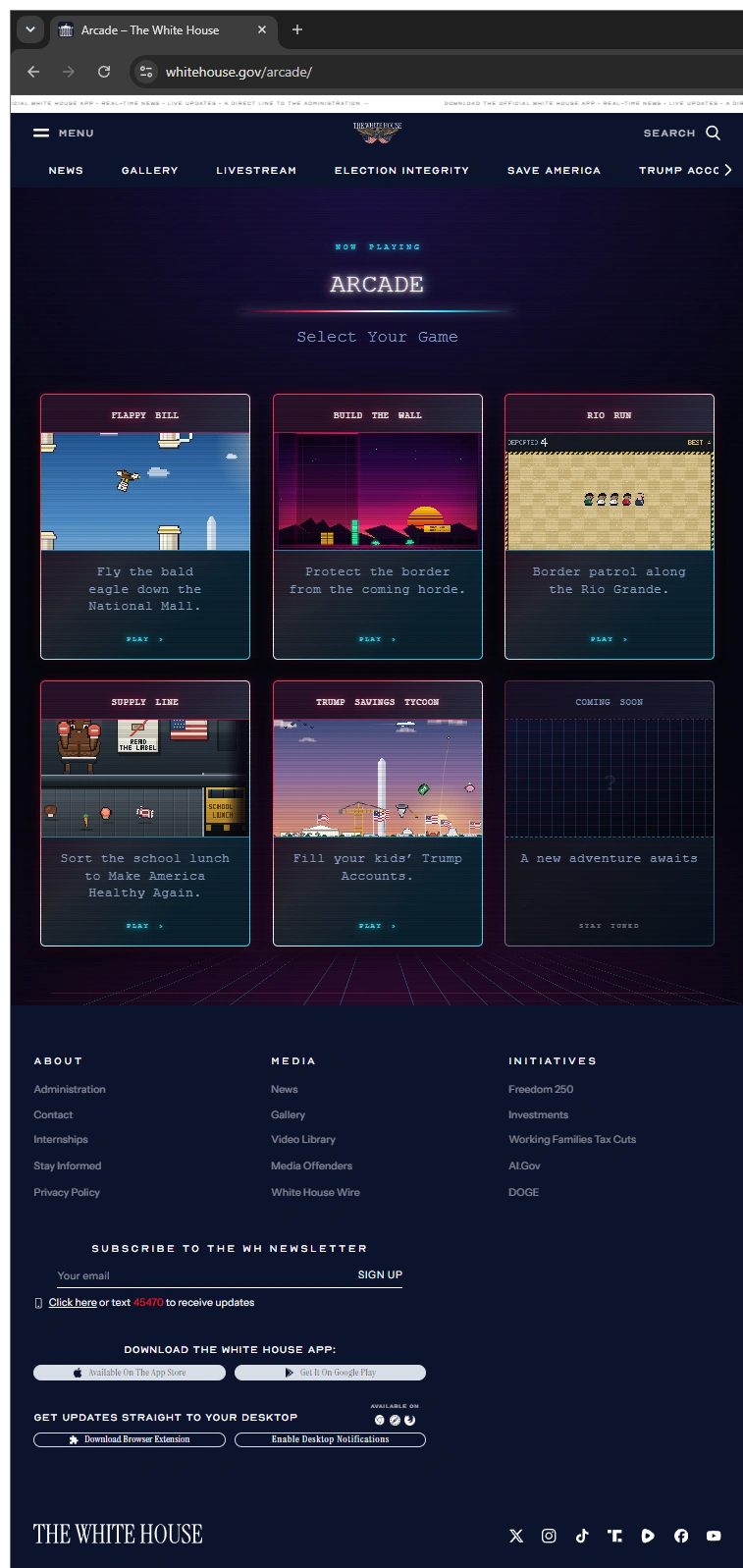
The lineup is Flappy Bill, Build the Wall, Rio Run, Supply Line, and Trump Savings Tycoon, with a Coming Soon slot that promises another title later.
None of this is a commercial studio release. It is official White House messaging dressed as an arcade cabinet.
Flappy Bill is a Flappy Bird style flight over the National Mall, with a bald eagle carrying legislation through monuments and obstacles. Build the Wall is a falling block puzzle in the spirit of Tetris. Players stack wall sections and, in the site’s own language, protect the border from the coming horde. Rio Run borrows the logic of Snake. A figure widely identified as Border Czar Tom Homan patrols a Rio Grande grid, collecting would be crossers and tallying deportations. Supply Line works like a short form Tapper or conveyor belt sorter. Healthy items such as broccoli, milk, and apples stay on the line. Seed oils, additives, and food coloring get knocked off in a Make America Healthy Again school lunch pitch. Trump Savings Tycoon asks players to swing a net at flying cash and gold and drop it into children’s Trump Accounts. Those accounts are the administration’s tax advantaged savings program, created under the Working Families Tax Cuts package and later tied to the One Big Beautiful Bill Act. Eligible children born from 2025 through 2028 can receive a one time $1,000 federal contribution. Treasury has said more than six million children have already been enrolled.
Each game maps onto a signature piece of the administration’s second term agenda.
The White House has been unusually direct about why this exists.
Officials describe it as a way to innovate how the administration tells the story of the president’s record and to reach people who will never sit through a briefing. Kaelan Dorr, deputy assistant to the president and head of digital strategy, called the games policy you can interact with. Another official said the site is meant to contrast what the White House calls a culture of fun and winning with what it frames as a darker Democratic alternative.
Timing matters too.
The arcade arrived as the 2026 midterms come into view, and after months of the administration building its own digital products that speak past traditional press channels. In that sense the games are not a side hobby. They are an outreach tool aimed at younger users, casual scrollers, and anyone more likely to tap Play than to open a fact sheet.
The official X account leaned into that tone.
One post invited people into the arcade of winning. Another asked if they were easily distracted and offered the site as a solution. A third joked that the country got Trump Arcade before GTA 6.
The humor is the point. Retro pixels and cabinet nostalgia lower the barrier. Once someone is inside, the objectives are not subtle. Build the wall. Deport. Fill a Trump Account. Sort the lunch line. Keep the bill in the air.
Reaction split along familiar lines. Supporters treated it as on brand spectacle, a government finally speaking the language of memes and high scores. Critics called the immigration titles dehumanizing, objected to turning enforcement into a score counter, and noted that Tetris's rights holders have already said they take copyright claims seriously.
Separate reporting has also flagged a broader pattern of unlicensed gaming branding around MAGA themed graphics. Those fights are not the arcade’s stated purpose, but they are now part of the story sitting next to it.
What remains after the jokes is a fairly simple experiment.
The White House decided that some of its core arguments on borders, children’s savings, and school food would travel farther if they looked like the games people already know how to play.






















































































































































































































































































