Actor Charlie Sheen publicly disclosed he was HIV-positive on NBC's Today Show.
"I’m here to admit that I am in fact HIV positive," Sheen said.
He first discovered about his status "about four years ago", and initially thought he had a brain tumor. He said that he has paid about $10 million to extortionists that threatened to reveal his HIV status, saying that "They were deep in my inner circle,” and adds, “we’re talking about shakedowns."
Sheen admits that he has had unprotected sex since his diagnosis, but that the two people involved were forewarned. Sheen also said that he has told all his sexual partners about his status.
At that time, he likely didn't realize the impact the news would make on the health of so many other people, as well as to the internet. A study published in the journal Prevention Science, the researchers called it the "Charlie Sheen Effect."
Breaking it down, Sheen's public disclosure was followed by the largest HIV-related Google searches ever recorded in the U.S.. In 3 weeks, there were about 2.75 million more searches than expected that included the term "HIV", and 1.25 million searches were relevant to public-health outcomes because they included search terms for "condoms", "HIV symptoms", "HIV tests" and "HIV testing".
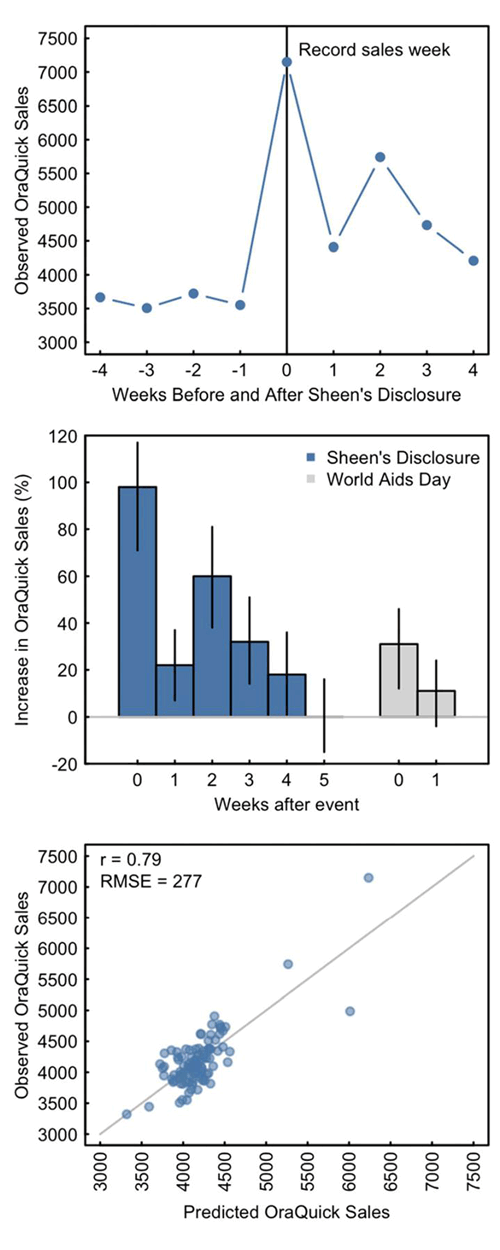
Sheen's disclosure was also followed by a 95 percent increase in over-the-counter at-home HIV testing kits OraQuick.
The kits' sales continued to be above normal over the next four weeks, fluctuating from approximately 20 percent to 60 percent above the previous level.
The study co-author Eric Leas, a research associate in the San Diego State University - UCSD doctoral program in public health, said that: "Our strategy allowed us to provide a real-world estimation of the Charlie Sheen Effect on HIV prevention and contrast that effect with our past formative assessment using internet searches."
The study co-author Benjamin Althouse, a research scientist with the Institute of Disease Modeling, said that: "In absolute terms, it's hard to appreciate the magnitude of Sheen's disclosure. However, when we compared Sheen's disclosure to other traditional awareness campaigns the 'Charlie Sheen Effect' is astonishing."
These findings reinforce the researchers' past analysis of Google search data. Using internet searches alone, the team was able to predict HIV testing sales within seven percent for any given weeks. This is because OraQuick's sales were correlated with Google Trends data.
"Public health leaders are often cautious, choosing to wait for traditional data instead of taking reasonable action in response to novel data, like Internet searches," said San Diego State University Graduate School of Public Health research professor John W. Ayers.
"Our findings underscore the value of big media data for yielding rapid intelligence to make public health actionable and more responsive to the public it serves."
The study's authors noted that "Charlie Sheen did more for HIV education than most UN events do." Sheen that spoke out for HIV prevention, said that HIV is "three hard letters to absorb", and he was "humbled" that he could raise awareness.