There are tons of horror game titles to play that most gamers wouldn't ever run out. But there is one that seems to echo a handful of survival horror classics, stitched together into one product.
For many players, Bloober Team’s new survival horror feels less like a standalone tale and more like the fever dream offspring of an unholy union.
It’s as if Dead Space lent its suffocating atmosphere and body horror, Resident Evil its resource-driven tension, Silent Hill its psychological torment, Alan Wake its emotional depth, The Evil Within its twisted dreamscapes, Returnal its looping structure, and even The Thing its fusion horror, grotesque transformations of living entities.
The result of this very twisted orgy of horror icons, is a monstrous baby called Cronos: The New Dawn.
The haunting visuals that showcase an eerie, retro-futuristic ambiance, brutalist architecture, and grotesque creatures. It didn’t take long for the internet to draw comparisons, seeing in its setup a strange familiarity.
Cronos: The New Dawn is a perfect shadow of way too many games, and the internet is convinced, but in the same way that it is also confused.
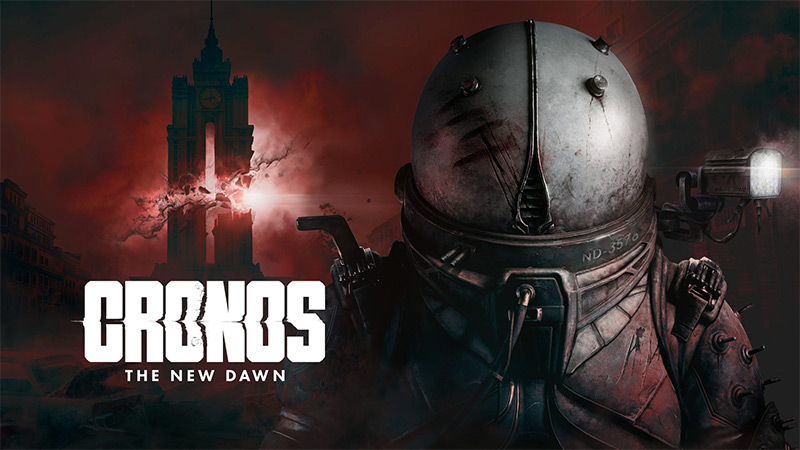
Players take the suit of The Traveler ND-3576, who works for The Collective, an enigmatic organization sending her spiraling back through fractured timelines to the 1980s, to the moments just before humanity was torn apart by a cataclysmic event known as the Change.
The world she emerged to, is a fictional version of Kraków’s Nowa Huta district, a place inspired by brutalist Soviet-era architecture, where cassette-futurism meets Eastern European history. It's world that fuses influences that are deeply tied into Polish history, communism-era aesthetics, and philosophical themes like identity, time manipulation, and collectivism.
She awakens from hibernation to a world already in ruins, the agent has her very identity as fragile and mysterious as the world around her.
When unprepared and unequipped with sufficient weaponries, her melee strikes feel weak against the horrors stalking her. The only thing standing between her and annihilation is the strange, weighty suit she wears, and It is no ordinary armor.
The suit that resembles something between a Victorian-era diving suit and a melancholy astronaut’s shell, is a bulky and gray attire purposefully built for burden the sense of sorrow.
More than just protection, the suit defines her role not as a warrior, but as a time diver, and a soul collector.
This is because the suit, built to withstand the crushing turbulence of fractured timelines, also houses the Harvester of Souls, a device on her left hand that lets her extract and carry the Essences of those who once lived.
Sent back in time using what's called the Dive, her mission isn't to slaughter monsters or to save people in a conventional way.
Instead, she's armed only to help her harvest Essences of select people.
In this case, her main quest is harvest the Essence of an individual named Edward Wiśniewski.
His Essence, like other Essences, have the people's memories, wills, and identities. The Traveler would salvage Essences from them during the brink of erasure, and make them bound to her.
As she carries more Essences in her suit, the suit begins to show signs of haunting whispers in her ears, flickers in her vision, and manifest things that can drag anyone into a slow descent into pain and insanity.
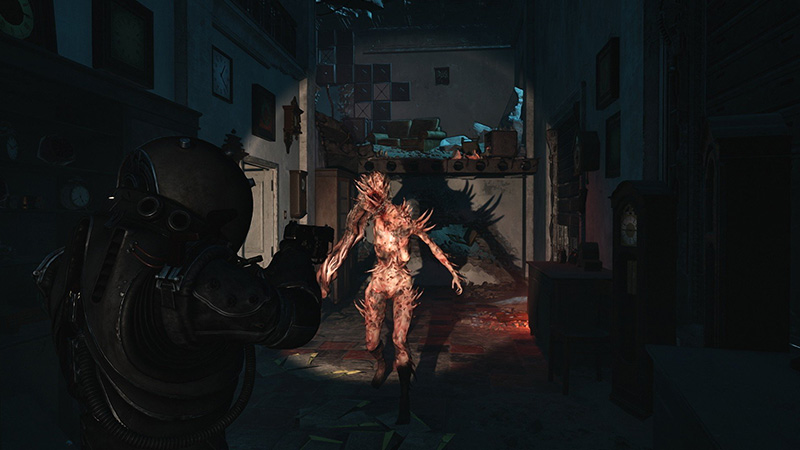
Along the way, during her quest to find Wiśniewski and others, she will encounter adversaries that are collectively known as Orphans, which are grotesque, body-horror monstrosities born from humanity's collapse.
These creatures are mutated remnants of people, born from flesh and nightmare, embodiments of despair in physical form by the catastrophic events that have scarred the timeline. Their appearance is deeply unsettling: skin fused with unnatural growths, limbs twisted at impossible angles, and faces that fluctuate between vaguely human and horrifyingly alien.
But what truly elevates the nightmare is the game’s signature Merge mechanic.
When an enemy falls, leaving its corpse behind, nearby Orphans can absorb it if the corpse has tendril-like tentacles. When merged, the new being is a stronger, faster, and more brutal. This grotesque evolution also changes its appearance and attack patterns, turning a manageable fight into a deadly escalation.
To survive, players must not only fight but plan their kills strategically, and knowing that there is limited resources in the desolated world, things can be difficult.
From scavenging the environment for scraps and looting enemies, The Traveler may need to avoid confrontations just to save resources.
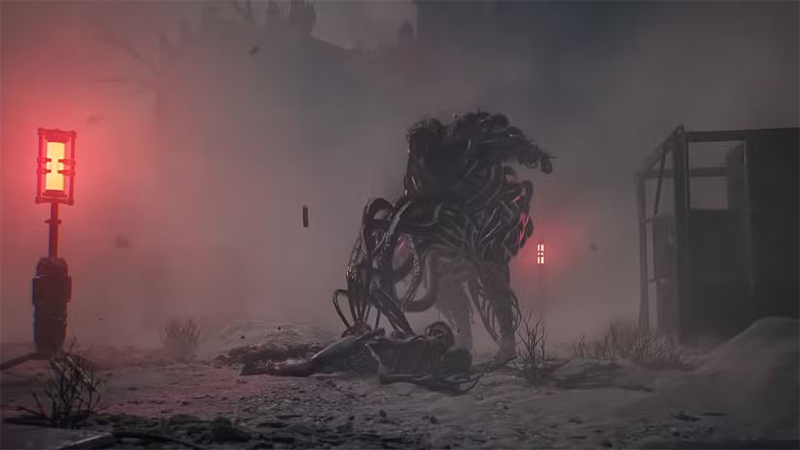
Fortunately for The Traveler, she will occasionally cross path with lifeless bodies called Fallen Travelers.
These aren’t mere corpses of former fellow Travelers who died in their mission; they are anchors in time containing the Essences she need to fulfill her quest, which also grant her precious upgrades.
To collect an Essence, she will activate the Harvester of Souls, and have the device extract and trap the Essence within her suit.
As explained, collecting the Essences means that each Essence becomes part of players' traveling burden.
Residing in her suit, the Essences will make The Traveler will hear echoes of their past, voices that lend layers of haunting depth to her psyche.

In other words, the Essences she collects are far from inert.
They can guide and enhance her abilities, but also distort her perception. Some of these twisted entities even whisper hints of humanity, believing themselves people despite their distortion. In turn, this leads to vision shifts and hallucinations that shift the environment around her, introducing eerie layers to exploration, and storytelling.
Every Essence gathered is a testament to loss, memory, and the resilience of consciousness. In Cronos: The New Dawn, players don’t simply collect resources. They need to tether souls to The Traveler's suit and trudge her forward towards the haunted history itself.
As the Traveler becomes a vessel filled with remnants of the lost, her fragmented mind becomes the canvas of the game’s emotional and visual horror.
Long story short, the game carries not only the horror of surviving a nightmare, but also the emotional weight and mechanical consequences that come with it.

Soon after the release of the trailer and gameplay, the internet voiced their thoughts.
Across forums, reviews, and social feeds, the conversation around Cronos: The New Dawn is a mesmerizing blend of fascination and cautious skepticism.
Some praise the game for its deep, immersive world that echoes decades-old horror, describing it as a vivid, retro-futuristic nightmare where every step evokes Dead Space yet feels freshly haunting. Despite this, some critics point out that its drawing from familiar tropes limits how impactful its core ideas, like how the Merge mechanics, feel.
Similarly, some commend the atmosphere and introspective story, but labels the combat as “run-of-the-mill,” arguing that it doesn’t quite live up to its bold concepts.
Lead writer Grzegorz Like shared that the emotional gravitas of Cronos: The New Dawn is deeply tied to Polish history, even sourcing childhood memories of real Nowa Huta from his own family to craft an eerily authentic setting
Bloober Team frames Cronos: The New Dawn as a "love letter to survival horror," which clearly explains where it gets its inspirations from.
Despite anchoring on real psychological weight within action-heavy gameplay, the developers sprinkled some light touches that can make things rather enlightening, like cats that The Traveler can pet and collect.
Still, not everyone is convinced. Concerns about originality and overused mechanics bubbled up, with players warning of thematic fatigue.
But in one way or another, the reveal of Cronos: The New Dawn triggers uproarious excitement because after all and like always, the internet life in always diverse.

















































































































































































































































































