Christopher Nolan's long-awaited adaptation of Homer's ancient epic The Odyssey has finally landed in theaters this month, arriving as a massive IMAX spectacle that follows the Greek king Odysseus on his perilous decade-long journey home after the Trojan War.
Starring Matt Damon in the lead role, the film assembles a sprawling ensemble that includes Tom Holland as his son Telemachus, Anne Hathaway as the steadfast Penelope, Zendaya as the goddess Athena, Robert Pattinson, Lupita Nyong’o, Charlize Theron, and others, all brought together under Nolan's meticulous direction with practical sets, ships, and sequences shot entirely on large-format IMAX film cameras across multiple countries.
With a reported budget of around $250 million, it stands as the most expensive production of Nolan's career and has already drawn strong early critical praise for its scale, ambition, and visual power, with some reviewers calling it among his finest works to date.
This release fits squarely into a career defined by films that routinely become cultural events long before they open.
The film's release has also drawn the attention of Elon Musk, who is using the moment to promote SpaceXAI's Grok, while outlining his own vision for adapting Homer's epic through AI.
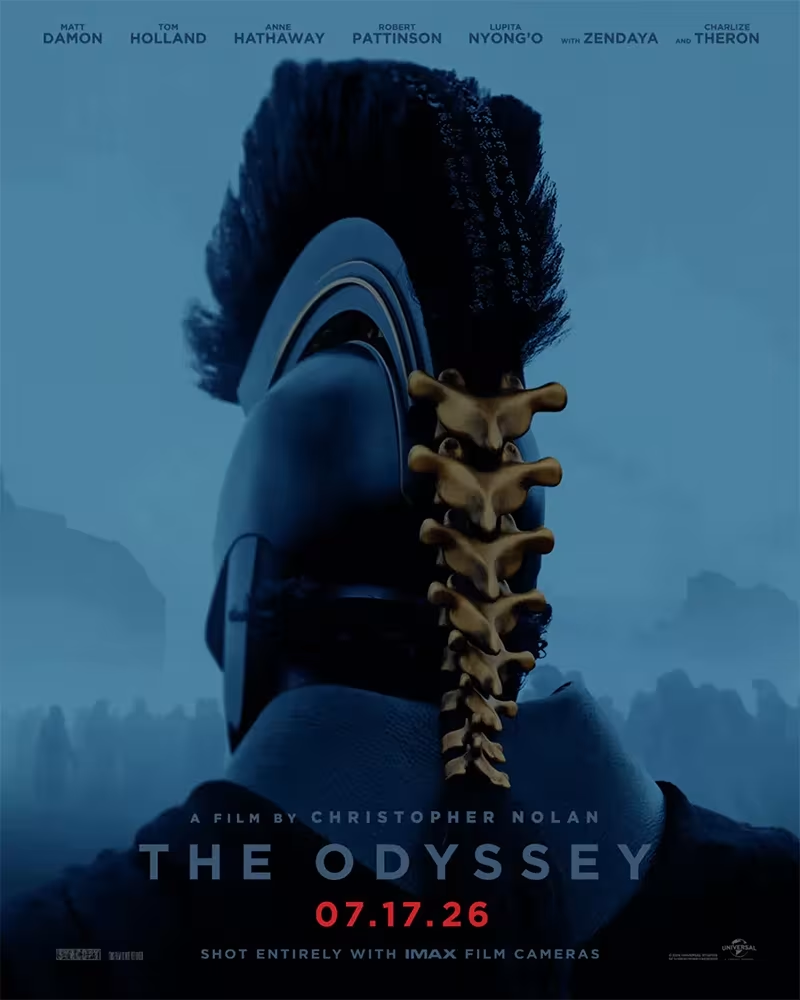
Nolan has built a body of work filled with highly anticipated and widely praised titles, from the mind-bending narrative of Memento and the layered magic rivalry of The Prestige to the Dark Knight trilogy that redefined superhero cinema, the dream-heist spectacle of Inception, the cosmic reach of Interstellar, the tense wartime urgency of Dunkirk, and the biographical intensity of Oppenheimer.
That last film earned him Academy Awards for Best Director and Best Picture, along with a string of other major honors including BAFTA and Golden Globe recognition, cementing a reputation for technical mastery and storytelling that consistently draws audiences and awards attention.
Nearly every major project of his has been met with intense pre-release anticipation and strong critical reception, establishing him as one of the most reliable architects of event filmmaking in modern Hollywood.
Into this moment of cinematic triumph has stepped Musk, who in recent days declared that before the year ends, Grok Imagine will produce a full-length movie of The Odyssey that is historically accurate and true to the art of Homer.
The Odyssey itself is one of the two great epic poems traditionally attributed to the ancient Greek poet Homer and ranks among the oldest surviving works of Western literature.
Composed in Homeric Greek around the 8th or 7th century BC, the epic has remained influential for nearly three millennia and continues to inspire readers, scholars, and artists around the world.
Divided into 24 books, the poem follows Odysseus, the king of Ithaca, as he struggles to return home after the Trojan War.
Although the war itself lasts ten years, Odysseus's journey home stretches for another decade as he confronts mythical creatures, hostile gods, shipwrecks, and countless other dangers that claim the lives of all his companions.
During his prolonged absence, he is presumed dead, leaving his faithful wife, Penelope, and their son, Telemachus, to fend off a growing number of suitors seeking to marry Penelope and seize control of Ithaca.
While ancient Greeks accepted Homer as the poem's author, modern scholars generally believe that The Odyssey and The Iliad emerged from a long oral storytelling tradition before eventually being written down.
In ancient Greece, the epic was commonly recited by professional storytellers, preserving its tales through performance long before widespread literacy made written copies accessible.
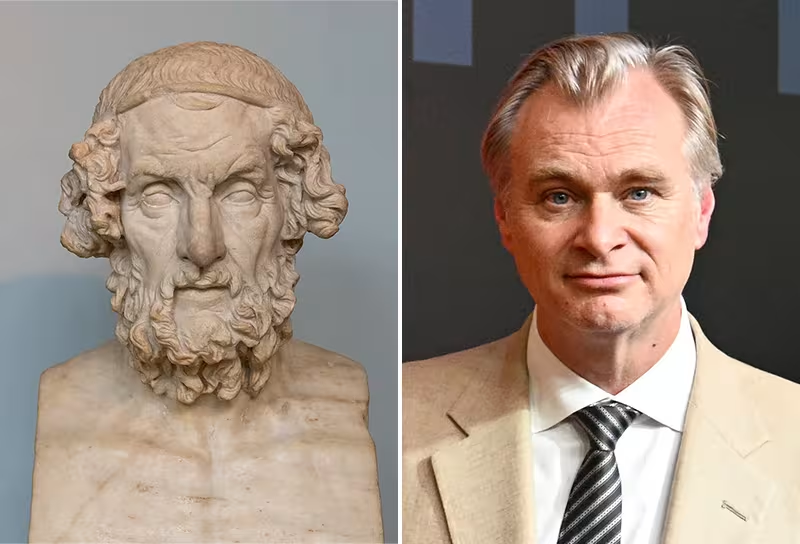
The announcement came alongside his agreement to the idea of funding a separate adaptation directed by Mel Gibson, one that would prioritize painstakingly historically accurate ships, armor, weapons, and casting, with all dialogue taken straight from the original poem and delivered in Homeric Greek.
These statements arrive after months in which Musk had publicly criticized Nolan's version, framing the casting choices as a departure from the source material's cultural roots and an example of broader industry tendencies he has long opposed.
Musk has made no secret of his opposition to what he calls the woke mind virus, a term he uses to describe cultural pressures that prioritize identity politics, diversity mandates, and revisions of traditional stories over historical fidelity or artistic integrity.
In his view, such influences have shaped Hollywood decisions, including the inclusion of Elliot Page in Nolan's film in the role of Sinon, a character drawn from later traditions surrounding the Trojan Horse.
Page, who previously collaborated with Nolan on Inception, represents for Musk and his supporters one of several modern casting elements that diverge from a strictly traditional reading of the ancient text.
By promising an AI-generated version grounded in historical accuracy and fidelity to Homer's original art, Musk positions the project as a direct alternative, one that sidesteps what he sees as contemporary Hollywood filters and instead aims to restore the epic on its own classical terms.
The timing and framing of Musk's comments suggest a deliberate challenge both to the film industry and to Nolan specifically.
Where Nolan has delivered a star-driven, large-scale interpretation that has opened to significant box office interest and critical acclaim, Musk is betting that AI tools can rapidly produce a competing vision free from the casting controversies and perceived progressive leanings that drew his earlier criticism.
The Mel Gibson proposal further underscores the point, invoking a director known for historical epics and uncompromising approaches in order to pursue a version that prioritizes linguistic authenticity and visual reconstruction of the Bronze Age world over modern ensemble casting.
In this light, the Grok Imagine project and the funding idea function as a statement that technology and private resources can now contest the cultural gatekeeping of major studios, offering audiences an Odyssey that Musk insists remains closer to the poem's original spirit.
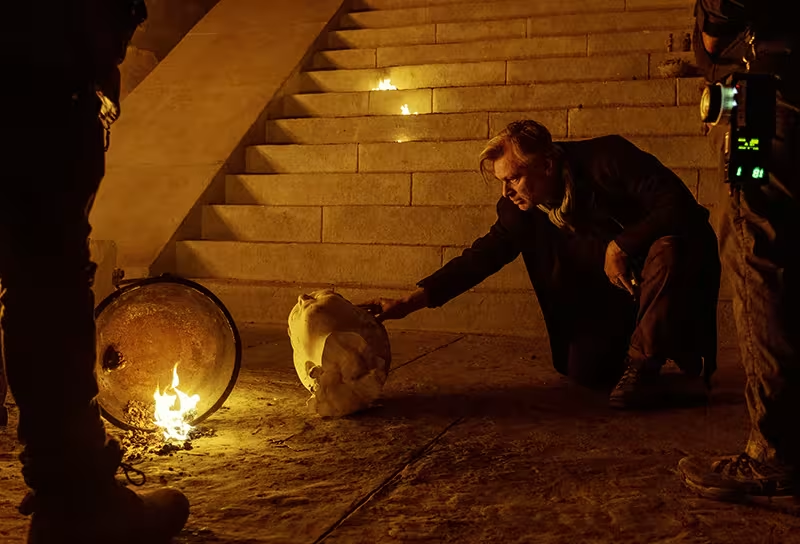
Whether these plans materialize into finished films remains to be seen, yet the contrast they draw is already clear.
Nolan continues a celebrated career of ambitious, meticulously crafted spectacles that have repeatedly proven their commercial and artistic power.
Musk, operating from outside the traditional studio system and armed with advanced AI capabilities, is using the same ancient story as a proving ground for an alternative model of storytelling, one that rejects the influences he has spent years publicly resisting.
The result is a cultural flashpoint in which one of cinema's most acclaimed directors and one of technology's most outspoken figures are effectively presenting rival claims on Homer's enduring tale, each asserting a different path for how such foundational myths should be brought to life in the present day.

















































































































































































































































































