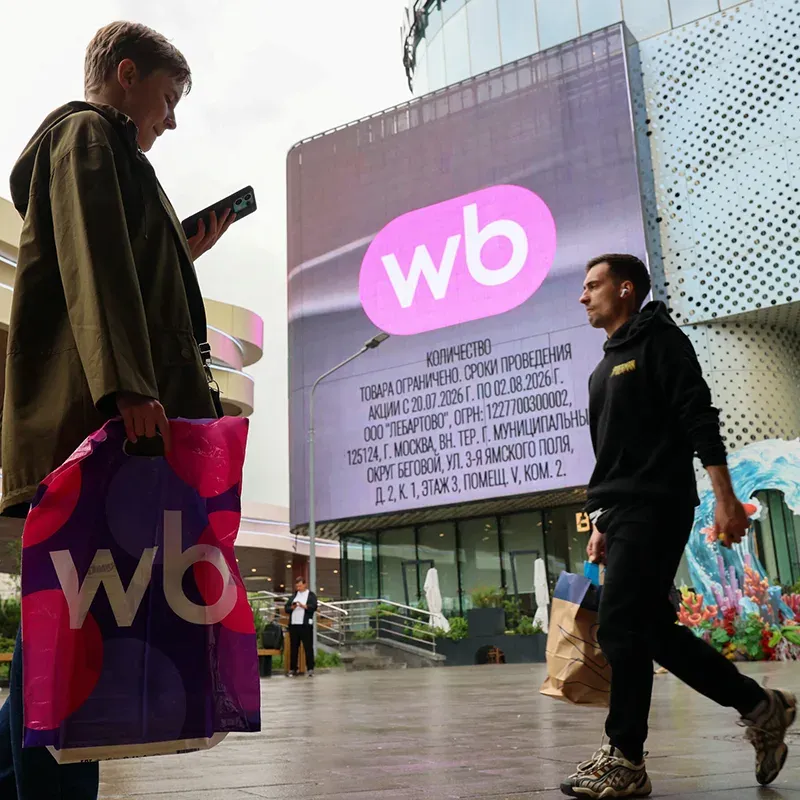
The purple bags, which are the signature packaging used by Wildberries, are literally everywhere.
In Russia, they can be found on buses in small towns, at bus stops in regional cities, in the hands of people walking home from work in the capital. For more than a decade they have been a quiet marker of how Russians buy the things they need.
Clothes for children, household goods, electronics, tools, even the small components that keep apartments running.
The platform behind those bags grew so large that it became part of the background of ordinary life, the kind of company people rarely think about until something goes wrong.
And that went terribly wrong when long range drones launched from Ukrainian territory struck warehouses belonging to the company again and again since the middle of July.
The attacks from Kyiv that have reached deep into regions far from the front lines have hit a major complex not far from Moscow.
The Ukrainian drone campaign against Wildberries facilities began on 18 July 2026 with strikes on warehouses in Kotovsk in Tambov Oblast and Elektrostal in Moscow Oblast.
Videos showed the buildings fully engulfed in flames.
Evacuation was chaotic according to eyewitness accounts. Fire alarms were reportedly not activated until the fires had already spread widely. Some managers allegedly kept workers inside rather than ordering an immediate exit, forcing employees to open automatic doors by hand. Supervisors in at least one case insisted that barcode scanners be returned before anyone left. A labour union source suggested the delays may have stemmed from fears that staff would steal goods. Seven of the nine deaths reported by late July occurred at the Kotovsk site.
Experts estimated the cost of restoring those two facilities alone at up to 35.8 billion rubles.
Strikes continued almost daily.

On 20 July drones hit a sorting centre in Domodedovo and a facility in Koledino south of Podolsk. On 22 July warehouses in Krasnodar and Nevinnomyssk were struck. The next day a site between Nechayevka and Alexandrovka in Voronezh Oblast was hit. On 24 July facilities near St. Petersburg in Novosaratovka and Shushary burned, along with a confirmed fire at the warehouse in Simferopol in occupied Crimea. By that date at least nine Wildberries warehouses had been attacked in a single week. Data Insight put merchandise losses alone at roughly 170 billion rubles. Nine people had died.
Analysts noted that Wildberries operated more than 200 warehouses and logistics centres across Russia, making comprehensive air defence impractical against low cost drones.
Further attacks followed through the end of July. A strike in Yekaterinburg on 25 July hit only the parking lot and operations resumed within hours. On 28 July a third party logistics warehouse next to a larger Wildberries site in Koledino caught fire. On 29 July the facility in Tyushevo in Ryazan Oblast was struck. Six people were injured by falling debris after Russian forces claimed to have downed 45 drones that night. Tatyana Kim later visited the region to discuss support measures with local retailers. On 30 and 31 July warehouses in Penza Oblast, Udmurtia, Perm Krai and Volgograd were hit. In Zelenodolsk in Tatarstan an industrial complex shared with Ozon was attacked.
Wildberries initially said the site was operating normally but after a second strike on 5 August it stopped accepting shipments and deliveries. Ozon reported only temporary evacuation and no structural damage.
In early August the campaign intensified.
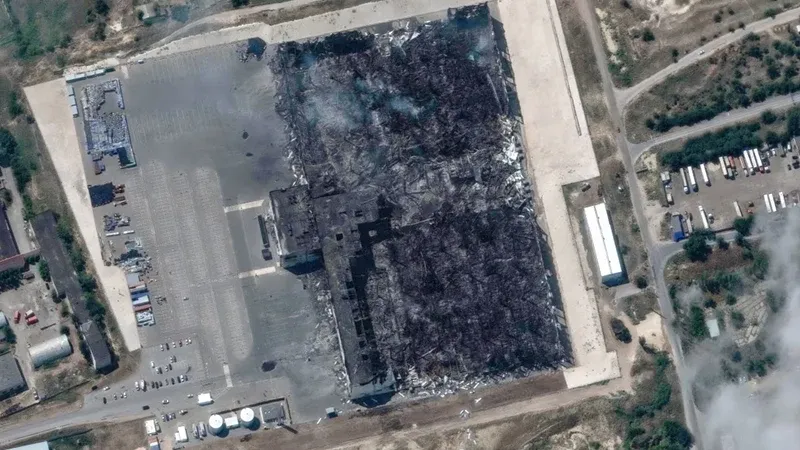
On 2 August a warehouse in Novosemeykino in Samara Oblast was struck. The following day one of the company’s largest facilities in Khryastovo in Vladimir Oblast was hit. By then investigative outlet Vyorstka calculated that the fourteen warehouses attacked covered more than 1.5 million square metres, or about 27 percent of Wildberries total warehouse space. Additional strikes occurred in Leningrad Oblast, Tula Oblast and Bashkortostan. On the night of 15 to 16 August multiple sites in Moscow Oblast were attacked, including Russia’s largest Wildberries logistics warehouse at Koledino, measuring 250,000 square metres. Satellite images the next day showed the northern building thoroughly destroyed.
Russian sources claimed nearly 200 drones had been intercepted that night. A later strike on 18 August near Obukhovo caused only minor wall damage and no loss of goods.
Wildberries facilities fall into two main categories: large distribution centres for regional storage and smaller sorting centres for local delivery. Some nearby non Wildberries sites were also affected, either by design or by proximity.
By mid August the company and its competitors had updated their terms to treat military action, including drone strikes, as force majeure, relieving them of the obligation to compensate sellers for lost or damaged goods.
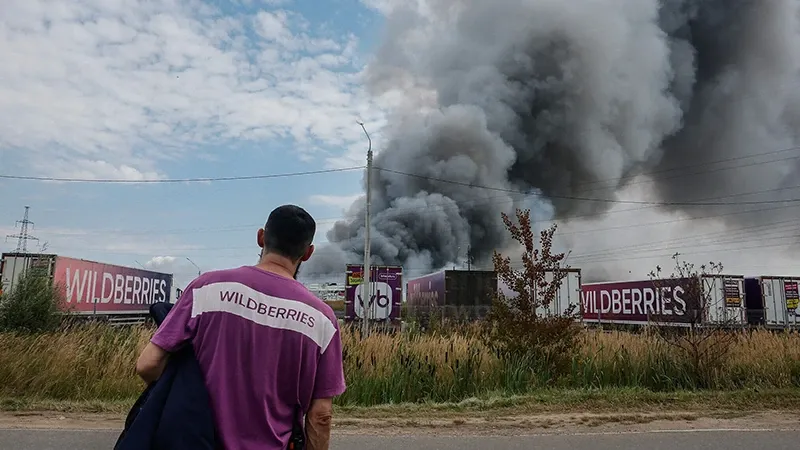
As a result of the attacks black smoke rose over the industrial outskirts for hours while emergency teams worked to contain the blaze.
Videos of the fire circulated quickly. Wildberries, which is Russia’s biggest online marketplace, just had many of its warehouses, including its biggest one, heavily damaged or destroyed.
This created a chain of events.
The consequences extend beyond any single fire or any of its warehouses.
Sellers now face delayed deliveries and lost inventory. Banks that finance the company have watched the figures with concern. Everyday shoppers notice longer wait times and occasional gaps on shelves that were once reliable. In a conflict that has already strained fuel supplies and transport networks, the targeting of the country’s largest online marketplace adds another layer of disruption.
The distance between a shopping cart and a strategic target has narrowed in ways that few anticipated when the purple bags first appeared on city streets. Smoke still rises from some of the damaged sites.
New drones continue to appear on radar.
The warehouses that once operated in the quiet margins of Russian daily life now sit inside the logic of a long war, where the machinery of ordinary commerce has become part of the contest itself.

All of this happened because Wildberries processes roughly half of all online purchases in the country, reaching tens of millions of users every month.
In sparsely populated areas the local pickup point is often one of the few pieces of commercial infrastructure still operating with any consistency. The scale of the network is enormous. Tens of thousands of pickup points stretch across the map.
The company also serves places beyond Russia’s borders and has presence in the United Arab Emirates and the former Soviet republics of Armenia, Azerbaijan, Belarus, Georgia, Kazakhstan, Kyrgyzstan, Uzbekistan and Tajikistan.
Until 2022 it had services in France, Germany, Israel, Italy, Moldova, Poland, Slovakia, Spain, Turkey and the United States.
It also once served buyers in Ukraine.
Warehouses measuring millions of square meters store goods that move every day.
The platform hosts more than a million sellers, most of them small and medium sized businesses that depend on its logistics to reach customers. The campaign against those warehouses has been methodical.
Ukrainian officials have said the sites were being used to move dual use items and components useful to the Russian military, including navigation systems and parts for drone production.
Russian statements have described the same strikes as attacks on civilian infrastructure intended to disrupt the wider economy and ordinary consumers.
The numbers that have emerged are substantial. Analysts estimate that goods worth hundreds of billions of rubles have been damaged or destroyed. Roughly a third of the company’s warehouse space has been affected in some way.
At least nine employees have been killed and scores more injured according to reports tied to the strikes. Several facilities have halted operations entirely.
The woman who built this system is Tatyana Kim.
In 2004 she was a 28-year-old English teacher on maternity leave in Moscow. The practical difficulty of shopping for clothes for herself and her newborn while confined at home became the spark.
With only a few hundred dollars of her own savings she launched a simple website from her apartment that allowed customers to order apparel from German catalogues such as Otto and Quelle.
The idea found an immediate audience among other young mothers facing the same constraints.
Her husband Vladislav Bakalchuk, a radiophysicist by training who had already founded an internet service provider called UTech, joined the effort and took charge of the technical side.
Although the company's official history emphasises her modest beginning, she also received substantial early capital from her husband, whose business activities later included the sale of UTech for approximately 7.5 million dollars.
That combination of personal insight, technical support and financial backing turned a small home-based project into the foundation of what would become Russia's largest online marketplace.
Over the years the small operation became the dominant force in Russian e commerce, surpassing the previous leader Ulmart, and is widely considered the Russian equivalent to Amazon in the United States.
After Western platforms withdrew following the full scale invasion of Ukraine in 2022, domestic marketplaces expanded rapidly. Wildberries was already the largest and it pulled further ahead.
The chain’s gross merchandise value almost tripled from 844 billion rubles in 2021 to 2.5 trillion rubles in 2023.
Kim became Russia’s richest woman.
The recent strikes have pushed her name into public view more forcefully than before, linking the private founder of a retail empire to the vulnerabilities of wartime logistics.
That background has grown harder to ignore. Across the country the logistics network that feeds those purple bags has come under sustained pressure.
Tatyana responded to the attacks through a video shared on her Telegram account. She called the Ukrainian drone strikes "terrorist attacks" and "acts of terrorism."
"For almost two weeks now, our company’s warehouses have been under terrorist attack," she said, saying that the attacks on Wildberries infrastructure are attacks on civilians, not only Russians, but also tens of thousands of entrepreneurs from Kyrgyzstan, Belarus, Kazakhstan, Armenia, Uzbekistan, China and other countries who do business on the platform.
She claimed these sellers had suffered losses "in the billions."
She rejected Ukrainian claims that the warehouses were being used for military goods: "You can open any global marketplace, Amazon or Alibaba, and see whether we carry anything they do not. There is no logic, no common sense, and no rationality in the terrorists' actions."
She said the real goal of the strikes was "to exert pressure, destabilise the situation, and cause panic and shock among a large number of Russians."
She also stated that the attacks constitute force majeure, so Wildberries is not legally required to compensate sellers for lost or damaged goods.
At the same time she said the company had already made two rounds of voluntary support payments covering nearly 100,000 small and medium-sized businesses, and that it was working with the Russian government on a broader package of assistance (including possible tax deferrals).

















































































































































































































































































