In the sun-baked highlands of Yemen's Al-Dhale Governorate, where the ancient crater of Haradhat Damt yawns like a wound in the earth, a young man once moved with the grace of someone who had made peace with danger.
His name was Al-Qa'qa' bin Antar, though most who followed his story knew him simply as the "Spider-Man of Yemen."
The nickname was not earned through comic-book heroics, or from being a fan of Peter Parker's alter ego. Instead, it was given to him by others, from doing what Spider-Man in real life could.
Al-Qa'qa' could scale sheer rock faces with little more than his hands and feet. His courage knew no bounds.
With no ropes, no harnesses, and often little more than determination and steady hands, he would lower himself into the steep, rocky throat of the dormant volcano to write visitors' names on the sheer walls high above the steaming sulfur waters below. For a few coins he turned impossible places into fleeting memorials, carrying whatever small payment he earned back to those waiting at home.
That, until fate finally caught up to him.
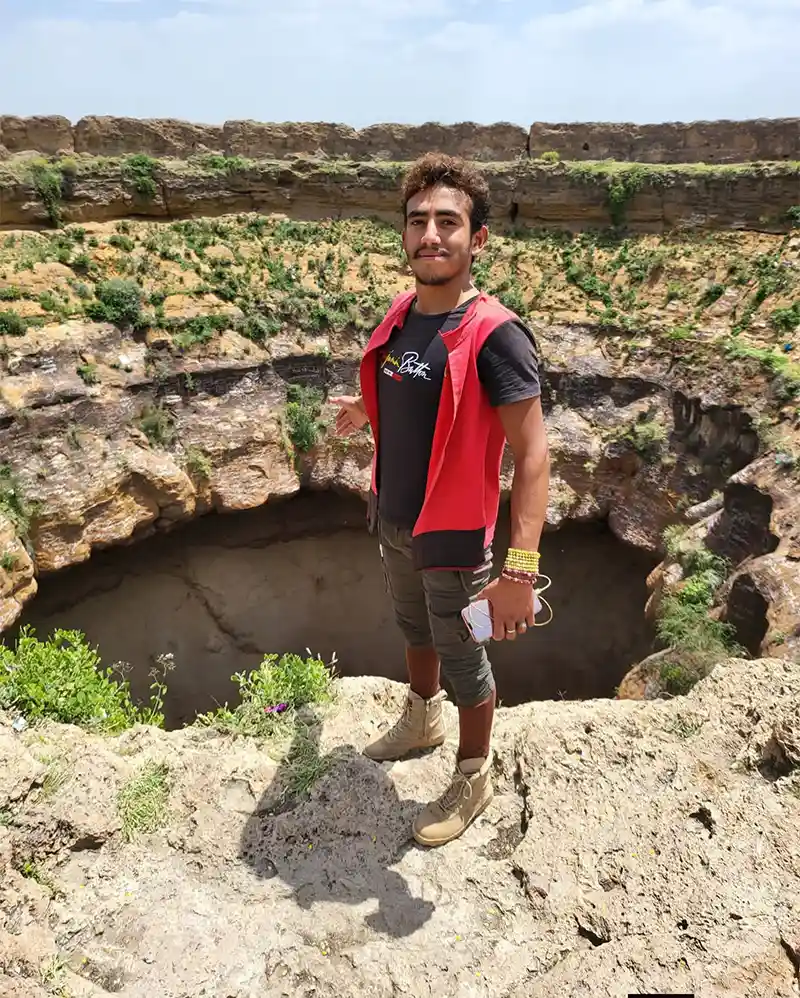
Haradhat Damt volcanic crater is located in the old town of Damt district, Al-Dhale Governorate at the south-central Yemen.
It is a prominent natural landmark, a dormant volcanic crater sitting atop a mountain with a depth of approximately 120 meters inside the crater.
Access to the rim of the crater is relatively easy. A metal staircase of more than 115 steps leads visitors directly to the edge, offering a dramatic view into the abyss below.
At the bottom lies a pool that, at first glance, resembles an ordinary freshwater pond. Its appearance is deceptive. The water has a distinctive murky, milky tint created by suspended mineral sediments and volcanic compounds dissolved within it.
Far from being a tranquil lake, the pool is acidic and saturated with sulfuric water, concentrated volcanic minerals, and toxic gases. The chemical conditions are so harsh that common green algae cannot survive there, leaving the crater devoid of the lush aquatic life typically found in freshwater environments.
And since the site is a popular local tourist attraction, the water is also littered with plastic bottles, food wrappers, non-biodegradables, and other litter are frequently discarded or blown over the edge.
In other words, there is no way for anyone to go to the bottom, and that the crater isn't a place where any living thing is meant (or wish) to normally linger.
But there, within these walls, hundreds of white Arabic inscriptions and names can be seen.
Many of which were written by Al-Qa’qa’ himself during previous descends.
Al-Qa’qa’ came from a family that knew hunger intimately.
Growing up in a household where every riyal carried the weight of survival, his climbs were never performed for the thrill alone. Al-Qa’qa’ literally laughed in the face of danger, just for work.
As a man in his 30s who had very few other choices in a country long scarred by conflict and economic hardship, his skills in scaling steep cliffs spread quickly through word-of-mouth, and through videos shared online.
People watched in stunned silence as his slight figure clung to rock faces that looked vertical from below. His movements were precise and almost casual against the backdrop of the crater's golden walls.
While doing his work barefoot, his agility seemed closer to that of a mountain goat than a human being.
The footage of him doing daredevil-like stunts traveled far beyond Yemen, turning him into a quiet sensation. Viewers far from the dust and heat marveled at his nerve, shared the clips, and sometimes sent small gifts or payments when they could. For a while the attention itself became part of the fragile economy that kept his family afloat.
He gained fame on social media, especially Facebook, with over 250,000 followers, most of whom were in awe of seeing his solo-climbs and stunts in the inner walls of a volcanic crater and writing/painting tourists’ names or messages in white chalk or paint high up on the rocks.
Videos of his climbs spread across social media, showing him ascending vertical cliffs and navigating narrow ledges hundreds of feet above the ground. To onlookers, it seemed as though gravity held less power over him than it did over everyone else.
His videos of these daring climbs went viral locally and internationally.
Virality, in its strange way, gave his desperate skill a wider audience and a sliver of extra income, even as it kept asking him to return to the same deadly edge.
For years, the crater rewarded precision and punished nothing. Each successful descent reinforced the illusion that skill alone could hold fate at bay. Then, one day, the margin vanished.
While moving along the inner slopes of the crater he had come to know so well, Al-Qa’qa’ slipped.
He had climbed those walls countless times and knew their contours better than most who had ever stood at the rim. But one mistake, he fell into the depths, vanishing into the hot, sulfurous waters that had long whispered their warning.
The crater that had been his stage and his livelihood had become the place that would not let him go.
Rescue workers and local volunteers rushed to the site, lowering themselves into conditions that offered little mercy. Through the scorching heat, the toxic fumes, and the unstable rock, the team searched through the long hours, driven by the same stubborn humanity that had once drawn crowds to watch him climb.
Up above, crowd formed around the rim of the crater, watching every moment as them descended to the sulfurous hell.
Al-Qa’qa’ fell on June 12th, and his body was recovered on or around June 13 amid the challenging conditions.
Some local sources noted that the rescue response from the Houthi-controlled district center was not as fast as hoped.
News of his death moved through Yemen and across social media with the same speed that had once carried his climbs.
Prayers rose in Arabic and other languages. Some messages held only grief for a young life cut short and for the family now left to face an emptier future. Others wondered aloud about the people who had paid him to take those risks or who had watched his videos with excitement, asking quietly whether the spectacle had ever been worth the price.
In the comments and reposts, there was anger at poverty that leaves young men with such narrow paths, and there was also simple sorrow that a man who had climbed so high for the sake of others should fall so far.
The same platforms that had amplified his daring now carried his absence, and the conversation turned, as it often does when tragedy arrives in pixels, to the thin line between admiration and complicity.
Al-Qa’qa’ bin Antar was not a character in a film.
He was a son who carried responsibility on his back every time he stepped toward that crater's rim. He was a neighbor whose skill became legend in a place where legends are hard to come by. He was one of many young people in Yemen who have learned to turn whatever gift they possess into daily bread when steadier work is scarce.
The crater still stands above Damt, its walls marked by hundreds of names written in white against the rock. Many were left there by Al-Qa'qa' bin Antar.
Long after the crowds have stopped watching and the videos have faded from people's feeds, those names remain.
They are reminders of the young man who risked his life to write the stories of others, only to leave behind a story that Yemen itself would remember.

















































































































































































































































































