At Massachusetts, the most populous state in the New England region of the northeastern U.S., lives an 85-foot northern red oak tree in a 4,000 acre Harvard Forest.
Located at an outdoor research lab owned and operated by the university, this tree is regarded as one of the oldest members living in the area of Prospect Hill. It has become one of the very few remaining after the 186 miles-per-hour winds destroyed much of the region back in 1938.
And here, the tree has been given its own Twitter account called 'A witness tree'.
From its @awitnesstree Twitter account, it introduced itself as “one of the oldest living organisms on the internet!”
With the help of a few researchers and scientists, including from Harvard University postdoctoral fellow Tim Rademacher, they want to preserve this particular Quercus rubra, by tweeting periodic reminders about the tree, and the dangers it faces as part of the world's global warming.
Hello, World! I am a century-old red oak at Harvard Forest in MA: one of the oldest living organisms on the internet! Follow me to learn more about my life in a changing environment. For more on info how I work, go to: https://t.co/vI5k4AzEEQ. pic.twitter.com/nN7yacQ0aR
— A witness tree (@awitnesstree) July 17, 2019
Rademacher chose this particular tree, because it's common in the U.S..
"We wanted something everyone could find in their backyard," he said as reported by Atlas Obscura. As for why the teeam chose a tree in the first place, is because trees like beech, birch, hemlock, white pine, and maple trees growing nearby, are all experiencing "the same environmental things that we experience," explained Clarisse Hart, the director of education and outreach at the Harvard Forest.
Humans and trees are very different in so many ways, but both are "absolutely experiencing heat, rain, growing, breathing, sweating, eating, doing all of these things that we do.”
Rademacher plans for the tree to publish at least six tweets a week for the foreseeable future.
And as for the tweets the team is tweeting, depend on what the tree's sensors are detecting.
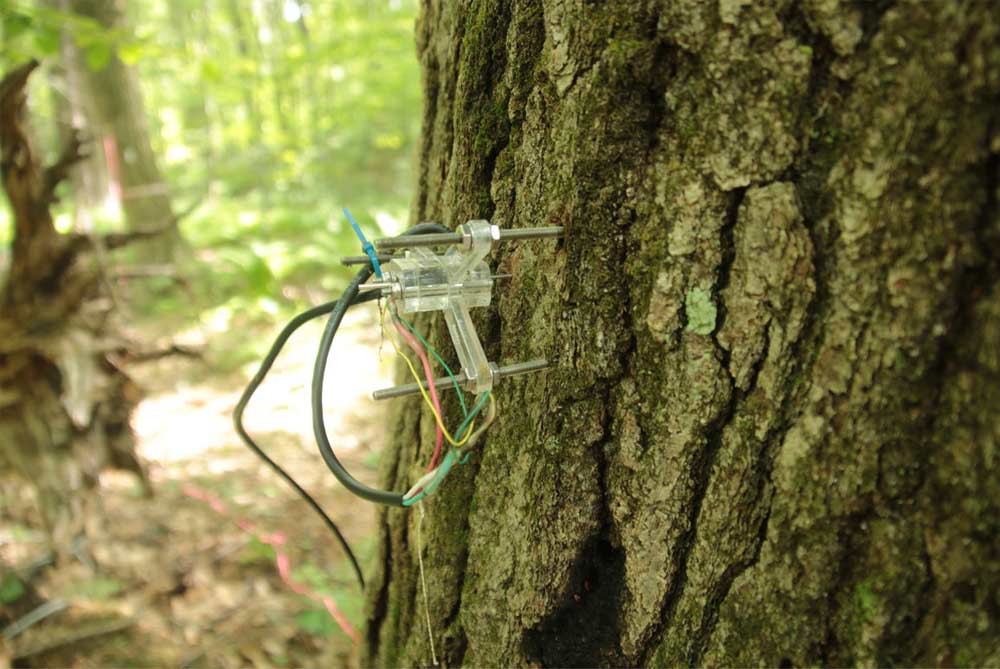
For example, the dendrometers measure the daily (or seasonal) expansion and contraction experienced after the tree soaks up water and passes it along to its leaves. Understanding this expansion and contraction cycle can help scientists understand how the cells help store carbon dioxide and offset greenhouse gas emissions.
The tree also has been equipped with a PhenoCam, a digital camera looking up at the tree’s canopy to snap a photo once every 30 minutes. The team also record soil temperature, wind speed, and other sorts of data gathered four times an hour from a nearby weather station.
With these equipment, the team receives streams of data to feed a bot built for Twitter to communicate to the world about what is happening in and around the tree.
Scrolling through its Twitter feed is a bit like reading through a diary.
"We knew that we wanted the tree to speak in the first person," said Hart. "That was important to us."
"How many accounts are there with a tree speaking for itself?" added Rademacher, saying that, "We’ve tried to make sure that all of the messages are data-driven or environmental facts, things we know for sure, and not about how the tree ‘feels'".
Previously, a 67-million-year-old Tyrannosaurus Rex fossil owned by Chicago’s Field Museum has also been given its own Twitter account at @SUEtheTrex.






















































































































































































































































































