The fierce competition in large language models, often dubbed the "LLM war," shows no sign of stopping.
Since the launch of OpenAI's ChatGPT in late 2022, the breakthrough chatbot captured global attention and demonstrated the transformative potential of conversational AI. What began as a consumer phenomenon quickly escalated into a high-stakes race among leading labs to build ever more capable frontier models, pushing boundaries in reasoning, coding, and multimodal understanding.
Yet this rapid advancement has come at a steep price: computational costs have skyrocketed as models grow larger and more sophisticated, with training and inference demanding massive GPU clusters, energy consumption rivaling small nations, and operational expenses that challenge even the best-funded companies to achieve profitability.
OpenAI, despite its early lead and enormous revenue from ChatGPT's viral adoption, has grappled with these realities, reportedly burning billions annually on compute while pursuing aggressive scaling. In fact, it even began launching ads to help keep the free ChatGPT accessible to everyone.
In contrast, Anthropic has carved out a distinct path, prioritizing sustainable growth through an enterprise-focused business model that emphasizes high-value, capability-driven usage over sheer volume.
Rather than chasing unlimited consumer access that could strain infrastructure, Anthropic targets businesses willing to pay premium prices for reliable, secure AI that integrates deeply into workflows: tasks like coding, data analysis, project management, and creative production.
This approach yields higher average revenue per user (ARPU), particularly in mid-market and larger segments, where companies deploy Claude for specialized, high-impact applications rather than casual queries.
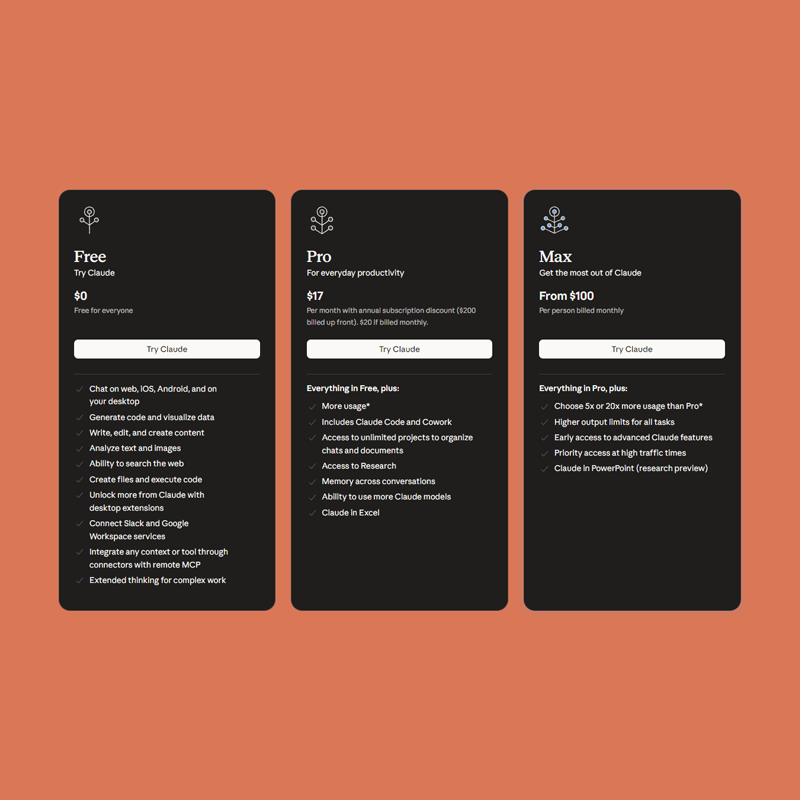
We're bringing some of Claude’s most-used features to the free plan.
File creation, connectors, and skills are all now available without a subscription. pic.twitter.com/6EjrwLTWVQ— Claude (@claudeai) February 11, 2026
And with that in mind, Anthropic is able to sustain the rising costs. And because of that, it's willingly make some of Claude's most powerful features, like file creation (for documents, spreadsheets, and presentations), connectors to tools such as Asana, advanced skills for complex workflows, and automatic context compaction (where Claude intelligently summarizes long conversations to maintain continuity), available on the free plan.
This democratizes access, allowing individuals and smaller teams to experience Claude's strengths without upfront commitment.
The move encourages organic adoption: users experiment with real-world tasks, like planning weekend events, generating flyers for parties, setting up creative request trackers in Asana, or building production models in Excel for product designs like athletic shoes factoring in tariffs and materials.
Visual examples abound, from bar charts analyzing customer distribution and segment insights in mid-market opportunities, to churn risk assessments highlighting retention strategies for small clients, and polished event flyers with artistic overlays blending music, fun, and good vibes.
These free-tier enhancements serve as a funnel. Casual users discover value in everyday productivity boosts, from leveling up PowerPoint decks to automating creative pipelines, fostering habit formation.
Compaction is also now on the free plan.
Claude summarizes earlier context automatically, so long conversations can continue without starting over.
Get started: https://t.co/tHPAZRgQkn— Claude (@claudeai) February 11, 2026
For what it's worth, many could naturally graduate to paid tiers for higher limits, priority access, and advanced capabilities when workflows scale.
This "freemium-to-enterprise" dynamic aligns with Anthropic's focus on capability over cost sensitivity, where businesses prioritize economic value from automation, even for pricier interactions, leading to stronger retention and higher ARPU in segments like mid-market firms with 100-1,000 employees.
In an era where compute demands threaten to outpace revenue for some players, Anthropic's model proves resilient: generous free access builds a broad user base and ecosystem lock-in, while enterprise-grade reliability and integrations drive monetization from those who depend most on the tool.
As the LLM landscape intensifies, this balanced approach not only offsets escalating costs but positions Claude as a practical, enduring choice for both individuals unleashing creativity and businesses streamlining operations.




















































































































































































































































































