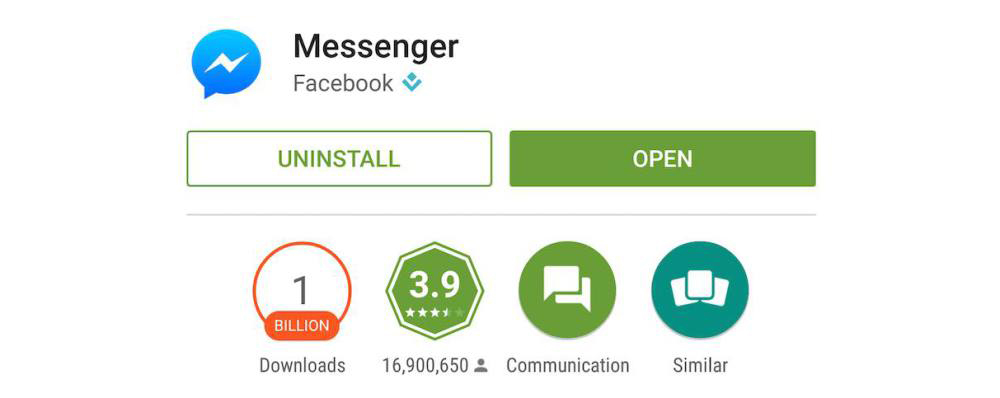
 When mobile devices are getting more popular, the number of Android devices increases along the way. As the owner of Android, it's not a surprise that Google and its services are able to reach 1 billion downloads on Google's Play Store. But on June 9th, 2015, Facebook that was the second company to reach that number, is putting another one up: Messenger.
Facebook's Messenger is joining the very executive club, along with Facebook's core app, WhatsApp, and Google's Gmail, YouTube, Search, and Maps.
The news first came from Messenger's team leader David Marcus, Facebook VP for Messaging Products, when he announced Messenger has now been downloaded over 1 billion times on Android.
"Happy to make it to the very exclusive Android 1 billion+ downloads club," said Marcus on his Facebook page.
By putting its second product as one of the most downloaded app on Google Play, Facebook proved how big its messaging business is. And with Messenger, the company is in pride that SMS can be replaced.
As for its strategy, Messenger is pushing its own modern mobile sharing feature with speedy texting. The strategy has proven well, and it all has paid off. With VoIP, video calling, stickers, voice clips, peer-to-peer payments, location, and becoming a platform for third-party content creation, Messenger is 'one simple messenger' with tons of feature.
With that in hands, Facebook wants Messenger to be the everyday way people communicate with others on mobile devices.
The 1 billion milestone is significant for Messenger not because it's backed up by Facebook, but because how it gets there. The app was initially received poorly by users, and now it's proving itself that it's never a slouch.
A Brand on its Own, a Name on its Own
Getting to the 1 billion mark wasn't easy. Even for the giant Facebook. When its competing with Google, Facebook has had a hard time. When Facebook decided to "unbundle the big blue app", the company is trying to liven up its services to become their own brand.
And in the messaging war, getting to this point is never easy.
With Facebook supporting its back, Facebook has made Messenger its own brand, but baked it a lot deeper into its product. Combined with Facebook's WhatsApp and streamlined SMS alternative, Facebook controls messaging in a way that deeply insulate its users from distraction (competitors).
Many other companies have tried in making their own messaging app. But Facebook succeeded them, by far margin, because it was already focusing on the communication utility across all platforms. Its social network its the fuel that enrages the number to speed up fast.
With tons of features flowing and running throughout Facebook, Founder Mark Zuckerberg decided that it would be best if Facebook unbundles to become even bigger. With communication at the heart of Facebook, messaging (Messenger) is sort of a Facebook's byproduct.
But that byproduct is not anymore Facebook's side dish. It's becoming the drink that accompanies the main dish.
When a user is searching for someone, or a friend, Facebook shows them how to talk personally to them on Messenger, not by visiting their profile. When its someone's birthday, in some cases Facebook recommends users to send a birthday greeting via Messenger, not by writing on their own wall.
Facebook's secret weapon in the messaging wars is by putting its social network byproduct as something other than its money making source. Rather than making Messenger bulked up and bloated with advertisements or marketing messages to convince users to do specific things, Facebook is making Messenger its close brother. Facebook is allowing Messenger to be free, leaving the 'big blue brother' to do all the money making.
And if talking about Facebook, people can be certain that the social network's mobile ads alone can earn enough money for the whole family.
One Racer, One Winner
Facebook has entered the messaging war with pride, and its pride is never less when it can show the world that it has succeeded. Facebook first saw its messaging feature as something buried under tons of its blue bahemoth weight. By freeing the extra weight, Facebook's social networking can breathe a bit easy, and Messenger becoming an agile product that was fast enough to swift around competitors fast and easy.
Google as one of Facebook's most powerful competitor in the internet and mobile business, is a company with big earnings and nevertheless, deep pockets. With its owned resources, Google has enough fund to create its own messaging ecosystem within its business. But Google is not tasting the sweet smell of messaging success when its attempt to own the industry was distracted by its multiple 'moonshots'.
Furthermore, Google was late on the mobile messaging business, and was already losing to Facebook when tried social networking with Google+. It has wasted resources on products with lesser success, such as with Hangouts, and missed the chance to acquire WhatsApp.
If it did acquire the messaging platform by Jan Koum, Google is probably making this messaging war a two-horse race.
Instead, Facebook acquired WhatsApp, and successfully made its Messenger following its footsteps. Facebook is certainly undisputed because it saw messaging as a byproduct of its social network, and saw the opportunity for it to become the center of mobile communication.
When people have been speculating about who will be the next Facebook-killer app, competitors coming from other part of the globe, such as China's WeChat, or the South Korea' KakaoTalk, or Japan's LINE, have been trying to answer the question in the messaging business. But Facebook oversees the industry with a happy smile on its face since it can provide the world with its own answer.






















































































































































































































































































