The landscape of AI has been dramatically reshaped in recent years, particularly with the explosive rise of conversational AI.
It's impossible to discuss this evolution without mentioning the launch of ChatGPT by OpenAI, captured the public's imagination with its human-like text generation and broad range of capabilities. Its arrival in late 2022 sent shockwaves through the tech industry, prompting established giants to accelerate their own AI initiatives.
Google, a long-time tech titan, was both in awe and worried.
At the time, it began to see the potential but at the same time, it started seeing it as a threat to its existing business.
In response to this, Google introduced Gemini, which then evolved to become a multimodal AI, capable of understanding and generating not just text but also images, audio, video, and code. It represented Google's ambitious effort to create a unified and highly capable AI model that could compete directly with the growing prowess of models like GPT-4.
While Gemini aims to tackle the bigger player and to push what the company is capable of in terms of top-tier performance across a wide range of tasks, Google also has Gemma, a family of lightweight, open models built upon the same research and technology that powered Gemini.
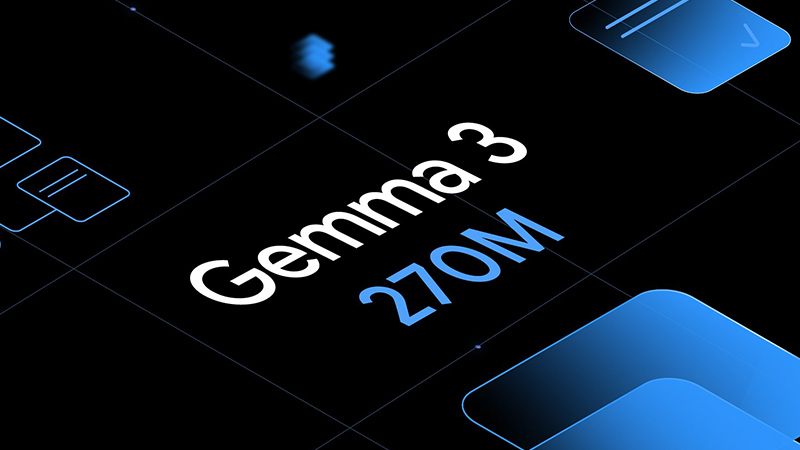
And within this Gemma family, Google introduces a particularly intriguing member: 'Gemma 3 270M.'
Introducing Gemma 3 270M
A tiny model! Just 270 million parameters
Very strong instruction following
Fine-tune in just a few minutes, with a large vocabulary to serve as a high-quality foundationhttps://t.co/E0BB5nlI1k pic.twitter.com/XntprMBqSC— Omar Sanseviero (@osanseviero) August 14, 2025
At first, people thought that it would be a massive AI model with billions of parameters. No, they were wrong.
The "270M" in its name refers to the approximately 270 million parameters it contains. To put this in perspective, larger language models boast billions or even trillions of parameters. This stark difference highlights the core principle behind Gemma 3 270M: small is powerful.
In fact, that amount of parameters is even smaller than Bard, the predecessor or Gemini, a model that had a botched introduction.
Bu unlike Bard, Gemma 3 270M that was trained by Google DeepMind, leverages the same infrastructure and techniques used to develop the larger Gemini models. This means it benefits from the knowledge and capabilities honed in those more expansive models, but distilled into a much smaller footprint.
The key here is efficient training methodologies and architectural choices that allow the model to retain a significant degree of intelligence despite its size.
In a world where the prevailing trend is towards ever-larger language models, the purpose of Gemma 3 270M might seem counterintuitive.
However, its creation addresses a crucial need: democratizing access to advanced AI. Larger models, while powerful, often require significant computational resources to run, making them expensive and less accessible for many developers and researchers.
Gemma 3 270M, with its minuscule size, can run on devices with limited processing power and memory, even potentially within web browsers.
In fact, it's so small that Omar Sanseviero, a developer at Google, wrote in a post on X, humorously stating that the Gemma 3 270M model "can run even in toasters."
This can run in your toaster or directly in your browser
Try it in https://t.co/KAfiH3hUnf— Omar Sanseviero (@osanseviero) August 14, 2025
While this is just a hyperbolic claim, this is just a claim on how remarkably efficient the model is, designed to operate on devices with minimal resources, not just high-end machines.
The pursuit is clear: Google continuous development in the field shows impressive results, and with the advancements of technology, it can pack enough firepower into a small package.
The goal of this the Gemma family, or this 270M model is to eliminate the barriers of entry.
LLMs run in resources so big they require stacks upon stacks of computers. And for more than often, these models require cloud infrastructure and specialized hardware.
Gemma 3 270M offers a compelling alternative by enabling on-device AI, where AI features run directly inside phones or laptops without internet; a faster way to train and fine-tune, better accessibility, and more.
Some fun things people may have missed from Gemma 3 270M:
1. Out of 270M params, 170M are embedding params and 100M are transformers blocks. Bert from 2018 was larger
2. The vocabulary is quite large (262144 tokens). This makes Gemma 3 270M very good model to be hyper…— Omar Sanseviero (@osanseviero) August 15, 2025
But it's small frame doesn't mean it's far from the league.
Despite having only 270 million parameters (170 million of them are embedding parameters and the remaining 100 million are transformers blocks), the 270M has a quite large vocabulary at 262,144 tokens. What this means, the 270M can be a very good model for hyper specialized task or tuned for a specific language, since the "the model will work very well even with less common tokens."
In conclusion, while the race for larger and more capable language models continues, Google's Gemma 3 270M represents a significant and valuable counterpoint.
By focusing on efficiency and accessibility, Google is empowering a broader range of developers and researchers to harness the power of advanced AI, potentially leading to a new wave of innovative applications that can run virtually anywhere.
This tiny titan might just play a crucial role in shaping the future of AI, proving that sometimes, smaller can indeed be mightier.

















































































































































































































































































