Google, the tech giant, always has its chin up, thanks to its unwavering confidence.
The company that was founded in 1998, quickly replaced internet directories by crawling the entire web, indexing everything, and make it searchable. By becoming the most prominent being on the internet, Google has earned a substantial amount of money and resources to surpass pretty much all other entities that have a web presence.
But after OpenAI launched ChatGPT, Google's CEO Sundar Pichai quickly realized the potential of this little insignificant product can have in the foreseeable future.
The most importantly, this OpenAI startup could become the next big thing that threatens the very existence of the mighty Google.
It was a "code red" at Google, and its founders, Larry Page and Sergey Brin were summoned to the office.
What came next, it's an arms race between a irreplaceable tech titan and a quick-growing phenomenon poster-child.
And this is becoming more apparent when Google created Gemini, which was previously called Bard, just to ensure that it remains relevant in the business.
The thing is, Gemini is an addition to Google Search, made to complement it.
Google that knows its position in this competition, tries to kill the web by transforming how people look for information. But this task is herculean, given how big Google Search is.
This is where OpenAI uses its position as an advantage, and teased SearchGPT, which should've sent the chills down Google's spine.
Then, the inevitable happens.
OpenAI finally released ChatGPT Search feature, where the chatbot can look for something up on the internet to answer users' queries, free for all users.
OpenAI knows that the search engine from OpenAI for the chatbot lives under the ChatGPT name. Being part of ChatGPT itself, the feature's reach will automatically go up the more people use the product.
It's reach will also expand the more Large Language Models become popular.
OpenAI never positions itself as a competitor to Google, but in an expected but bold move, OpenAI now announced that it's making the ChatGPT Search available to everyone, for free, and no signing up is even required.
ChatGPT search is now available to everyone on https://t.co/nYW5KO1aIg — no sign up required. pic.twitter.com/VElT7cxxjZ
— OpenAI (@OpenAI) February 5, 2025
The reason for this is based on the fundamentals of searching with Google and interacting with Large Language Models like ChatGPT.
They offer distinct experiences due to their differing architectures and purposes.
Google Search functions as an index of the web, continuously crawling and updating its database to provide the most recent information. Upon entering a query, users receive a list of relevant web pages, requiring them to navigate to these sites to find specific answers. This method ensures access to up-to-date information from a variety of sources.
In contrast, LLMs are trained on vast datasets to understand and generate human-like text, enabling them to engage in contextual conversations. They provide direct, coherent responses to queries, often without the need for external navigation. However, their knowledge is based on the data available up to their last training cut-off, which may result in outdated information if not updated regularly.
A key difference between the two is interactivity. LLMs offer conversational interactions, allowing for follow-up questions and clarifications, whereas traditional search engines provide one-way information retrieval.
While search engines direct users to external sources, facilitating access to a broad range of perspectives, LLMs are known to generate responses based on their training data, which may not always reflect the most current information.
With features like ChatGPT Search, this is changing.
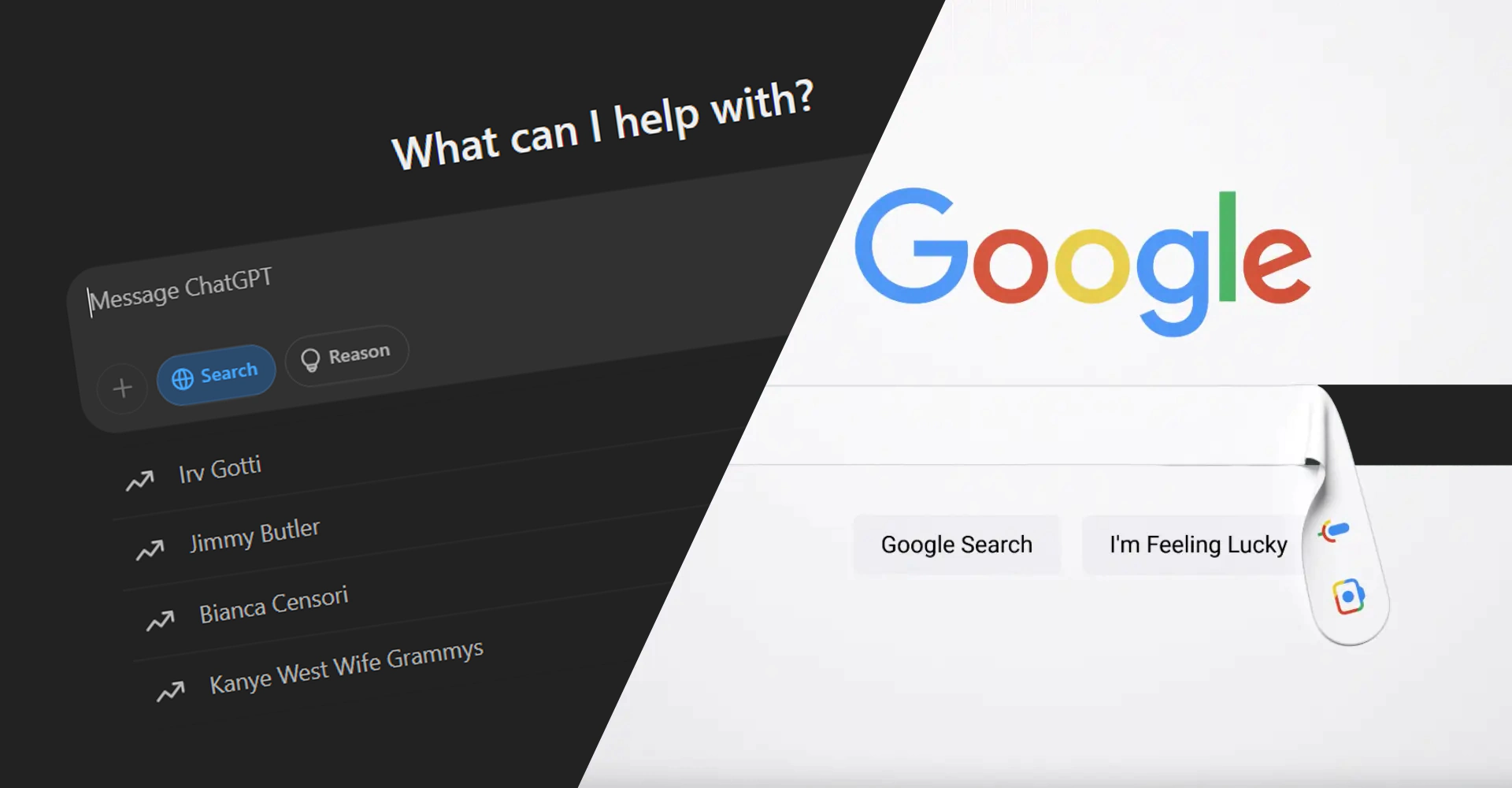
OpenAI versus Google is like the equivalent of an irresistible force paradox, which can be described as a classic paradox formulated as "an unstoppable force trying to hit an immovable object.".
The paradox exists because it relies on two incompatible premises.
In other words, at least in business and influence perspective, if ever OpenAI can catchup to the level Google Search is already at, its the end of King Google.
If not, ChatGPT will forever remain an alternative to Google Search and its Gemini underling.






















































































































































































































































































