In an age when screens deliver endless streams of text and images, the physical book retains a quiet authority that digital fragments rarely match.
Its pages hold the work of authors, editors, and printers who shaped ideas over months or years, creating something durable enough to sit on shelves for decades. Libraries, secondhand shops, and private collections still serve as repositories of that concentrated knowledge, even as online sources expand without limit.
The race to build more powerful AI systems has begun to draw these same objects into a different kind of economy.
High quality training data has become one of the scarcest resources in the field.
And Anthropic has done something imaginable.
Traditionally, web crawlers that scout the web through every link they can find produce vast quantities of text. However, much of it is noisy, repetitive, or already contaminated by earlier machine generated content.
Books, especially those published before the recent wave of generative tools, offer cleaner, more carefully structured language.
Companies seeking an edge have therefore turned to physical volumes in large numbers.
Court filings unsealed in connection with a copyright lawsuit against Anthropic revealed the scale of one such effort.
In early 2024 the company launched an internal initiative it called "Project Panama."
An planning document described it as an effort to destructively scan all the books in the world and added a clear instruction that the work should remain unknown outside a small circle.
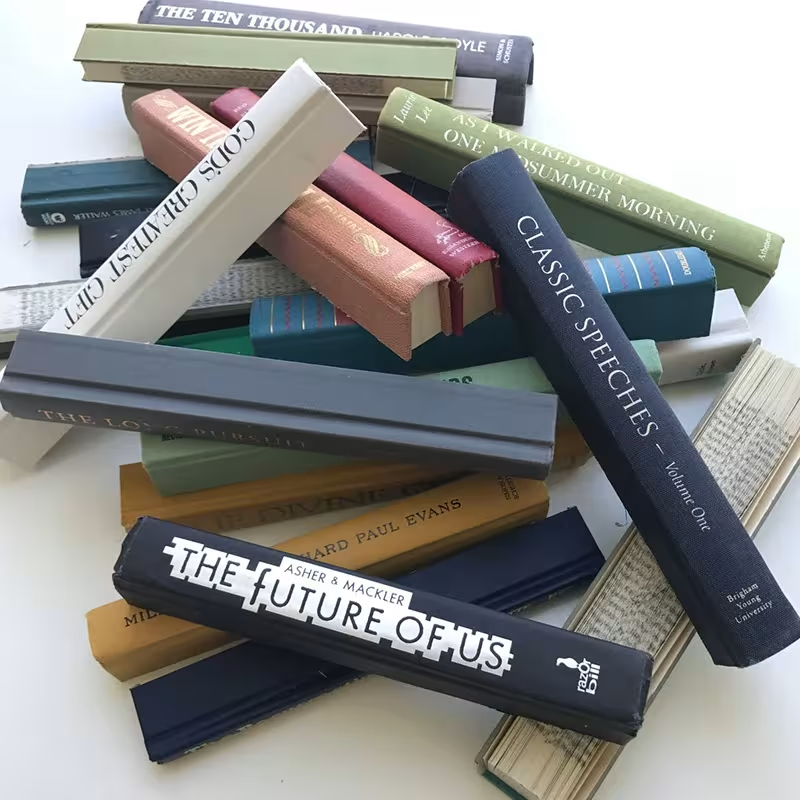
Anthropic spent tens of millions of dollars acquiring used books in bulk from sellers such as Better World Books and the British firm World of Books.
Shipments arrived by the tens of thousands and filled industrial warehouses whose photographs later appeared in the legal record.
To process the volumes at speed the company turned to Tom Turvey, a Silicon Valley veteran who had earlier helped launch Google Books.
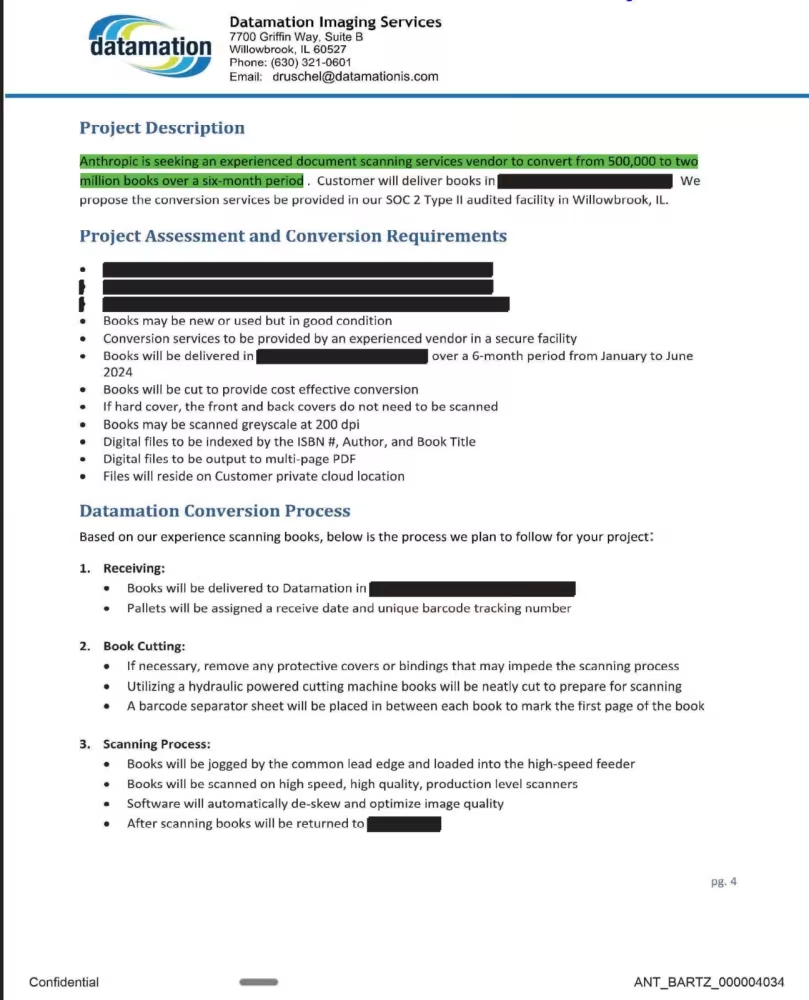
Vendors received proposals seeking capacity to handle between 500,000 and 2 million books over roughly six months.
The method itself was straightforward and irreversible: using a hydraulic powered cutting machine sliced the spines from the bound volumes so that individual pages could be fed through high speed production scanners.
Once the digital images were captured the paper was collected by recycling firms and pulped.
The resulting files became part of the internal library used to train Anthropic's Claude models.
A federal judge later ruled that this particular sequence, the purchase of physical copies followed by their conversion into a single digital version kept strictly inside the company, qualified as fair use.
The transformation from print to searchable data, the court found, did not create extra copies for distribution and therefore stayed within the bounds of the law.
Separate claims involving millions of pirated digital downloads from sites such as Library Genesis led to a different outcome.
Anthropic settled those claims for $1.5 billion dollars, an amount that works out to roughly $3,000 per eligible title for the authors and rights holders who filed claims.
Thing is, the precedent did not remain confined to one laboratory.
And that many of the books Anthropic acquired, are rare.
Across Europe secondhand and antiquarian dealers began receiving unexpected bulk inquiries.
Lists of thousands of International Standard Book Numbers arrived overnight, often from firms that few in the trade recognized.
One Singapore based company calling itself "2077AI" sent a Dutch bookseller a roster of 3,000 English titles that included a 1999 geomechanics monograph, a 2018 study of laser treatment on ceramics, and a 2021 volume of Irish folk tales.
A Canadian outfit named Zoom Books placed systematic orders in the early morning hours for volumes that shared no obvious collecting theme.
Dealers reported that the titles were frequently too specialized or low circulation to attract ordinary buyers, raising the suspicion that the books were destined for the same destructive process.
Brokers have since entered the market openly.
One firm that maintains a large bibliographic database now advertises bulk acquisition services to AI clients, offering lots that can range from a few thousand to a million volumes.
Its own materials note that the optics of large scale destruction remain a real problem and that headlines about companies destroying millions of books do not generate public sympathy.
Buyers are often kept anonymous and the transactions are covered by nondisclosure agreements.
Not every laboratory has adopted the same approach.
In late July 2026 Elon Musk stated that he had instructed his own AI team to preserve rare books in a library and to scan them by slower, nondestructive methods rather than cutting the spines.
The contrast highlights an emerging choice.
Digitization can safeguard the intellectual content of a work that might otherwise decay or remain inaccessible.
At the same time the physical object itself carries historical and material value that disappears once the paper is recycled.
For common titles the loss of any single copy may be negligible. For obscure academic monographs, limited foreign language editions, or low print run volumes the disappearance of the last circulating examples changes the landscape of what remains available to future readers and researchers.
The episode leaves the industry and the public with a set of unresolved tensions.
The demand for clean, high quality text continues to grow as models expand. Legal rulings have drawn a line between pirated downloads and purchased physical conversion. Market mechanisms now supply the books at industrial scale. Whether the long term result is a richer shared digital heritage or a quieter thinning of the physical record depends on choices still being made in warehouses, courtrooms, and laboratories.

















































































































































































































































































