Few video game franchises have carried the same weight, mystery, and legacy as Metal Gear.
Born in 1987 under the creative vision of Hideo Kojima, the series pioneered the stealth-action genre, blending tactical gameplay with cinematic storytelling long before such hybrids were the norm. Over the decades, Metal Gear evolved into a cultural phenomenon, marked by its complex plots, unforgettable characters, and themes that challenged the boundaries of what video games could be.
By the time Metal Gear Solid V: The Phantom Pain was released, the series had already cemented itself as one of gaming’s greats.
The anticipation was massive, not only because it was billed as Kojima’s last Metal Gear title under Konami, but also because it promised to push the franchise into a new open-world era.
And in the middle of all that attention, one character managed to overshadow almost everything else: Quiet.
She is silent, but made everyone else scream the loudest because of her presence.
And that is for obvious reasons.
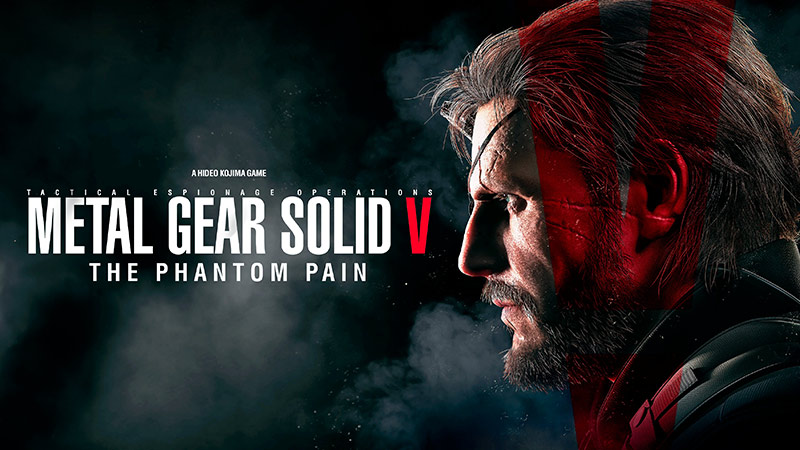
When Metal Gear Solid V: The Phantom Pain launched in September 2015, it marked both a culmination and a new beginning for the legendary stealth-action series.
Developed by Kojima Productions, the game pushed the boundaries of open-world design while retaining the cinematic storytelling and intricate plot twists the franchise is known for.
Set in 1984, the story follows Venom Snake, the enigmatic leader of Diamond Dogs, as he navigates a world rife with political intrigue, mercenary warfare, and the lingering scars of past conflicts. With sprawling environments across Afghanistan and Africa, dynamic day-night cycles, and a vast array of tools and companions, the game offers players unprecedented freedom in how to approach each mission.
Besides Snake, the game also brings back key recurring figures from the franchise, including Revolver Ocelot, the legendary gunslinger and manipulative operative; Kazuhira "Kaz" Miller, Snake’s loyal ally and tactical strategist; and Eli, the young child destined to become Liquid Snake.
But it was Quiet, the mysterious sniper, that stole the spotlight beyond others, even Snake.
The mute woman joined Snake, a "Big Boss" on his mission. And soon after the game revealed her, she became an internet sensation almost overnight.

From trailers and gameplay footage leading up to the release, she was already controversial.
As an aid to Big Boss, she was integral to the gameplay and story. Being a buddy character, Quiet could scout locations, provide sniper support, and fundamentally change the way missions played out.
For many players, she became indispensable.
And as the story progresses, her bond with Snake grows deeper. By the time her emotional arc reached its conclusion, countless fans who had initially dismissed her design came to see her as one of the most memorable characters in Metal Gear Solid V: The Phantom Pain.
But there's more where that came from: her revealing outfit.
Quiet wears a bikini top, torn tights, boots, and a few straps of gear. Literally speaking, the mute woman is half-naked in a military setting.
This revealing outfit was defended by Kojima as something that would make sense within the story. Kojima said that Quiet was exposed to parasites that allowed her to only breathe and absorb nutrients through her skin.
Because of this, she was forced to wear minimal clothing in order to survive.
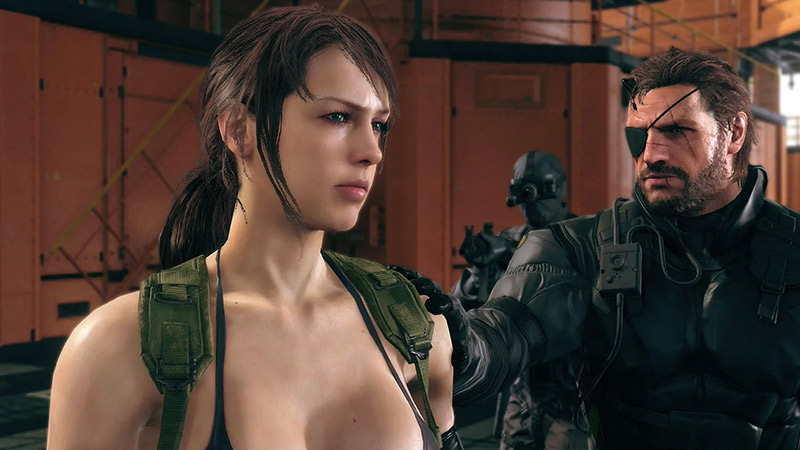
This happened earlier, when Quiet, known to the Soviet forces as Tixij, was tasked by Skull Face to assassinate Snake, who was going by the name "Ishmael," at a hospital.
Quiet managed to kill both the nurse and doctor in attendance, but failed to kill Snake. Quiet was doused with a bottle of medical-grade ethanol, and Ishmael lit her on fire.
Ultimately, she survived, although with severe enough injuries to force herself to be infected with a mutant strain of the "the one that covers" parasites. The infection repaired the physical damage she sustained, and granted her superhuman speed, perception, durability, longevity, phasing and invisibility. It also allowed her to breathe through her skin and take in nutrients via photosynthesis or small showers, effectively removing the need for food, drinking or breathing.
To Kojima’s supporters, this was an attempt to ground the design in narrative logic; to his critics, it felt "oversexualizing" the female character, and his statement is like a thin excuse for fanservice, arguing about sexualization in games.
It’s like Konami and Kojima Productions agreeing with a plot that was constructed after having her visual design finalized, not the other way around. And even if it isn’t, the effort is still undermined by the way her scenes focus more on her physical appearance, and less about her emotions.
In the game, if the affection between Snake and Quiet increases, more scenes can be unlocked.
For example, there is the scene where Quiet dances playfully in the rain, sunbathing where Snake can interact, multiple animations where she sits, gazes, or interacts with Snake mid-flight. Then, there is the notable shower scene, which can be triggered when Snake returns to the base bloody enough. Not to mention the close-quarter combat training, where Quiet had a friendly spar Snake.
Another scene where Quiet was sexualized, was during in Afghanistan.
Declared Missing in Action (MIA), Quiet was captured by the Soviet forces, and was forcibly clothed for modesty. This interfered with her parasite-based respiration and suppressed her abilities. Despite her attempts to escape, she was recaptured, and in a tense, threatening encounter, one of her captors attempted to take advantage of her.
One of the men tried to subdue her by drowning her. Then, the man saw an opportunity, and began removing her pants.
But now, her skin bare means that she can breathe freely again. And in contact with water restored her abilities.
Quiet retaliated, mutilating and slaughtering him and the other soldiers.
She defeated most of them while still in handcuffs.
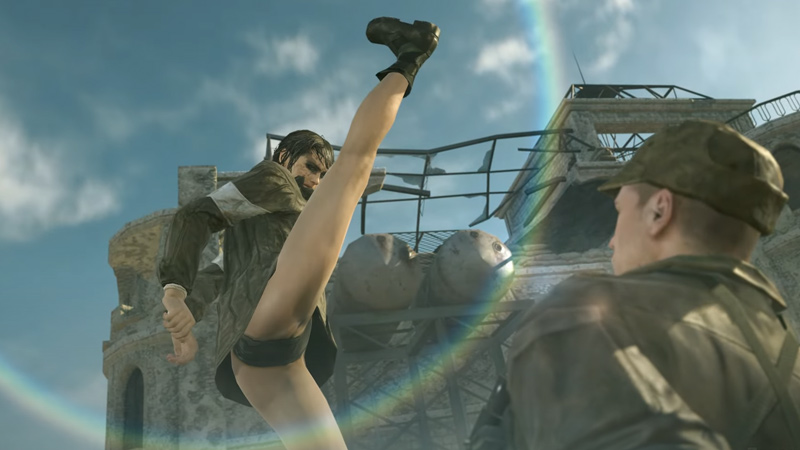
In previous Metal Gear games, females have had their characters sexualized.
From Metal Gear Solid’s Sniper Wolf and Meryl, to Metal Gear Solid 3: Snake Eater's EVA, to Metal Gear Solid 4: Guns of the Patriots's Dr. Naomi Hunter, for example. These women have been depicted in various states of undress. Similar to Quiet, these females are more often had their bodies as the main focus of attraction, far longer than their male counterparts.
But unlike those women, Quiet isn't some spy tasked to seduce Snake, nor they have a story that focuses on personal growth.
EVA may have her jacket unzipped all the way down to her navel, but she has a purpose in doing so.
Quiet lacks the autonomy. While she eventually shows loyalty and a complex personality, throughout the game, she is mostly a tool: a sniper under Snake's orders, comparable in function to a dog, horse, or robotic vehicle in war. The critics argue that if Quiet had her own voice and more agency, her design and story could feel justified.
If she could make choices about her clothing, refuse certain orders, or be part of a more balanced lineup of allies, she could end up being more of a character than just being objectified.
While Metal Gear Solid V: The Phantom Pain does get the appraisal it needs as an AAA game, cited as one of the greatest stealth games ever made, and that its positive reviews aren't caused by Quiet, but it's actually Quiet that indirectly boost the sales.
There’s little doubt that the mute sniper helped keep Metal Gear Solid V: The Phantom Pain in constant conversation.
In 2015 and 2016, every major gaming site, forum, and social channel had something to say about her. Her viral status also boosted her name, making Quiet more widely searched on the internet than the game itself. Quiet became one of the most viral characters in the Metal Gear franchise, trending heavily.
Cosplayers rushed to bring her look to conventions, fan art exploded across platforms like DeviantArt, Tumblr, and Reddit, and YouTube videos analyzing or parodying her flooded feeds. Quiet was everywhere, and whether people loved her or hated her, they couldn’t ignore her.
Regardless of where people stood, the controversy itself pushed Quiet beyond the boundaries of the game into mainstream discussions.
In other words, Quiet was much more than just a partner of Snake and an eye candy.

For Konami, this is a blessing.
But also a curse because of the controversy that kept it in attention.
Quiet also highlighted deeper tensions between Kojima’s artistic vision and the gaming industry’s ongoing debate over representation and sexualization.
Looking back, Quiet represented the paradox at the heart of Metal Gear. On one hand, she was criticized as an example of the industry’s worst habits; on the other, she was celebrated for her role in one of gaming’s most ambitious experiences. She was divisive, viral, and unforgettable—the very essence of what Metal Gear has always been.
In the end, Quiet became more than just a sniper or a side character.
She was a cultural flashpoint, a reminder of how video games are not only played but also discussed, dissected, and shared across the world. And in the history of Metal Gear, she will forever remain the silent figure who made the loudest noise.

















































































































































































































































































