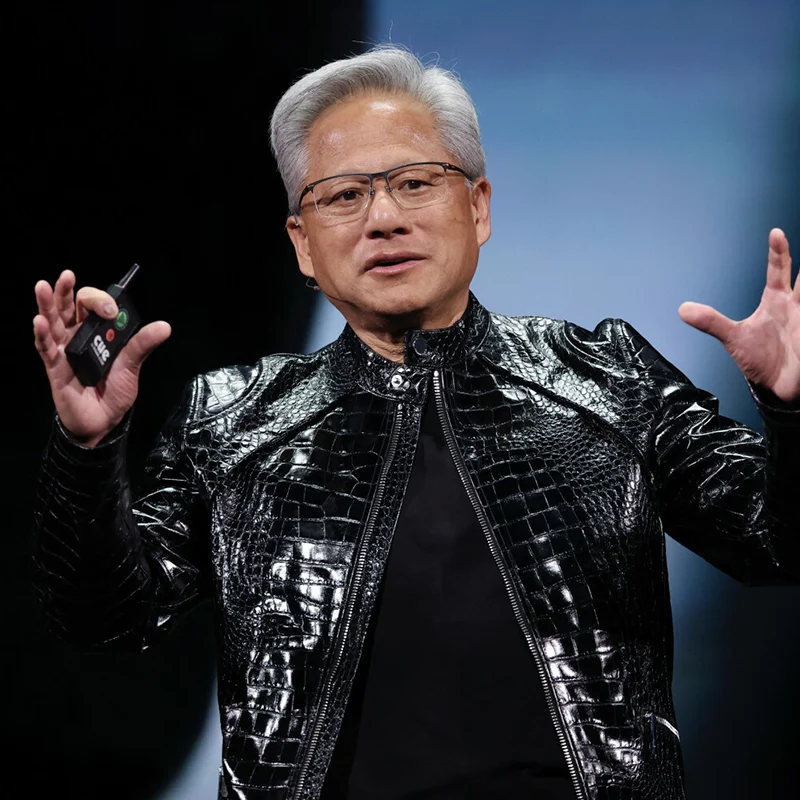
Jensen Huang chose an unusually high-stakes moment for his first post on X.
On July 24, 2026, the Nvidia CEO shared a joint industry letter titled "Open Weights and American AI Leadership," co-signed by his company and roughly two dozen other organizations.
In the accompanying text he wrote that AI will transform every industry, power every company, and be built by every country, and that open models strengthen safety, cybersecurity, innovation, and sovereignty.
The world, he added, needs both frontier closed models and frontier open models.
The letter itself is a deliberate intervention in the intensifying policy debate over open-weight AI systems: models whose trained parameters anyone can download, inspect, modify, and run.
It draws an explicit parallel to the open-source software movement of the 1980s, arguing that America’s long-term AI leadership will not be measured by any single frontier model but by whether the U.S. builds a robust, open ecosystem that diffuses into factories, hospitals, farms, classrooms, and Main Street businesses.
Its central claims are set out clearly:
- Open weights expand economic access so that startups, universities, established companies, and public institutions can adapt advanced models without training from scratch or paying frontier prices for every task.
- They strengthen competition across model developers, chipmakers, cloud providers, and application layers, preventing the concentration of AI gains in a few hands.
- They give organizations greater control over their data, their specialized capabilities, and the value they create, supporting both commercial independence and national technological sovereignty.
- They improve safety and cybersecurity by enabling broad scrutiny, red-teaming, and defensive research; relying solely on closed models creates single points of failure and is not inherently safer.
- Policymakers should expand compute access, invest in shared datasets and evaluation tools, and avoid premature restrictions that could stifle competition or push innovation overseas, while addressing unlawful extraction of closed models through targeted legal tools rather than broad bans on legitimate techniques such as distillation.
Elon Musk quoted the post within hours and declared it had his full support, adding simply that Jensen is right.
Jack Dorsey followed with a one-word endorsement: excellent.
The combination of Huang’s debut, the letter’s substance, and the rapid backing from two of the platform’s most influential voices turned the statement into one of the day’s most visible technology conversations.
The signatories form a revealing coalition: Nvidia, Microsoft, Meta, IBM, Hugging Face, Mistral, Mozilla, the Linux Foundation, Palantir, CrowdStrike, Dell, Y Combinator, Andreessen Horowitz, and others.
Notably absent are the leading closed-model labs, like OpenAI, Anthropic, and Google.
The letter arrives amid rising performance of Chinese open-weight models, accusations of distillation and intellectual-property concerns, and growing talk in Washington of possible sanctions or export-style limits.
Huang himself had recently argued that excellent Chinese open models should be usable by American firms because they expand the overall market.
Taken together, the letter and the endorsements amount to a public case that openness is not merely an ideological preference but a practical requirement for American competitiveness, resilience, and broad prosperity. Whether policymakers treat open weights as strategic infrastructure or as a risk to be constrained will shape the next phase of the AI era.






















































































































































































































































































