For years, governments around the world have wrestled with a difficult question: how far should technology companies be held responsible for what happens on their platforms?
As encrypted messaging services have become central to communication, they have also become flashpoints in debates over terrorism, national security, privacy, and free expression.
Those tensions have now intensified once again, this time with one of the world's best-known messaging platforms at the center of an escalating legal confrontation.
Russia's Federal Security Service announced that it has charged Telegram founder Pavel Durov with aiding terrorist activities and begun the process of placing him on an international wanted list.
The move marks a sharp escalation in the Kremlin's long-running campaign to rein in the messaging app, which remains one of the most widely used platforms inside Russia despite years of pressure and partial restrictions.
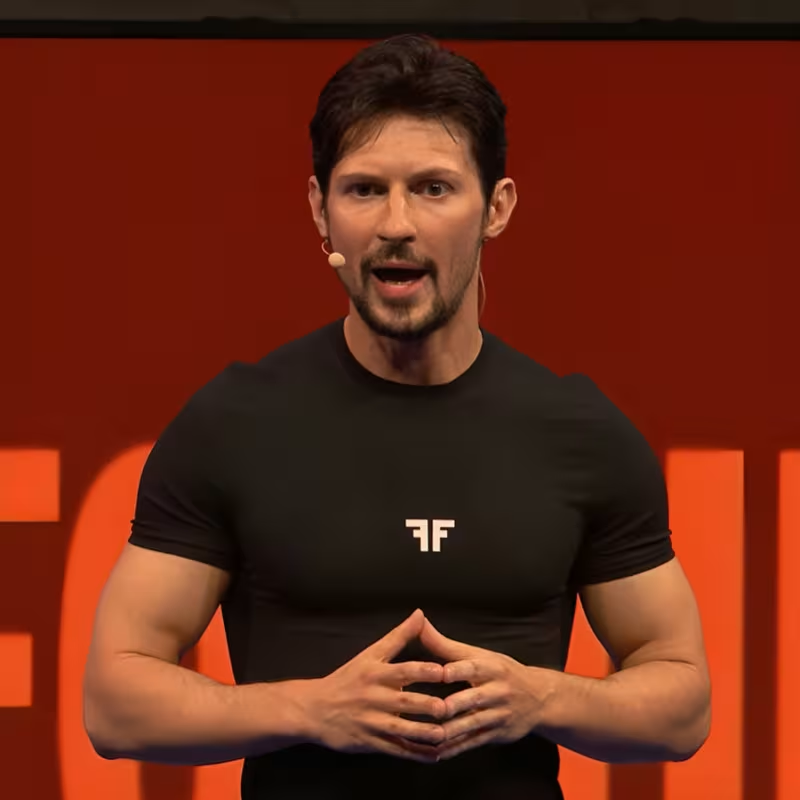
Russia’s Federal Security Service announced on July 29 2026 that it has charged Telegram founder Pavel Durov with aiding terrorist activities and begun the process of placing him on an international wanted list.
Moscow is accusing Russian-born Durov, and Telegram’s administration for failing to remove "numerous channels, chats and bots" that are "actively used by Ukrainian intelligence agencies, terrorist, and extremist organizations to prepare and coordinate acts of sabotage and terrorism, mass murder, and cyberfraud" in Russia, the Federal Security Service (FSB) said in a statement Wednesday.
All of which, the agency said, contributed to "attacks killing civilians."
The move marks a sharp escalation in the Kremlin’s long running campaign to rein in the messaging app, which remains one of the most widely used platforms inside Russia despite years of pressure and partial restrictions.
The FSB statement accuses Telegram’s leadership of failing to delete material that Ukrainian intelligence services and various extremist groups allegedly used to plan and carry out operations on Russian territory.
According to the agency these activities produced both human casualties and substantial financial losses.
Key claims from the FSB include:
- Telegram left in place numerous channels, chats and bots employed by Ukrainian special services for sabotage, terrorist attacks, mass killings and large scale cyber fraud
- Ukrainian operatives used a popular Telegram dating chatbot to pose as young women and recruit Russian residents, many of them teenagers, for arson and assaults on police
- At least 46 people aged 12 to 22 were detained across Russia in connection with those recruitment efforts since July 2025
- The overall pattern of unremoded content is said to have caused deaths and billions of rubles in damage
Durov, who left Russia in 2014 after refusing FSB demands for user data on Ukrainian protesters, has a long history of clashing with the Kremlin over digital privacy and state surveillance.
Years earlier, while leading VKontakte, Russia's largest social network at the time, he refused requests to remove opposition groups and disclose information about activists.
After losing control of the company amid mounting political and corporate pressure, Durov left Russia and later founded Telegram.
He now lives in Dubai and holds French and Emirati citizenship in addition to his Russian passport. He has not issued a detailed personal statement, though Telegram's official account posted a curt visual response earlier in the day.
In previous comments this year, Durov described similar Russian investigations as fabricated pretexts designed to undermine privacy and free speech.
The legal risk is serious. Conviction under Article 205.1 of the Russian Criminal Code can carry a life sentence. In practice, however, enforcement faces obvious limits. Durov resides outside Russian jurisdiction, and Telegram is headquartered in the United Arab Emirates. Any international warrant would require cooperation from other governments, many of which have their own ongoing disputes with the company over content moderation.
This latest charge fits a broader pattern. Russia has already restricted access to WhatsApp and repeatedly throttled or blocked features of Telegram while aggressively promoting its own state-backed super app called MAX. That platform lacks end-to-end encryption, shares user data with authorities upon request, and is now pre-installed on many new smartphones sold in the country. Critics view the campaign as part of a broader effort to replace foreign platforms with state-controlled alternatives and create a more tightly managed domestic internet, drawing frequent comparisons to China's digital governance model.
Telegram itself continues to claim more than one billion users worldwide and remains a critical communication tool for both sides of the war in Ukraine, independent journalists, opposition voices, and ordinary Russians. For Durov, the latest criminal case echoes the dispute that led him to leave Russia more than a decade ago, suggesting that the conflict between the Kremlin's demand for greater control and Telegram's privacy-first philosophy is far from over.

















































































































































































































































































