The relationship between people and the objects they collect has always carried a quiet emotional weight.
A shelf of worn paperbacks, a stack of vinyl records with faded sleeves, or a row of game cases lined up by release year each tell a story of time spent, money traded, and memories formed through touch as much as through content.
In gaming that physical presence once felt essential, a disc that could be passed to a friend, sold when funds ran low, or kept as proof of a purchase that belonged fully to its owner.
Over the past two decades that model has steadily eroded.
And Sony has made one of its most controversial decision yet: killing the sales of new physical discs, starting with PlayStation 6.

Physical software sales in major markets have fallen from peaks measured in the billions of dollars to a fraction of former volume, with digital downloads now accounting for the large majority of console game transactions.
Convenience, instant access, and the disappearance of disc drives from many new machines accelerated the change.
Platform holders responded in kind, trimming manufacturing costs and capturing higher margins when sales moved entirely online.
Sony’s decision to stop producing physical discs for new PlayStation titles beginning in 2028 simply formalizes a trend already visible in sales data.
New games will arrive only through the PlayStation Store or as download codes inside otherwise empty boxes, leaving the secondary market without fresh inventory to trade.
However, despite the sales of new physical discs do shrink, the secondary market remains substantial.
Global sales of pre-owned video games, consoles, and related hardware were valued at roughly $7 billion dollars in recent years, with projections that once pointed toward continued growth.
Historically around one-third of all games sold eventually changed hands again, supplying currency for trade-ins, gifts, and bargain hunting.
Without a steady flow of new physical releases the pool of tradable discs shrinks, and analysts expect the used segment for console games to contract sharply and, in time, largely vanish.
Retail chains that depend on trade-in volume face particular pressure, while collectors and budget-conscious players lose a reliable source of lower-priced copies.
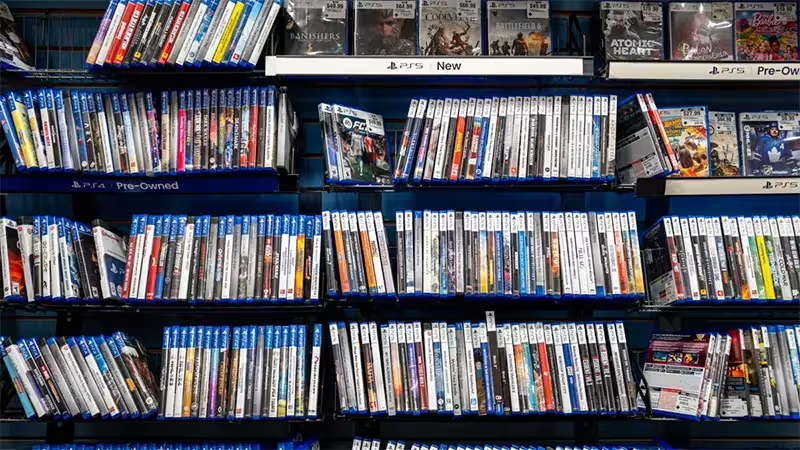
Price comparisons underscore why the loss matters.
For many older titles the standard digital price on the official store stays close to the original launch figure, even years later. Used discs of the same games routinely sell for a fraction of that amount at retailers or through private sales.
Deep digital discounts do appear, yet they arrive in limited windows that require patience and constant monitoring.
Physical copies, by contrast, clear the market continuously and can be resold for partial recovery of the original cost. The existence of that alternative has long exerted downward pressure on digital pricing.
Once the alternative disappears, the sole distributor gains greater freedom to set and maintain higher prices.
The shift also carries a layer of historical irony.

More than a decade earlier, when a competing platform experimented with tighter controls on game sharing, Sony publicly championed the simplicity of the disc.
Executives demonstrated how easily a physical copy could be handed from one player to another and stressed that buyers retained the right to lend, trade, or keep what they had purchased.
That stance helped differentiate the brand and won goodwill.
Removing the disc now reverses the earlier position, replacing tangible ownership with a license that can, under certain conditions, be revoked or rendered inaccessible if accounts fall inactive or licensing agreements change.
Preservation adds another dimension.
Physical media can survive long after a storefront closes or a company alters its terms of service, whereas digital purchases remain tied to servers and accounts that may not endure indefinitely.
Industry veterans have voiced concern that works created for the platform risk becoming harder to archive or experience decades later.
Petitions, public criticism from developers, and expressions of frustration from players reflect a broader unease about the permanent transfer of control from consumer to platform holder.

The outcome is not purely negative for every participant.
Digital distribution lowers production and shipping costs, reduces the environmental footprint of plastic cases and discs, and gives publishers faster access to revenue.
Many players already prefer the convenience of downloads and never miss the physical object.
Yet the transition removes a set of consumer options that once balanced the closed nature of console ecosystems.
For the moment the path chosen prioritizes efficiency and margin over the older model of tangible, resalable media that once defined how games moved through the world.

















































































































































































































































































