The longstanding rivalry between Israel and Iran can be traced back to historical animosity and geopolitical tensions.
From the 1979 Iranian Revolution, which overthrew Iran’s authoritarian Shah, Mohammad Reza Pahlavi, by Ayatollah Rohullah Khomeini’s forces, to Iran’s nuclear ambitions, its proxy networks, and later, the Israeli covert campaign, and more, the relationship with the two nations have been seeing both ups and downs.
But in 2024, things escalated from bad to worse.

This happened following the surprise attack by Palestinian militant groups led by Hamas to Israel, at least 1,200 people were killed, including 360 at a music festival.
Unarmed civilian hostages and captured Israeli soldiers were taken to the Gaza Strip, including women and children.
Iran, which reportedly assisted Hamas with planning the attack, threatened Israel to immediately stop the war on Gaza. This didn't go well with Israel.
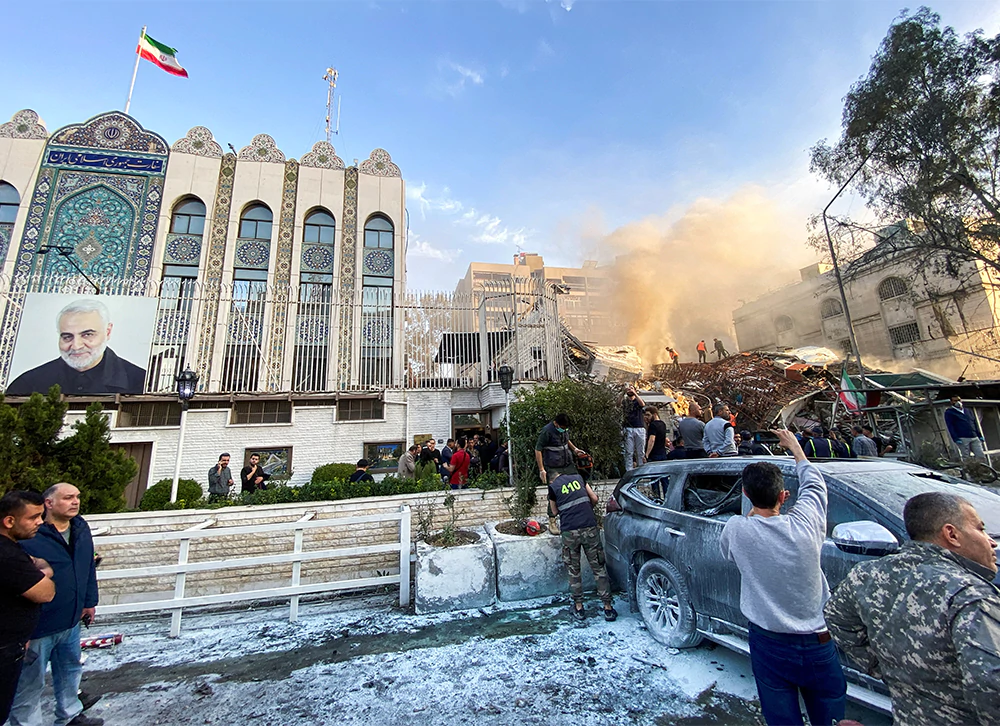
On 1 April 2024, when an Israeli airstrike bombarded the Iranian consulate annex building adjacent to the Iranian embassy in Damascus, Syria.
The attack killed 16 people, including Brigadier General Mohammad Reza Zahedi, a senior Quds Force commander of the Islamic Revolutionary Guard Corps (IRGC), and seven other IRGC officers.
Angered by this attack, Iran retaliated on 13 April, by launching an attack to Israel.
The attack was the largest attempted drone strike in history, intended to overwhelm Israeli's anti-aircraft defenses. It was the first time since Iraq's 1991 missile strikes that Israel was directly attacked by the military of another state.
More than 300 missiles and drones were launched, and that the majority of them were intercepted with the help of the US, UK, France, and Jordan, as well as Israeli's own Iron Dome defense system.
Israel stated that 99% of the drones and missiles were destroyed by the coalition.
300+ launches.
99% interception rate.
This is the breakdown of Iran's attack last night: pic.twitter.com/aRPvxSutW2— Israel Defense Forces (@IDF) April 14, 2024
On 19 April, Israel launched a series of retaliatory missile strikes on Iranian military sites.
While both sides have retaliated, both countries face a delicate balance.
אל-קודס הקדושה תהיה בידי המוסלמים, והעולם המוסלמי יחגוג שחרור פלסטין. pic.twitter.com/PB3wZk1jcN
— Khamenei.ir (@khamenei_ir) April 14, 2024
The attacks demonstrate that such an unprecedented show of force cannot pass without consequences.
First of, Iran is the third-largest producer in oil cartel OPEC, meaning that instability in the region can rise oil prices.
Second, the conflict’s intensity and involvement of major powers have raised concerns about an even broader regional war.
Both countries have powerful allies and they understand the risks associated with direct conflict.
This is why for more than many times, they opt for proxy wars and not a direct war, partly because of this.
Neither sides went all out in their retaliatory attacks.
Both Israel and Iran held back, and refrain from launching more attacks, but warn their opposing sides to not retaliate any more.
Besides the desire to avoid a full-scale war, other reasons for not going all out also likely involve strategic considerations and international pressure.
The effects of Iran’s attack on Israel can still be seen weeks after it occurred.
Earlier today, our troops removed the debris of a surface-to-surface missile intercepted during the Iranian attack. At the beginning of the week, the debris was found by hikers in southern Israel.… pic.twitter.com/UeFiYBuGhg— Israel Defense Forces (@IDF) April 26, 2024
While the situation remains tense, and the world watches closely, hoping for de-escalation and stability, people fear World War III.
This is because Israel has powerful allies, which include the U.S., and Iran has allies from China and Russia.
People have been using hashtags, like #IranIsraelConflict to show their support.
While most Iranians and the Muslim world side with Palestine, there are lots that use #IraniansStandWithIsrael to suggest that they are against Iranian regime and oppression.
At this time, Iran is still having issues with women not wanting to wear the hijab, which became more apparent following the death of Mahsa Amini.
Read: The Anti-Hijab Social Media Campaign Where Iranian Women Remove Their Hijab In Public






















































































































































































































































































