Researchers successfully beamed Wi-Fi internet to the Moon.
After a long time plan in bringing internet connection to the Moon, researchers at NASA and MIT have made it possible using four 6-inch diameter telescopes beaming pulses of infrared light to a satellite circling the Moon. As a result, the scientists established a solid connection with a speed of 19Mbps.
This is a factor of 4,800 times faster than any radio frequency (RF) system ever used at the time.
This achievement demonstrated for the first time that a data communication technology can provide space dwellers with the connectivity people have on Earth, enabling data transfers and even high-definition video streaming.
At CLEO: 2014 held June 8-13 in San Jose, California, the team presents details about the first comprehensive overview of the on-orbit performance of their laser-based communication uplink between the Moon and Earth.
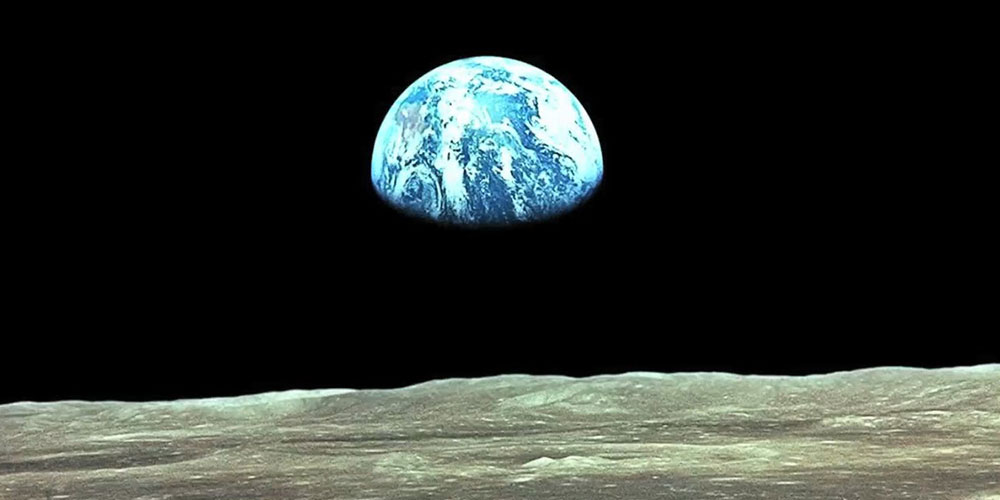
"This is the first time that we present both the implementation overview and how well it actually worked," said Mark Stevens from MIT Lincoln Laboratory. "The on-orbit performance was excellent and close to what we’d predicted, giving us confidence that we have a good understanding of the underlying physics."
"Communicating at high data rates from Earth to the Moon with laser beams is challenging because of the 400,000-kilometer distance spreading out the light beam. It’s doubly difficult going through the atmosphere, because turbulence can bend light—causing rapid fading or dropouts of the signal at the receiver."
To solve fading signals over the far distance between the Earth and the Moon, the researchers uses several techniques to overcome the challenging atmospheric conditions in both darkness and bright sunlight.
First, a ground terminal at White Sands, New Mexico, uses four separate telescopes to send the uplink signal to the Moon. The 6 inches in diameter telescopes are fed by a laser transmitter that sends information coded as pulses of invisible infrared light. The total transmitter power is the sum of the four separate transmitters, which results in 40 watts of power.
The reason the researchers use four telescopes is that each one transmits light through a different column of air that experiences different bending effects from the atmosphere. According to Stevens, this increases the chance that at least one of the laser beams will interact with the receiver, which is mounted on a satellite orbiting the Moon.
The Moon's receiver uses a slightly narrower telescope to collect the light, which is then focused into an optical fiber similar to fiber optic networks on Earth.
Then, the signal is amplified about 30,000 times. A photodetector converts the pulses of light into electrical pulses that are then converted into data bit patterns that carry the transmitted message.
Of the 40-watt signals sent by the transmitter, less than a billionth of a watt is received at the satellite. But still, that is about 10 times the signal necessary to achieve error-free communication, Stevens said.
This however, is still shy to the ISS-to-Moon connection in comparison, which offered 622Mbps down. But over an Earth-to-Moon distance of 238,900 miles, 19Mbps is still relatively higher than earth's average.

















































































































































































































































































