In the intersection of global cryptocurrency wealth, celebrity culture, and traditional Chinese marriage customs, a legal dispute that reads like a cinematic drama has captivated the public.
Justin Sun, the 36-year-old billionaire founder of the TRON blockchain network, has initiated a high-profile lawsuit against prominent Chinese actress Jing Tian and her parents.
Accepted by the Yanta District People's Court in Xi'an, the lawsuit demands the full return of 30 million yuan (about US$4.5 million). Sun and his legal team assert that this massive sum was transferred to Jing Tian's family as a traditional betrothal gift, known in China as caili, given with the explicit expectation of marriage.
After a whirlwind romance that reportedly lasted a little over seven months, their engagement and plans to start a family collapsed abruptly in the first half of 2026, prompting Sun to aggressively seek the recovery of his funds.
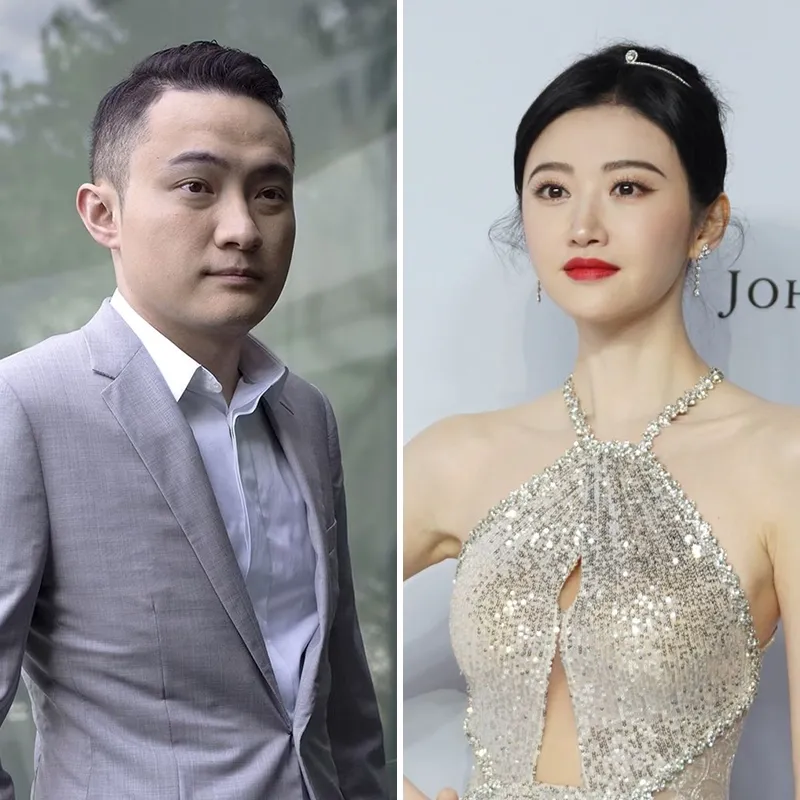
Jing Tian is a prominent Chinese actress who gained widespread recognition for her versatile performances across television and film.
Born in Xi'an, Shaanxi, she graduated from the prestigious Beijing Film Academy, a premier institution that has produced many of China's top cinematic talents. Early in her career, she caught the attention of major directors and quickly transitioned into high-profile historical dramas and epic action films, establishing her as a recognizable face in Chinese media and beyond.
This is because her career is notable for its rare bridge between domestic Chinese cinema and major Hollywood productions.
She achieved global visibility by starring in several big-budget American blockbusters, including Legendary Pictures' The Great Wall alongside Matt Damon, Kong: Skull Island with Tom Hiddleston, and the science-fiction sequel Pacific Rim: Uprising.
These roles solidified her status as one of the few contemporary Chinese actresses to successfully cross over into mainstream Western cinema during the late 2010s.
In recent years, Jing Tian has maintained a strong presence in the domestic television industry, winning critical and audience acclaim for her performances in popular fantasy and romance dramas, most notably the hit series Rattan.
Known for her elegant screen presence and fashion influence, she continues to be a highly discussed figure in C-entertainment, balancing her artistic pursuits with high-profile brand endorsements and media attention.
And here, the financial dispute exploded into a massive public spectacle on August 27, 2026, when Sun published a sprawling, ten-thousand-character essay on the social media platform X titled "My Girlfriend Jing Tian."
In the post, which Sun claims he drafted over two sleepless nights while visiting Bhutan, the crypto mogul detailed a series of staggering luxury expenditures made to woo the actress.
He described harboring a crush on her since his college days, buying out an entire movie theater so they could privately watch the film Zootopia 2, and booking an entire floor at the Montage Laguna Beach hotel in California for 30 days at a cost of $1 million dollars to protect her privacy.
According to Sun's narrative, the true breaking point of their relationship occurred in the U.S. while the couple was preparing for egg retrieval and surrogacy procedures. Sun alleged that Jing Tian's side abruptly demanded a payment of $50 million to proceed with the medical process.
Sun even claimed he consulted the AI model Claude about whether to pay, ultimately refusing the demand, which led to a complete breakdown in their communication.
Adding a bizarre layer of complexity to the drama, Sun attached a disclaimer to both the beginning and the end of his viral essay, explicitly labeling the entire account as purely fictional and stating that any resemblance to real events was coincidental.
However, on the exact same evening, his attorney Zhang Qihuai formally confirmed to the press that the 30 million yuan lawsuit was very real, and that a property preservation application had been filed with the court in Xi'an.
Jing Tian and her legal team immediately filed a jurisdictional objection to the lawsuit and vehemently denied the claims made in the essay.
Her representatives characterized the viral post as a deliberate shakedown designed to use an artist's reputation as leverage.
The following day, the actress went to her Weibo account, where she commands over twenty-six million followers, to address the controversy, stating that while she had shown poor judgment in men, she would never sell her love for money and would never sell her soul.
She emphasized her trust in the law to deliver fairness.
The sheer spectacle of the essay even sent ripples through the Chinese stock market.
A bizarre subplot in the essay about Jing Tian filing Sun's nails for an hour caused shares of a scissor manufacturing company to jump, while Tianyu Digital Technology, a company rumored to have indirect equity connections to Sun, hit its daily limit-up to reach a market value of nearly $1.9 billion.

Modern Chinese law handles the ancient tradition of betrothal gifts.
Under the Civil Code of the People's Republic of China, a caili payment is not treated as a standard, unconditional present. Instead, it is legally defined as a conditional gift given for the specific, mutual purpose of solemnizing a legal marriage.
Because the exchange of large sums of money ahead of weddings frequently leads to bitter financial disputes when relationships fail, the Supreme People's Court issued updated judicial interpretations in early 2024 to standardize how courts across the country resolve these exact conflicts.
According to these strict judicial guidelines, a Chinese court will mandate the return of a betrothal gift under three primary circumstances.
The first and most straightforward condition is if the couple never legally registered their marriage, which is the exact legal argument being utilized by Sun's attorneys. The second condition applies if the couple did formally register their marriage but never actually lived together as husband and wife. The third condition allows for the return of funds if the payment of the caili caused severe financial hardship to the giver, though this particular rule must be invoked alongside formal divorce proceedings.
Because Sun and Jing Tian never officially tied the knot, the law provides a clear pathway for the return of conditional marriage funds.
However, Chinese courts are careful to distinguish between authentic betrothal gifts and the ordinary expenses accrued during dating. High value assets such as real estate, luxury vehicles, large jewelry, and massive lump sum cash transfers made as explicit preconditions for a wedding fully qualify as refundable caili. On the other hand, daily living expenses, luxury vacations like a million dollar hotel stay, casual holiday gifts, and symbolic money transfers meant to show affection are categorized as "unconditional gifts that cannot be reclaimed."
If a couple cohabited for a brief period before breaking up, judges will evaluate the duration of cohabitation, how the funds were spent on joint expenses, and which party was primarily at fault for the separation before deciding on an equitable, proportional refund amount.
Furthermore, the law explicitly acknowledges that Chinese marriage customs are often family affairs, which perfectly explains the structure of Sun's current lawsuit.
Judicial interpretations state that if parents actively negotiated, paid, or received the betrothal funds on behalf of their children, they can be legally named as co-plaintiffs or co-defendants in a civil suit.
By suing Jing Tian alongside her parents, Sun is leveraging this exact legal provision to ensure all parties who allegedly received the $4.5 million are brought into the proceedings.
As the Yanta District People's Court prepares to navigate the jurisdictional objections and the substantive facts of the case, the dispute stands as a fascinating collision of vast digital wealth, modern celebrity public relations, and deeply rooted statutory marriage law.




















































































































































































































































































