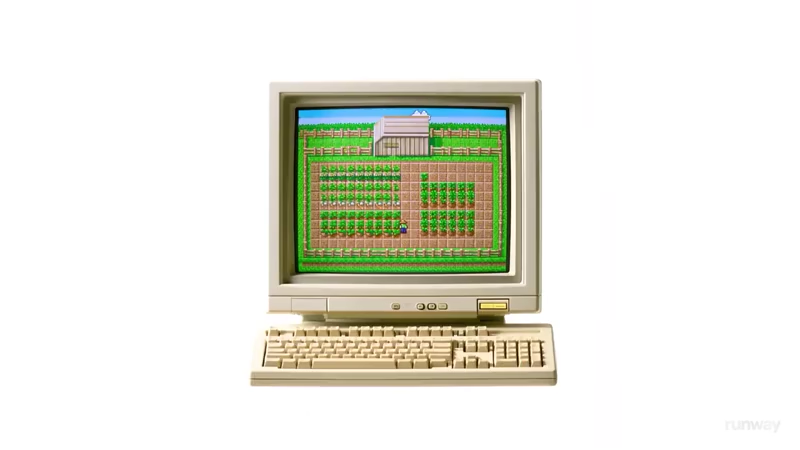
Software still reaches a screen the same way it has for decades. A designer produces a picture of an interface. Engineers translate that picture into code. An operating system or browser then draws pixels according to that code.
Every click is mapped in advance to a state the developers thought to implement.
The picture and the program remain two different objects, and something is always lost in the conversion.
Over the last few years those two objects have been under pressure from opposite directions. Large Language models (LLMs) can now write HTML, React, and CSS from a screenshot or a sentence, which shortens the translation but does not remove it.
Image models can produce screens that look finished. Video models can produce clips that look like software in motion. But none of those systems is the software.
The generated page still has to be wired up. If the layout changes, an agent that learned the old buttons often fails.
A parallel line of research has been trying to model environments rather than documents. Researchers use the phrase world model for systems that keep an internal picture of a scene and predict what happens after an action.
The term is older than the current wave. It comes from reinforcement learning, where an agent needs a simulator so it does not have to learn only by breaking things in the real world. In practice the label now covers several different machines.
Runway has an idea, and in an announcement, the researchers call it the "Interface World Model."
Whereas earlier models, like OpenAI's Sora, treated a large video generator as a loose simulator of physics and games while others, like Google's Genie models aims on creating a state that a planner can use, Runway sits kind of in the middle.
The tool called 'Solaris' wants to be able to create scenes users can control, but a playable environment rather than as an application.
Runway spent years selling video generation, then in December 2025, it published GWM-1, a family of autoregressive models built on its Gen-4.5 video system.
Those variants were aimed at explorable scenes, talking avatars, and robot rollouts. Frames came one after another. A person or a policy could change what happened next.
The company described a world model as a system that builds an internal representation of an environment and uses it to simulate future events inside that environment.
That is closer to a live simulator than to a finished movie. It is still, in most demos, a world you look into rather than a tool you fill out.
Solaris is essentially an interface where users can use, framed as a step toward software whose user interface is streamed by a real-time video model, without HTML or CSS underneath.
Co-founder Cristóbal Valenzuela added that the image is the interface and that the same setup could be used to train agents in environments that keep changing.
What Solaris does is straightforward to state and harder to place.
A session starts from a frame, often grounded in real product imagery. LLM interprets what the user asked for and what should happen next. The world model then draws the next frame, conditioned on prior frames and on the latest click, drag, or typed request.
There is no document object model sitting under the picture.
The frame is the application for as long as the stream continues. Demos include a clothing store where a shirt can be dragged onto a figure from a single reference image, a salad built by dropping ingredients into a bowl, a combustion demonstration in which materials can be moved and observed, and rooms in which furniture, light, and camera angle keep updating as the user acts.
That is different from ordinary video generation in several mechanical ways.
A standard diffusion video model refines an entire clip over many denoising steps. The output is a file. Latency of seconds or minutes is acceptable if the job is a trailer. An interface stops feeling like an interface at roughly half a second of delay.
Runway says it converted the Gen-4.5 stack into a real-time engine in stages: frames are produced autoregressively so each one depends only on what came before; the long denoising chain is distilled into a few steps; the faster model is then trained on its own outputs so quality does not collapse as the session runs.
Target quality is given as 720p.
The company does not publish a hard frame rate in the announcement. The point is not a prettier clip. It is a closed loop in which the user’s action is the condition for the next picture.
It is also a narrower object than the world models that have drawn most of the research attention.
GWM Worlds is for moving through and altering a simulated place. GWM Robotics is for predicting what a manipulator will see after a command. Genie-style systems are closer to games. Latent world models used in reinforcement learning often never draw pixels at all.
Solaris treats the screen of an app as the environment.
Objects on that screen can be given behaviors in natural language, including behaviors nobody coded as buttons.
The claim is that rendering and interaction can be the same process, so there is no second implementation hidden under the mockup. Whether that process is a faithful simulator of software, or a visually convincing sampler of software-like frames, is the argument now forming around the work.
Runway’s own measurements are aimed at that argument. In reconstruction tests, multimodal models including GPT-4o, Gemini 2.5 Pro, and a Claude variant the company refers to as Fable 5 were asked to rebuild interfaces from screenshots.
Similarity was scored with SSIM for appearance and DINOv3 features for content.
Quality fell as layouts got more complex, which the paper reads as evidence that turning a visual interface into text or code throws information away.
In a separate user study, 250 people made about 7,500 pairwise judgments across 30 interaction examples. Compared with interfaces produced as code by Claude Opus 5, Solaris was chosen 61% of the time for following the instruction and 71% of the time for behaving naturally in the scene.
Those figures come from Runway, and that they have not been repeated by an independent lab.
Reactions from users include designers and investors treating the demo as a shift from screens that are specified to screens that are sampled. Others, including people who work on front-end products, focused on determinism: a conventional interface is a finite state machine, and the value of a button is that pressing it twice does the same thing.
A generated frame is a draw from a model.
If two identical clicks can yield two different next states, the system may work as a demonstration or a game and fail as something that has to be audited, tested, or regulated.
A third thread, including Runway's own framing, is agent training.
Computer-use models now practice on websites that look like the websites they will meet. A generator that can keep inventing layouts is, in principle, a way to stop those agents from memorizing one toolbar. Whether that training transfers to real browsers is untested in public.
The company lists the gaps itself.
Stable, readable text is still a weak point of video generators, and interfaces depend on text more than almost any other visual domain.
One suggested workaround is a hybrid: pause and let an image model draw type-heavy views, then return to video for motion. Grounding is another. A fluent wrong answer is worse than a blank screen in a store or a lesson, so sessions are anchored to a starting frame built from real references.
Longer open-ended use still drifts.
Generated pixels also have no natural hook for screen readers or accessibility APIs, which means the flexibility the model is selling does not yet sit inside the rest of the software stack. Cost per frame, session length, and security questions about prompt-driven impersonation of controls are mostly discussed outside the paper.
What sits in front of the industry is therefore smaller than an operating system and larger than another video demo.
For the moment Solaris is a research system that draws interactive pictures at interactive speed, using a language model for intent and a distilled video world model for appearance.
It does not ship as Windows, iOS, or a website you can bookmark.
If text becomes stable and the same action becomes repeatable, the translation step between design and code becomes optional in more places than mockups and ads.
If those two conditions do not hold, the work still functions as evidence that the video stack Runway trained for cinema can be turned, with enough post-training, toward the surface of software rather than toward another clip.
The next useful facts will not be slogans about neural software. They will be whether a partner can keep a generated storefront coherent for a full shopping session, and whether an agent trained in those frames can book a room on a site the model has never drawn.




















































































































































































































































































