There was a time when the military can only boast their big guns, immense firepower, strategies, their war veterans and more. But with the advancements of technologies, the military has other thing to boast: gadgets.
The U.S. military sat at the very top, with its vast array of weaponry and tech. With more than $700 billion in annual spending, the military's deep pockets enables it to formally move forward with the largest-ever government-related deal for headsets in the virtual and augmented reality (VR, AR) sector.
And that is by a 10-year agreement worth $21.9 billion, where Microsoft is expected to provide 120,000 custom headsets that are "based" on the HoloLens product for its Close Combat Force (CCF).
The custom headsets pack an array of sensors, available on existing enterprise-only HoloLens, but customized by what's known as Integrated Visual Augmentation System (IVAS), which come with additional features, like the "field of view" for virtual elements.
Reports suggest that the headsets are also equipped with some other military-grade features, like thermal and night vision cameras, visual target acquisition, vitality sensors, and a system to detect whether the wearer suffers a concussion.

The standard-issue HoloLens headsets enable users to augmented reality in the form of holograms, overlaid as layers on top of whatever is on the display of their actual environments.
Through the headsets' sensors, users can interact with the devices using their hands and voice.
The HoloLens that the military wants, go way beyond that.
"The IVAS headset, based on HoloLens and augmented by Microsoft Azure cloud services, delivers a platform that will keep soldiers safer and make them more effective," wrote Alex Kipman, a technical fellow at Microsoft and the person who introduced the HoloLens in 2015, in a blog post.
"The program delivers enhanced situational awareness, enabling information sharing and decision-making in a variety of scenarios."
"Microsoft has worked closely with the U.S. Army over the past two years, and together we pioneered Soldier Centered Design to enable rapid prototyping for a product to provide Soldiers with the tools and capabilities necessary to achieve their mission," he continued.
The plan with the custom HoloLens, is to amplify the Army's "Lethality, Mobility, and Situational Awareness," in both training or in combat, and allowing soldiers to "fight, rehearse and train using a single platform."
For most people, these features are game-like features. In the announcement by the Army, it's confirmed that the headsets pack "a life-like mixed reality training environment."
The deal makes Microsoft a more prominent technology supplier to the U.S. military.
It also shows that Microsoft can generate a good amount revenue by developing a futuristic product resulting from years of research, beyond its core areas such as operating systems and productivity software.
Following the news, Microsoft shares climbed up by 1.7% to $235.77 per share at the end of Wednesday's trading session.
It should be noted that this deal follows a $480 million contract Microsoft received to give the Army prototypes of IVAS in 2018. The biggest difference in this deal is that, the Army demands Microsoft to provide it with production versions that can really function in the field.
This announcement also follows heightened scrutiny over the Department of Defense's deals with Microsoft.
The loudest opposition has come from Amazon, whose AWS division was in a bidding war for a $10 billion cloud-computing contract, which was eventually awarded to Microsoft Azure.
Before that deal was inked in October 2019, Oracle had sued to claim that the bidding process was "tainted" by several government staffers who had close ties to Amazon.
Amazon itself filed a lawsuit in December 2019, with its claims largely revolving around then-President Trump's public feuding with CEO Jeff Bezos.
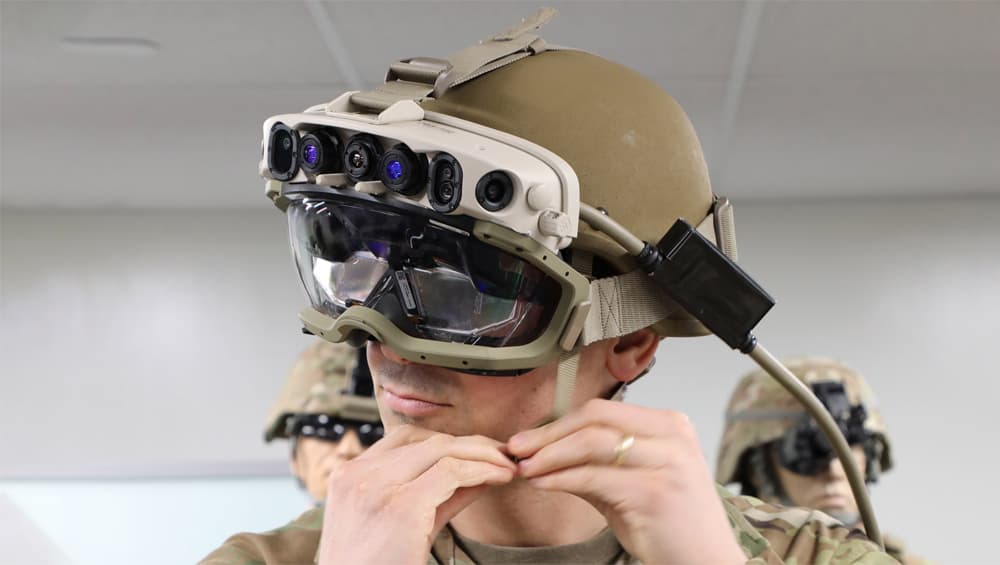
Microsoft has also faced internal opposition, particularly to the Hololens-related piece of these deals.
An early 2019 open letter written by Microsoft employees, titled "HoloLens for good, not war," demanded that Microsoft cancel the IVAS contract, due in part to it being internally developed with weaponization in mind.
Many Microsoft employees opposed to providing open-ended software because the military might be able to retrofit it to support combat or violence.
"We did not sign up to develop weapons, and we demand a say in how our work is used," the employees wrote in an open letter regarding the HoloLens contract.
Days later, Microsoft CEO Satya Nadella defended the Army augmented reality project, saying that "we made a principled decision that we're not going to withhold technology from institutions that we have elected in democracies to protect the freedoms we enjoy."
The Army, meanwhile, has suggested that the augmented reality technology could help soldiers target enemies and prevent the killing of civilians.
"We appreciate the partnership with the U.S. Army, and are thankful for their continued trust in transitioning IVAS from rapid prototyping to rapid fielding," Microsoft said in a blog post. "We look forward to building on this successful partnership with the men and women of the U.S. Army Close Combat Force."
Related: Google Project Maven In Helping Pentagon Create AI For Drones

















































































































































































































































































