
Created from dreams and popularized by science-fictions, Artificial Intelligence (AI) has become a hit and a hint of...
Trends
Latest Stories
Facebook Allows Users To Add Country Flag To Their Profile Photo: A Platform For A Unified Community

Facebook has added nearly 200 flags to its Profile Frames feature. This allows users to add overlay imagery filters of...
On the internet that is growing, everyone wants to be seen. Thanks to the many things the web has to offer, many people...

On the internet where people are connected, security breaches happen almost every time. From websites to yet another...

When we think about the internet and the World Wide Web, we often imagine an invisible world that is populated by humans...

Twitter is making another bold move to get more user engagements. The microblogging platform has announced that users...

The Internet of Things (IoT) brings computing to a whole new range of devices. By making ordinary objects "smart", it's...
The social giant Facebook has a live-streaming feature and also the ability to show 360 footage. Since then, It has been...

Fake news are problems for many people that seek for the truth. On the internet where its contents are essentially...
Progressive Web App, or PWA is a term used to denote a software development methodology where It is seen as a "hybrid"...

Facebook is the largest and the most populous social media on the internet. With way over 1 billion users, Facebook is getting closer to become the web itself where it changes how we see the web.
What began as a text-only web page. We've seen many advancements of technology that aided us in creating more and more complex contents and iterations. With faster internet connections in more places around the world, we're seeing more people connected, and that more people means potential targets by internet companies, including Facebook.
Founder and CEO Mark Zuckerberg has put video first into Facebook's attempt to get more engagements. At first, the strategy was seen as a way to compete with the streaming titan YouTube, but later it was realized that the potentials are much more than that.
Facebook has come to a time where it can shift the media industry.
The more organic videos Facebook users are watching, the more high-priced video ads Facebook can include in their feed. Facebook has been focusing to deliver more auto-play videos, paying Live content producers as well as offering more creative tools to make more people share their videos.
The goal is to propel its massive revenue growth. The video first strategy has given Facebook a better engagement, and of course, more money into its pockets.
When Facebook revealed its strong quarterly earning, the company's average revenue per user grew to about 49.1 percent in the U.S. and Canada, that is compared to 35 percent worldwide growth.
In his earning call, Zuckerberg said that:
"What is enabling video to become huge right now is that fundamentally the mobile networks are getting to a point where a large enough number of people around the world can have a good experience watching a video. If you go back a few years and you tried to load a video in News Feed it might have to buffer for 30 seconds before you watched it, which wasn’t a good enough experience for that to be the primary way that people shared. But now you can - it loads instantly. You can take a video and upload it without having to take five minutes to do that."
Back when Facebook only thrives on desktop where web games were popular and eventually spamming the News Feed, seeing video in the News Feed was quite rare. Uploading videos to Facebook was clumsy, difficult, and aren't really useful. Videos took a long time to load, and many were taken from YouTube.
But the rise of video contents on Facebook happened for reasons.
When Facebook popularized its feed-based social network where people can browse to discover content, it quickly became the home to brand ads. As users first shifted to mobile, it attracted app install ads from developers.
And as mobile data networks strengthen to support high-bandwidth content, gadgets' hardware were becoming capable for high-quality videos. Facebook expected that, and has already built a powerful distribution network that video advertisers want to join.
With good cameras and bigger screens, the number of engaging users also increased. And with video creation tools, both amateur and professional video creators can bring their creations to the web fast and easy.
When memes started occupying many internet's images. ALS Ice Bucket Challenge and more, videos are becoming more prevalent. Advertisers that weren't yet understand the approach and the format, came to the hang of them. They started to create video ads that are designed to grab attention: cut straight into action - adopting eye-catching effects and visuals to make every seconds count.
So here we see that advertisers are becoming more focused on delivering short videos but able to tease high engagement rather than a fully-hyped ads that are becoming rarely seen. It's the shift that makes them become more social.
With a continued user growth, engagement also increased. Video ads has contributed much of Facebook's $7.01 billion in revenues this quarter, up 59 percent year-over-year, and its $2.35 billion in profit. Essentially, Facebook’s pivot to video worked.
And with Facebook's ability to make video ads organic, it can bring other organic contents to mask the ads. This will keep people engaged without annoying them.
Here, Facebook is certainly catching up with YouTube with a more social approach. The two have now become dominant in their own ways.
Further reading: Explaining Facebook's "Core Values" That Power Its News Feed
Facebook is redesigning its in-app camera for meet the era of augmented reality. Not the first in the business, Facebook is again copying its competitor, and that competitor is no others than Snapchat (again).
Snapchat is one of Facebook's competitor. While living inside the same sphere, the two couldn't be any different, and aren't competing in the same league. Facebook is far larger and is having a lot more influence in the social media industry, but Snapchat is still in many people's hearts.
Facebook may not be able to squash Snapchat. But by copying one of its best features, Facebook wants to take more of Snapchat's market to be its own.
The features were first introduced by Snapchat as animated selfie masks, overlaid graphics, geofilters and art-themed style transfer filters. Facebook calls it "the new camera", and it's accessible from the News Feed in Facebook's app.
First introduced in August 2016 during the Olympics, now the company is testing it by placing more Snapchat-esque features into it.
With some added innovations, Facebook wants that same thing, and it's now having it.

The feature began testing on October 28th, 2016 in Ireland. the company said that it will test more feature variations before rolling them out globally.
"We want to make visual sharing on Facebook fast, fun, and flexible," said Facebook's Product Manager Sachin Monga.
While the feature is indeed a copy of yet another Snapchat feature, what Facebook wants is to revitalize the original sharing capability of Facebook, which has declined over the year.
The new camera feature for Facebook is seen as the next iteration of camera. With Facebook's influence, this can be many people's first experience in augmented reality and selfie masks. This happened thanks to the company's acquisition of MSQRD.
Facebook wants the feature to complement the News Feed, not its primary attraction. This is seen as Facebook puts it in a more conservative space, out of sight off-screen next to the News Feed. But by making it quickly accessible with a swipe or tap of the Camera button, Facebook wants the feature to be there whenever its users are wanting some engaging mirror selfies.
Once the new feature is accessed, users can swipe down to see the different filters Facebook is providing. A tap on the Creative Tools button will allow the user to add more effects. And for last, the geofilters will stylize graphics describing where the users are.
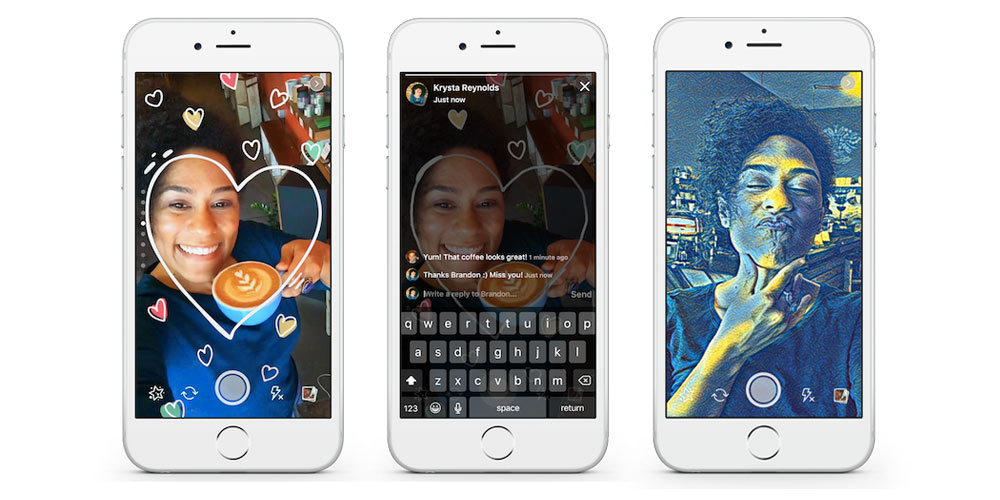
While the features of the new camera are similar to Snapchat's, Facebook puts a bit of its own innovations into them. For example: they cover the screen in leaves so users can wave around with their arm. There is the little colored line patterns that users can disrupt with their movements.
After users are done playing with the feature, they can then post it to the News Feed like regular posts. The only difference is that the photos shot with the in-app camera will appear differently. Users can also share the pictures they've made to the new Direct private messaging feature. Here, they can create private conversations with someone they want without having other "friends" to comment.
The person the user wants to share with, can directly view and respond to the Direct message. If he/she doesn't respond within 24 hours, without using the replay, the conversation automatically disappears. This again, is similar to Snapchat's direct messaging feature.
More: How Many Of Your Social Media Friends Are Actually Your "Friends"?
If You Can't Beat Nor Buy Them, Copy Them
There is a saying that says: "If you can’t beat them, buy them". Snapchat is one of the competitors that probably gave Facebook a headache. With high engagement from its more targeted users, Snapchat is popular in its own way.
Facebook has tried to acquire Snapchat back in 2013, but founder and CEO Evan Spiegel turned down the offer. Because joining Snapchat isn't an option, since then, Facebook copied more than several Snapchat's features, and clone them as if they're its own.
Facebook's purpose to copy and launch the feature is to make users to share more visuals. Facebook wants more engagement, and there aren't many things better to get a higher engagement than introducing a feature that allows silly and funny things to be shared.
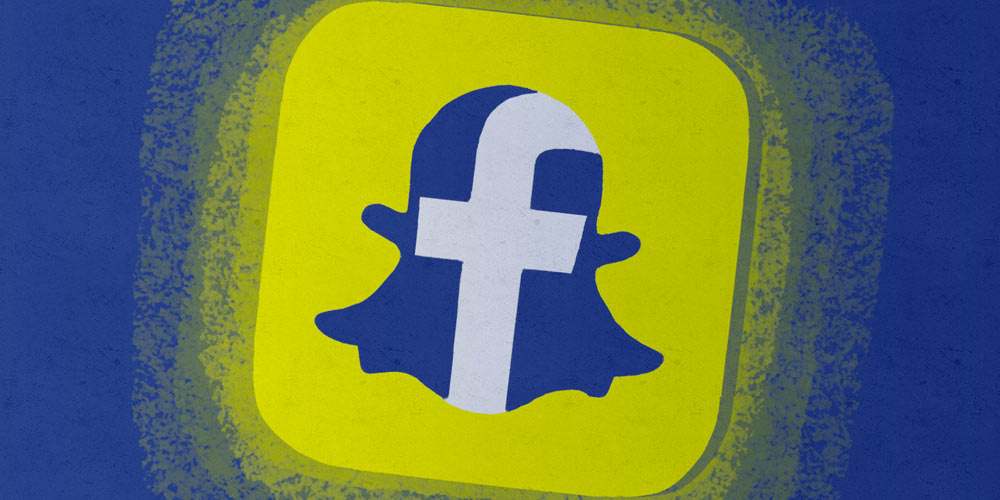
By having more feature, Facebook that is the most popular social media, is becoming a behemoth king sitting on its throne. While it still have the reasons to hold that position, the more features it introduces, the more fragmented it becomes.
For example, Facebook's Direct and Messenger are completely two different beings. While the strategy is clear: making them do their bests without confusing users, but it makes things at Facebook more complicated than they were.
The many ways to share and be on Facebook, makes experience to feel more redundant. Facebook has more than several products that overlap, and things aren't getting simpler as Facebook puts even more things into them.
That fact is a compliment for a free service by a giant company with plenty of resources to spend. With more users than practically anything on the internet, Facebook can introduce new features that people can't escape. The company can test, do R&D live, and won't have that much problem with revenues.
And this Snapchat-esque camera is just another way Facebook wants to be young again after more than a decade becoming king. Facebook may never be the new Snapchat: with its influence, it doesn't need to be as cool as the original. What it wants is to tease competitor's loyalists.
Further reading: Facebook, Instagram Vs. Snapchat: Copying To Eliminate The Threats
Trending Stories
Explore Topics
3, 401
2, 412
1, 570
1, 326
967
918
902
825
571
512
508
415
407
384
384
331
324
306
296
284
241
235
232
213
164
162
158
149
147
145
144
126
125
119
118
110
109
104
104
103
100
95
91
86
75
73
70
70
67
67
59
59
58
54
51
49
49
49
49
48
43
42
40
40
39
37
37
35
34
33
33
32
32
30
30
29
28
28
27
26
25
24
24
23
23
23
23
22
22
21
19
18
17
17
16
16
15
15
15
14
14
13
13
13
12
12
12
12
12
12
12
11
11
11
10
10
10
9
9
9
8
7
7
7
6
6
5
5
5
4
4
4
4
4
3
3
3
3
3
3
3
3
3
3
2
2
2
2
2
2
2
2
2
2
2
2
2
2
2
2
1
1
1
1
1
1
1
1
1
1
1
1
1
1
1
1
1
1
1
1
1
1
1
1
1
1
1
1
1
1
1
1
1
1
1
1
1
1
1
1
1
1
1
1
1
















































































































































































































































































