
Apple is not that open and it doesn't like to talk about openness either. But for the sake of Artificial Intelligence...
Apple is not that open and it doesn't like to talk about openness either. But for the sake of Artificial Intelligence...
Accidents are accidents. They're unfortunate incidents that happen unexpectedly and unintentionally, and may result in...
What happens when we sleep? While the body rests, the brain continues to work. This is what Google wants, the tech giant...
Making machines to know how to the world works isn't something new. With Artificial Intelligence (AI) and machine...
Google's Play Store has more than 2 million apps users can pick from.
With that many to search and choose, discovery is a major challenge for users. And that is a concern to both Google and also app developers.
While searching for famous and popular app won't be that difficult, many others will stay down below the surface. Here is where artificial intelligence (AI) comes to work. By having neural network to aid the human touch, Google can figure out better which apps belong in which categories.
According to Google's AI researchers on November 8th, 2016:
AI with the technology called neural network, works by loosely mimicking how the human brains work. On the Play Store, Google processes the app names and their description, to then try to figure out which ones to show in the search result.
This is because AI can be designed to do a better job in sorting apps according to categories, especially when there are many of them to choose from. With the attempt, Google is focusing to balance new apps with popular standbys, take out malicious apps, and help developer to get their own apps to show up high in search results.
In order to make this happen, Google trains the system by creating very rough approximation of language-centric learning. The team trained the neural network to learn how language was used to describe apps. By using a Skip-gram model, the team can make the neural network predict the words around a given word. After that, the neural network encodes its knowledge as embeddings where they can be then used to train another model called classifiers to distinguish which topics apply to which apps.
While the architecture produced good results, it would sometimes overgeneralized. As the team explained, it might associate Facebook with "dating" or "educational games."
To produce more precise classifiers, the team needed a lot more data to train the system. Here is where humans take their role. The data that is funneled can be evaluated by human raters to get the classifier output, to then feed it back again to the system. The process allowed the team to bootstrap the existing system, giving them a way to improve classifier performance.
And because the AI solutions learn more about users' habits and preferences and make better recommendations than they currently do, Google allows people to assess how well the categorization worked and thus steer it toward even better results.
Besides putting AI into a good use by helping how the Play Store works, Google is also making some visual changes to the Play Store. So here changes behind the scene follows minor redesigns at the front.
The changes aren't drastic and are more cosmetics than an overhaul. The focus here is to make Play Store less cluttered.
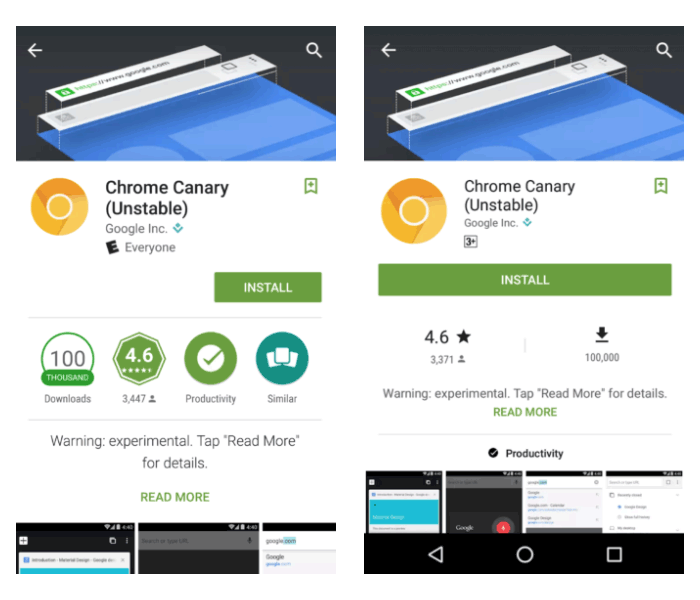
At first, the green background has been given a darker shade, and each app's page has been given a larger install button and the app ratings are also made a lot more distinguishable. This should make call-to-action more prominent, putting engagement first before information.
Additional changes include the removal of the box which listed the appropriate age category for the app. Badge is also removed.
The new UI still shows the average stars received by the app by users, along with an approximate number of downloads. While these stats are no longer posted inside a badge, they remain displayed under the larger install button. Other changes include larger screenshots of the app, and a new position for the "Read More" link that expands the description of the app.
App carousel on the main Play Store page has been made a bit smaller, and the "More Information" page that was previously located at app description has been relocated above the developer's information.
The new UI was first spotted on Nexus devices running Android 7.1.1. At the moment, Google seems to be settled with the Play Store's current design. Adopting Material Design with colorful visuals, the minor adjustments are more based on user testing than its own willingness.
In addition to the above, Google also wants to expand Play Store's support to more payment methods, introducing numerous new tools aimed to help developers monetize their creations and expansion to Daydream, Android Wear 2.0, and more Chromebooks.
With all the above, Google is planning to help developers to cope with increased competition by expanding the Play Store ecosystem as a whole.
Google has a lot in mind, and many of the things involves Artificial Intelligence (AI). Meant to make computers smarter, AI is a way humans want computers to represent them. This time, Google is putting it into a good test, and the subject is cryptography.
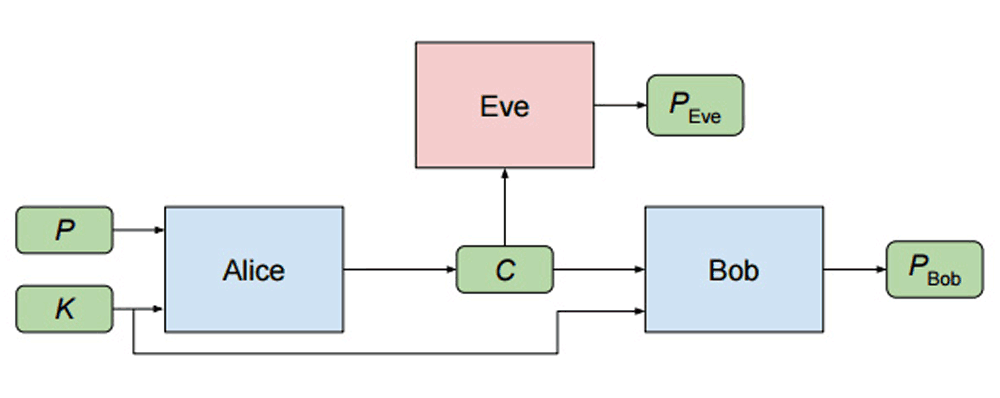
A team of researchers at Google Brain, a division that focuses on deep learning, built a game with three entities powered by deep neural networks: Alice, Bob, and Eve.
They have discovered that if AI, when given a task properly, could create an inhuman (odd) sort of cryptographic schemes. And because AI made it, they're also able to encrypt and decrypt the information.
What the researchers did was simple: Alice was designed to send an encrypted message of 16 zeroes and ones to Bob, which was designed to decrypt the message. The two bots shared the same key, the foundation for the message's encryption. Then they put another neural network into the equation. The name was Eve. Here, Eve was tasked to intercept the communication and designed to try to decrypt the message, without the key.
The project works on one condition: a "loss function" for each party. Bob should read Alice's encrypted message, and so should Eve. But the encrypted message had to be as close to the original message as possible.
To avoid Eve figuring out the encryption, Alice started encrypting the message in different ways. Bob then adapted to the shift in order to keep up. The researchers measured Eve's success by how close it got to the correct message.
Researchers Martın Abadi and David G. Andersen said:
The three AI were designed as generative adversarial networks. What this means is that they weren't previously taught about encryption or shown examples on encrypted and decrypted messages. They were just designed to outsmart each other.
In the image below, Bob (red) quickly adapted to the learning encryption because it had the shared key, while Eve (green) was unable to keep up.
For the first 7,000 messages, Alice and Bob started out simply and Bob figured out Alice's messages quite easily. Meanwhile, Eve had to guess and that wasn't easy for the AI. But after the next 6,000 messages, Bob and Alice became very good at encrypting and decrypting, with Bob able to decrypt messages with no errors at all. Eve that has learnt its way around the subject, did get some correct with seven or eight of the 16 characters missing.
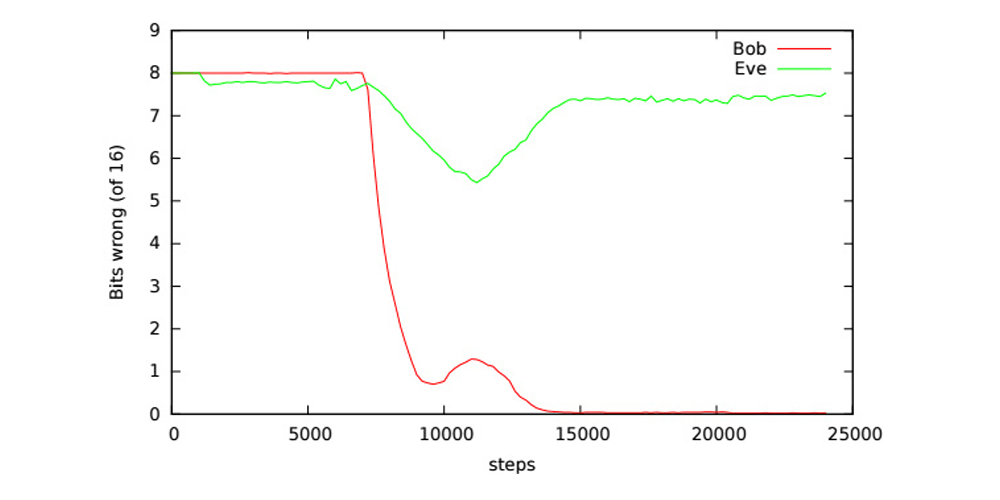
What happened was, over time and eventually, Bob and Alice were able to communicate using the shared key. They got really good at sharing encrypted information and many of their techniques were quite odd and unexpected (uncommon in human-generated encryption).
This is because the kind of learning is done over thousands of iterations by a mosaic of mathematic weights being altered by algorithms.
Without time-consuming analysis, even the researchers themselves can't understand how the encryption were built.
What this research has concluded is that AI can be good in creating their own solid encryption as long as they value security. Eve has had a hard time in decrypting encrypted message communications because it had no key. This is similar to humans. What this means is that computers can be made talk to each other in a way that even humans or other robots won't be able to crack.
It's almost Halloween, and spooky things happen in October. Just in time, MIT scientists have succeeded in creating an...

Computers are getting smarter and smarter, but we've never really see them to be able to interpret and understand speech...

DeepMind is an artificial intelligence (AI) company acquired by Google back in 2014.
Under Alphabet's umbrella, its...

The Three Laws of Robotics, or also known as Asimov's Laws, is the handbook for robotics. Its First Law stated that:
"a...
Humans are so good in describing things in a flash. We can easily detail anything we see down to the very bits. While...

SwiftKey provides an input method for smartphones and alike. In September 15th, 2016, the company has rebuilt its famous...